Category Archives: energy

interseasonal heat transfer

Pams second post on snow and ice clearance over at Public Works blog, reminded me of two items I had collected into my google notebook for future isite posts.

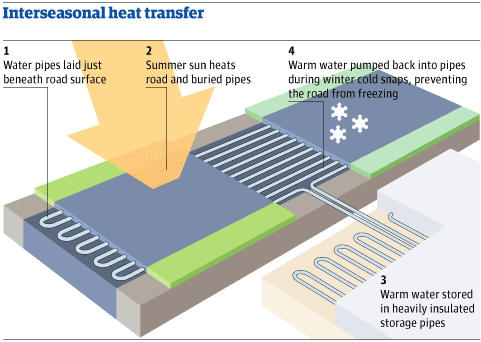
The GuardianReported in the Guardian Friday last Under Road heaters may beat snow and ice , the Highways Agency plans to install pipes underneath a section of road to gather solar energy in summer and recirculate it in winter. Experts hope the scheme could be a way to treat the roads which are the first to freeze.

The scheme, known as interseasonal heat transfer, or IHT, will lay a network of plastic pipes filled with water just below the road surface. In summer, when road temperatures can reach 40C, the water is warmed and pumped to pipes insulated with polystyrene. In winter, when sensors detect the temperature at 2C, warm water is pumped back under the road to heat the ground and prevent ice forming.

Also a Guardian mp3 audio item to download Which discusses the technology and approach to using IHT on UK roads.

Too cool for schools – featuring a pièce de résistance of the building as the construction of the world’s first IHT system underneath the playground. IHT will take heat from the sunshine that falls on the tarmac playground, then stores it and releases it in the winter to heat the school.

Waste wood – the untapped resource for Biomass Fuel?

The huge potential of reusing waste wood as fuel is being wasted, Environment Minister Joan Ruddock has warned. The significant carbon and energy benefits of recovering energy from waste wood are detailed in a new information report on the sector that surveys the activities of producers, aggregators and users of waste wood.

all homes to be code level 6

All UK homes could meet a Code Level 6 by 2050  in line with the planned Code for Sustainable Refurbishment to reduce carbon emissions from existing homes.  Source

Now this will surely start another, necessary, debate on how this is possible, and how it will impact on the huge sector of our industry that refurbs and maintains our housing stock.

Do we have the skills? ( I sense another Skills Gap analysis report will be on its way soon, stating the obvious)  It starts to make the 2010 Great ReSkilling programme predicted by Rob Hopkins in the Transition Handbook sound more feasible.

isite radar for april 08

On my radar today:

Low carbon uk

– a New Scientist / Arup online discussion forum

Your computer chip could warm your home

– a medium size data center could heat 70 homes

Ecotowns are not the answer to climate change or housing needs

Reducing the carbon footprint of the existing built environment must take priority. The government must focus its climate-change agenda on Britain’s cities precisely because they are the most prolific polluters. This should be a Guardian response against Simon Jenkins article crticising eco-homes – can no one be found to defend Eco Homes?

Companies will have to tell all on carbon emissions

All quoted companies will be forced to detail carbon emissions in their annual reports after the Government caved in to backbench pressure. What will this mean for construction and facilities management organisations?

Don’t blame the equipment

Can lessons be learned about training needs from the fiasco of Terminal 5’s opening?…the sophistication of the baggage-handling system – described by BAA as one of the most advanced in the world – surely emphasises messages about the importance of human capital.

sustainable connectivity

A new look for isite with a new image on the top banner(*). I like this design as it includes a RSS button – to get isite delivered to your desktop, and a search facility to search back through isite items.

But a little more too. After reflection on this blogs contents and direction, I have slightly amended the purpose of isite.

Yes it will continue to be a news views and comments blog for the built environment, poking here and there when things dont seem quite right or dubious, or indeed covered with greenwash. It will continue to be a voice to the online world for the Lancashire Best Practice Construction Club and to a lesser degree the CKE, and will continue to focus on collaborative working, integrated working, facilities management, futures and improvement towards excellence. The emerging web2.0 or even 3.0, and I include second life here, is an important theme that links and enables allot of what we, what I do, so will remain a key element of the posts and comments.

isite is also of course the outlet to the world for my business – fairsnape.  (the name was taken from the local hill in the Forest of Bowland visible from my base here)

However, more importantly I see isite starting to look at connectivity with the natural environment. A number of activities I have been involved with lately has made me realise we may be where we are today because we have lost, and struggling to regain connectivity with our impact on ecology in its widest sense.

What does this mean? – Ecological footprints more than carbon footprints – as John Muir said when we tug on a single thing in nature we find it attached to everything else . – natural materials rather than harmful – renewable energy rather than fossil fuels, community based FM rather than endless target driven fm, about responsible sourcing rather than supply chain bullying, all putting a new direction to CSR.

I have long used the triptych of fit for people purpose and planet (before it became enshrined into the triple bottom line concept I like to think) . It is what Patrick Geddes would call folk, work and place, nearly a century ago, and reading Satish Kumar over the weekend – he described our modern trinity as needing soil, soul and society. Soil for the environment. soul for a spiritual dimension and society for justice.

Kumar a great walker – now based at the Schumacher college in Dartmoor, that incidentally run courses on Zen and Construction, talks about never trusting ideas that you never worked through whilst walking. “when you walk you are connected with nature, when in a car or a building your are disconnected, you walk to connect yourself”.

A while ago I started a benchmark walking programme to do just this – getting workshops and learning sharing events out of a training room or hotel into the countryside. With a loose agenda that emerges to deal with peoples real improvement needs, benchmarkwalks allows real learning and sharing, I likened it to doing business on a golf course – but this is business improving on a walk.

So all this as a preamble to a new thread for isite – connectivity – one I hope that will give it more scope, depth and importance as we address the sustainability issues, the soil, soul and society issues facing the built environment.

(* taken at Beacon Fell, Forest of Bowland, Lancashire recently – a location for many benchmarkwalks)

… the futures nano

The science of nanotechnology is already revolutionising the worlds of medicine and construction, according to a Guardian article looking at nanotech in food, Once Bitten
Seamless tubes of graphite one atom thick and 10,000 long (to the naked eye, large quantities would look like soot), carbon nanotubes are up to 100 times stronger than steel but around eight times lighter. They can be teased into a twine that can be woven into sheets and, potentially, mixed with composites to eventually overhaul the way – and the height to which – we build.

And those buildings could be covered with solar cells made from nanomaterials that could supply all their energy needs. 

And in communications … nanotechnology would allow the Nokia Morph concept phone to be laid flat like a keyboard or folded into a bracelet that can be connected wirelessly to a headset.

And in RFID, nano-transistors could revolutionise asset management  and hence reshape the way in which facilities management works.

Worlds greenest city and eco home?

Is the German city of Freiburg, the  worlds greenest Eco City? Is the Passiv Haus the most effective and efficient Eco-Home? If so why are we not learning for eco-homes and eco-towns in the UK ?

Also, more on Eco Cities at Eco City 2008

…on coal, blue and earth day 2008

Wear BLUE for Earth Day 2008 to VOTE for No Coal

This blog has commented through many posts on coal, on its significant contribution to carbon footprints, on the relationship with the built environment (coal – safe cigarettes for the built environment) and on the recently approved new coal power station in the UK.

But did you know that the UK Eon power station, the first for 20 years, will add 5% to the UK’s carbon footprint, and that the proposed magic cure of carbon capture, when viable, will take some 40% of the energy proposed just to drive the capture application. (source – Guardian Environmental weekly podcast 12/03/08).

isite has long supported Architecture 2030, a movement in the US that makes the link between design / buildings in use and energy production from coal.

isite is proud to have been asked to promote Architecture 2030’s rallying call to everyone to participate in the BYOBlue campaign by calling on everyone to wear BLUE during Earth Day 2008 to signify a vote for NO COAL. (April 20th)

More details can be found at www.byoblue.org and in Ed Mazria’s article posted at Grist (here).

Details on any UK BYOBlue activities will be posted here.

wind turbines – love or hate?

BBC Radio 3 broadcast a fascinating programme on Saturday …

 A sonic meditation on wind turbines and their place in today’s environment, recorded in Norfolk and the Fenlands. Including contributions from poet Kevin Crossley-Holland, architecture critic Jonathan Glancey and local residents, along with music created from the sounds of the turbines themselves.

… strange how those who love turbines hear symphony music and whale like song, yet those against turbines hear machine humming and sleep disturbing noise.

Available to listen again for a short while on Radio 3

zero carbon route map to Wales

Jane Davidson the Welsh AM for Environment, Sustainability & Housing,  launched the new Renewable Energy Route Map for the Welsh Assembly Government last week – out for consultation until May.

It details lots of wind farms and lots of public engagement. Of note is the speed of the intentions across all energy themes, including the built environment as:

The devolution of the Building Regulations: Assembly Government control of the Building Regulations, in addition to our existing Town and Country Planning powers, should enable us to ensure all new buildings in Wales are built to the highest possible low carbon standards, both in respect of energy efficiency and the use of renewable energy.

Higher standards through devolved Building Regulations would be aimed at delivering the aspiration for all new buildings to be zero carbon by 2011. Over the next 3 years the Assembly Government will be looking to demonstrate a path to zero carbon buildings through construction work it funds.

Carbon Zero by 2011 – a far more ambitious plan than the Code of Sustainable Homes and other targets being set, increasing the importance of a strategy to follow with confidence