Category Archives: green buildings

on walter segal construction

Holding an improvement module event within a Walter Segal construction last Weds, introduced me to this concept of sustainability and green construction. I also wonder why we dont hear more of it as an alternative approach to housing and other small non domestic construction.  And with the concept being ‘self build’ opens up a whole new approach to community involvement, eco towns and villages

From wikipedia:

The Segal method is based on traditional timber frame methods modified to use standard materials available today. It eliminates the need for wet trades such as bricklaying and plastering resulting in a light-weight methods which can be built with minimal experience and are ecologically sound. The roofs tend to be flat with many layers of roofing felt, which allows the creation of grass covered roofs. Foundations are minimal, often just paving slabs, the strength coming from the geometry of their construction. Segal houses have been compared to traditional Japanese houses.

Examples of construction

Current Segal inspired projects

out breeam’d ?

The UK Green Building Council has promised an open source sustainability code, to help address the confusion arising from the myriad of different green building standards with a new Code for Sustainable Buildings, joining in the debate / tussle between LEED and BREEAM.

Paul King, Chief Executive of the UK-GBC,: “Industry needs a clear and practical route map and milestones that are aligned with Government policy to give it the confidence and knowledge to move forward on a trajectory to 2019.

UK-GBC Chairman Peter Rogers , “The UK-GBC wants to see very wide take-up of robust and customer-friendly tools, and we believe that the standards at the heart of a new Code for Sustainable Buildings should be ‘open source’, meaning that such a Code could potentially be incorporated into a range of different tools, from a range of providers who could then compete in terms of service provision, without confusing the industry with different standards.”

The concept of open source, is to be welcomed, allowing the code to be incorporated into regional, corporate and community developments, and also allowing other standard bodies, building firms and consultancies to use elements of the code in their own green building guidelines.  And it flies in the face of the more closed and commercial approaches from BREEAM and LEED

The final code, which is scheduled to be published in March next year, is expected to mirror the government’s Code for Sustainable Homes and as such, will feature wide-ranging rules and guidelines on the metrics and best practices builders should embrace to limit the environmental impact of offices, commercial properties and other non-domestic buildings.

Is there something else here,? Can codes, approaches, tools and technologies which in essence will improve environmental performance, carbon emissions, sustainability generally, and ‘save the planet’ morally be closed and commercial. The emerging models of wikinomics, freeconomics etc must be applied to sustainability, where the economic model is built upon giving away free ‘lead’ products.

I would love to see much more open approaches with the built environment sustainability agenda using for example the creative common model.

facilities management of green buildings

I like this, and wonder if there are any other facilities management courses that focus on managing buildings that are green, LEED or BREEAM accredited? After all its all in the management of the building and facilities not just the design and the tick in the box.

(INDIANAPOLIS) The Purdue School of Engineering and Technology at Indiana University-Purdue University Indianapolis (IUPUI) will offer a unique course beginning in the fall of 2008 entitled “Greening Organizations.”

The masters-level course will introduce students to the requirements needed for existing buildings to become LEED Certified by the United States Green Building Council. The course will also cover other rating systems and the management of green buildings.

“Because LEED Certified buildings conserve energy and water, reduce waste, and have lower operating costs, creating and sustaining LEED Certified buildings is a trend that is here to stay. It is important for our students to receive a solid foundation in this area of study,” said Ken Rennels, associate professor of mechanical engineering technology and facilities management program director at the Purdue School of Engineering and Technology at IUPUI.

The “Greening Organizations” course is offered as part of the School’s recently launched online Master of Science degree emphasizing Facilities Management. The program is delivered via the Internet to meet the needs of working professionals, preparing students to meet a growing demand for skilled employees in the Facilities Management field.

on zero carbon and routes to get there …

There have been some very worthwhile and considered articles and comments on the definition of and feasibility of zero carbon recently – take a look at Mels post .. and Phils post for excellent round ups and for good technical comment take a look at CarbonLimited from Casey

The difference in opinions and views is healthy – maybe there is no ‘one’ definition, maybe we should not waste (mental) energy on defining – but as per the zero accidents, zero waste and zero defects debates of recent years accept it as a worthwhile, Utopian goal and work how how to best get there. I recall from my TQM days the concept of zero waste drives lean management approaches, but absolute zero waste is not ‘defined’ – it is a philosophy.

From the supply, contractors, perspective the very confusing debate on what is zero carbon just encourages the ‘keep heads down until it blows over approach’. Understandable, but a strategy that will return to haunt those not prepared to address the changes we will have to make. Most do not have a strategy or vision for moving to a low carbon future, content to be led by circumstances.

Within the Route to Zero programme I run, we start to understand, from industry intelligence, what an organisations customers, shareholders, people and even suppliers are expecting in the context of zero carbon over the next 10 – 20 years. From this intellenge we can develop a maturity matrix of strategies and objectives that would be necessary, ie a Route to Zero. A matrix that would be reviewed regulaly as ‘requirements’ will unfold and change and most likely toughen up. Armed with such a route-map, organisations may not achieve zero , but have the evidence that they are thinking of a zero future.

And as to the general public, those who will buy the zero carbon homes, Mel is correct in pointing out the confusion we as an industry may be giving, a damaging message maybe? What home owners would like to know is the balance between capital purchase and the running costs per month, and what savings per month would a code 6 or zero carbon home give me over a traditional home? Take a look at the house sale literature in the states – this is exactly what green homes are sold on – a reduction in energy bills, making the purchase of green homes desirable, a no brainer and making non green homes nearly unsaleable.

Ad then there is the existing housing stock issue …. which is where effort must be put, not on new build, eco challenges, eco home etc etc ….

LEED 2009 V3

The new edition of LEED – version 3 for 2009 is open to public comment here – promising to reset the bar for green building leadership because the urgency of the LEED mission has challenged the industry to move faster and reach further than ever before.

More comments when I get chance to view the documents …..

on greening existing buildings

Within a month of the release date for the UK Construction Sustainability Strategy ( due 11 June) we see another initiative announcement from government:

a parliamentary enquiry into the greening of existing offices, shops and warehouses, aimed at providing industry leaders and public figures the opportunity to contribute evidence that will go into the final report of the All Party Urban Development Group, which will cover what ministers, city leaders and property owners and occupiers need to do to reduce the environmental impact of commercial property.

Key issues are likely to be the lack of clear guidance over standards and the lack of information on costs and benefits of the various available schemes. It is expected that business leaders will call for clearer definitions and evidence on the financial impact of green agendas.

Attention to existing building stock – domestic and non domestic is urgently required so this enquiry is more than welcome, I just hope when the CSS arrives it joins together all the jigsaw initiative pieces.

… on what makes a building green

Build the best product, cause no unnecessary harm, use business to inspire and

implement solutions to the environmental crisis.

Patagonia’s Mission Statement

I have mentioned Patagonia the outdoor clothing organisation a few times before on this blog, and recently searching for a model CSR policy or statement for a Masters course I am in part delivering, went back to their web site and Yvon Chouinard’s Let My People Go Surfing book.

More on Patagonia’s approach to building here and Patagonia’s environmental, CSR, approach here. And if you like environmentalism mixed with the great outdoors, mountains, clothing innovation and quality, along with a sprinkling of built environment comments – then check out the blog from staff, customers and friends at The Clean Line

zero carbon ‘floating’ development for Preston

Green, innovative and zero carbon project development on our doorstep in Preston, Lancs, !

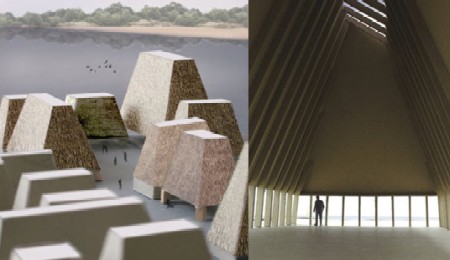
The RIBA have recently awarded a zero carbon design as the visitor center at the new Brockholes Wetland and Woodland Nature Reserve in Preston, to regenerate a former quarry site into a major visitor attraction.

The project called “A Floating World”, consists of zero-carbon floating buildings (the name coming from the fact that the zero-carbon buildings will be built on an island of floating pontoons)

Adam Khan Architects, won the RIBA design competition to work on the ‘jewel in the crown’ of Britain’s largest eco-regeneration scheme. The project is zero-carbon in both use and production, with materials of low embodied energy – thatch, willow, timber, with off-site prefabrication and on-site energy generation and waste treatment.

Floating world will feature cafe, shops, gallery, education areas and meeting rooms and is part of the £59 million Newlands Scheme, a project that will turn 900 hectares to community woodland and green space.

On announcement of the winner, Peter White, Head of Infrastructure & Development at the Northwest Regional Development Agency said:

“This site has the potential to become an important visitor attraction for the region, building on its rich natural assets and impressive biodiversity. The Agency is supporting its development through Newlands, a wide reaching scheme that aims to reclaim brownfield land and transform it into thriving community open spaces, and has so far invested £800,000 in Brockholes. The chosen design will not only create an inspirational open space for the local community to enjoy but will also enhance a key gateway into Lancashire and attract further investment into the area. We look forward to working with our partners to progress these plans.”

More on this as the project develops …

isite radar for 14 april

Phil has mentioned podcasts recently – just as I was to recommend the Guardian Environment Weekly podast. Listened to the last two on the car journey home last night, useful interviews with Brain Paddick and Ken Livingston. Next week plans an interview with Boris Johnson (all of whom are apparently standing for Mayor of London – or somewhere down south – on a green election !)  Also an item on Transition Towns – which Brian admits to not having heard of- and a useful round up of enviro news

Over at WorldChanging is an article on ZeroFootprint Cities – an initiative to to link the citizens of the world’s cities around software that combines an environmental footprint calculator, linked to social networking and business intelligence tools. The idea has the backing of Ken Livingston, chair of the C40 Cities Group

Also at WorldChanging: Intelligent Green Buildings Informative article  on linking intelligent buildings into a smart energy grid.

For a few days I  have been meaning to recommend heat monitors are a no brainer from Casey over at Carbonlimited.  Nice simple ideas like this are so important.

zeroHouse

A search over a coffee, starting from Pam’s link (here) led me to zeroHouse.

Now this may be hitting a lot of boxes on the zero list, may be an architects vision or dream, but to call eco (as in ‘eco’ =’home’) and a place to live?

Does this primary school Lego construction have a soul – ie a spiritual dimension. Is it at all aligned to nature – it actually looks as though it has flown in to the location and cant wait to be off again. And just imagine a society, a neighbourhood or development of these. Or even, gulp, an eco-city.

And on the current theme here of usability – has anyone lived in one of these I wonder and feedback comments to designers, or indeed feedforward experiences to the next iterative design.

Saying all that this would be a good design to have within the Second Life International Eco Code Park so visitors can move around, experience its ‘feel’ if only virtually and leave comments on their ‘experience’ (click here to enter into the Park)