Tag Archives: nature

NW England: for the best of this year’s Autumn colour.

If you’re keen to catch autumn leaves at their best then this may be the best time to head out with your camera. In fact, recent research highlights that 2016 is a particularly vibrant year for autumn colours. Owing to 2016’s wet spring, followed by above-average amounts of sunshine and a mild August and September, trees […]

via Where to see the best of this year’s Autumn leaves — Wild about Scotland

Cities setting biophilic commitments.

Pittsburgh has become the latest city to be inducted into the Biophilic City network, setting ambitions and commitments to eliminate the use of all pesticides, fungicides and herbicides, to increase the city’s tree canopy from 42 percent to 60 percent by 2030, to pursue  the daylighting of streams in stormwater management efforts and to develop more greenways.

pexels-photo-94616-1

To qualify as a Biophilic City, cities work within a number of guidelines and monitoring indicators:

Guidelines:

  • Biophilic cities are cities of abundant nature in close proximity to large numbers of urbanites; biophilic cities are biodiverse cities, that value, protect and actively restore this biodiversity; biophilic cities are green and growing cities, organic and natureful;
  • In biophilic cities, residents feel a deep affinity with the unique flora, fauna and fungi found there, and with the climate, topography, and other special qualities of place and environment that serve to define the urban home; in biophilic cities citizens can easily recognise common species of trees, flowers, insects and birds (and in turn care deeply about them);
  • Biophilic cities are cities that provide abundant opportunities to be outside and to enjoy nature through strolling, hiking, bicycling, exploring; biophilic cities nudge us to spend more time amongst the trees, birds and sunlight.
  • Biophilic cities are rich multi-sensory environments, where the sounds of nature (and other sensory experiences) are appreciated as much as the visual or ocular experience; biophilic cities celebrate natural forms, shapes, and materials;
  • Biophilic cities place importance on education about nature and biodiversity, and on providing many and varied opportunities to learn about and directly experience nature; in biophilic cities there are many opportunities to join with others in learning about, enjoying, deeply connecting with, and helping to steward nature, whether though a nature club, organised hikes, camping in city parks, or volunteering for nature restoration projects;
  • Biophilic cities invest in the social and physical infrastructure that helps to bring urbanites to closer connection and understanding of nature, whether through natural history museums, wildlife centres, school-based nature initiatives, or parks and recreation programs and projects, among many others;
  • Biophilic cities are globally responsible cities that recognise the importance of actions to limit the impact of resource use on nature and biodiversity beyond their urban borders; biophilic cities take steps to actively support the conservation of global nature.

Indicators

  • Natural Conditions (eg % of forest or tree canopy cover, % working/living within 300m of green space, area of green roofs, living walls)
  • Biophilic Engagement ( eg daily visits to green spaces, flora and fauna eco-literacy, outdoor activity membership)
  • Biophilic Institutions, planning and governance, (eg city budget allocated to nature conservation, restoration education)
  • Human Health and Wellbeing (% spending 30 mins + in urban nature, in outdoor activities, equitable and just access to nature)

Other aspects of a biophilic city include bird friendly, water friendly (blue urbanism) and dark sky preservation.

Other Biophilic Cities include Wellington, NZ; Birmingham, UK; Victoria Gasteiz ; Spain; Portland, USA and Singapore.

The Biophilic City website has a wealth of information, stories and resources.

UK among the most nature-depleted countries in the world…

Agriculture, Urbanisation, Wetland and Forestry Management alongside Climate Change are the cause in a significant drop in the health and state of UK nature and wildlife. The State of Nature 2016 report published today describing the UK as “among the most nature-depleted countries in the world”

pexels-photo-93013

The 2016 Report led by the RSPB and the collaborative effort of over 50 conservation organisations details the dramatic decline in nature as a result of climate change “overwhelming negative” agriculture, industrialisation and urbanisation, pointing out that it is not just historical but continues today.

The report highlights the positive efforts with examples of natural habitat and wildlife recovery but sadly points out there are too few to prevent a tipping point, citing how public funding for biodiversity has decreased by a third over the last 7 years.

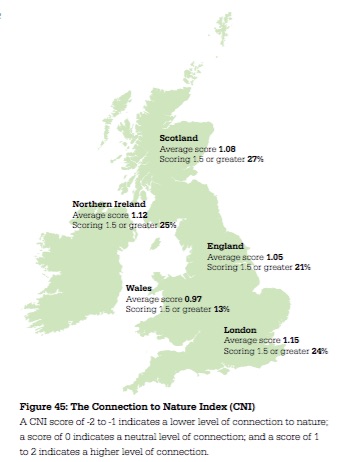
Of particular interest, relating to the current surge of interest of nature within the health, wellbeing and biophilic agendas, and recognition of biophilia and rewilding as the secret sauce for sustainability, is the report’s Connection to Nature Index.

connection-to-nature-index

  • Nature can have positive impacts on young people’s education, physical health, emotional well-being, and personal and social skills,
  • Only 21% of eight to 12-year-olds in the UK currently have a level of connection to nature that is considered to be a realistic and achievable target for all children.
  • Children who were more connected to nature had significantly higher English attainment” and that there are “strong correlations between [connection to nature] and pro-nature behaviours and pro-environmental behaviours.”


Going Wild for 30 Days

From 1st – 30th June 2016. The UK WildLife Trusts are running a month-long nature challenge.

Reconnecting with nature through campaigns such as #30DaysWild can be seen as part of the secret sauce for sustainability behaviour. We spend 90% of our time inside buildings, and as our relationship with nature disconnects, then our tolerance for respecting the environment and behaving sustainably will diminish.

Rewilding Nature, Rewilding Buildings and Rewilding People is a key aspect in addressing sustainability, health and building performance gaps.


Here, then are my #30DaysWild plans …

  1. Stop to appreciate nature, birds and wildlife when cycling
  2. Spread the word about biophilia and rewilding within construction circles
  3. Sleep out under stars
  4. Climb a tree
  5. Re Read Feral
  6. List all the trees in our garden
  7. Visit Brockholes Nature Reserve
  8. Garden with bare hands
  9. Plant trees
  10. Turn off technology for a day
  11. Identify 10 ‘weeds’
  12. Support Curedon Valley Park visitor centre project
  13. Present at least once on Living Building Challenge
  14. Walk in the rain
  15. Bivy or Bothy by Bike
  16. Create log pile
  17. Take time to identify dawn chorus birds by birdsong
  18. Capture nature, wildlife, birds,  with GoPro
  19. Catch a sunset from a Bowland Fell
  20. Add a twibbon to twitter account
  21. Brew coffee on a hill, mountain top
  22. Share extracts from FutuREstorative
  23. Capture nature in images for future presentations
  24. Reinvigorate our compost heap
  25. Take time to site and tune into nature
  26. Stargazing – become familiar with a new constellation or cluster
  27. Read Wild – An Elemental Journey’ has been on reading list too long!
  28. Shop by bike, not car
  29. Bring pond back to life
  30. Watch sunrise from Bleasdale Woodhenge

Join in & do something wild every day for a month and share with #30DaysWild


Biophilic Design & Rewilding- the secret sauce of sustainability?

Biophilia is emerging as the secret sauce of sustainability. It is not just about being able to see trees and fields from our windows, or having green plants within rooms, but something deeper and more profound.

The Cuerdon Valley Park Visitor Centre in Lancashire, the first UK project to be registered for and working towards Living Building Challenge certification, recently staged a project team biophilic design workshop (1), led by Joe Clancy using the Terrapin Bright Green guide ’14 Patterns of Biophilic Design’ (Joe, as an intern with Terrapin Bright Green was part of the guide team and co-author)

The workshop reviewed the design, construction and operation of the building from a new perspective, through each of the 14 patterns, covering aspects from light through to the layout of chairs and food to be served in the cafe.


Biophilia translates as love of nature and in design terms the consideration of how our innate relationship with nature can be addressed within buildings. We have evolved as part of nature, and as such the human mind and body function with greater efficiency and performance when natural elements are present. Biophilic design is ensuring that these elements and patterns are present.

Biophilic elements enhance wellbeing, foster the feel good factor, reduce building related illness and even improve health. For example light as in daylight, circadian lighting, differing light spectrums is being considered as a form of medicine, not only to reduce illness, but to improve and maintain health.

ReWilding
There is much talk of rewilding at present, and as rewilding nature and environments is not just about reintroducing wolf, lynx or other top of the chain predators but more about restoring or regenerating the natural environment ‘creating conditions that allow the emergence of natural responsiveness and development’(2)

We should learn from and apply rewilding thinking to our built environment,and in doing so rewild people, those who inhabit buildings, creating the conditions, through for eg biomimicry and biophilic applications, that allow (new and existing) buildings to breathe and to respond to natural and bioclimatic cycles. We are losing or removing our natural barometers from buildings, increasingly replacing them with SMART technologies, to satisfy a blinked focus on energy performance. In turn, this has weakened our intrinsic relationship with nature.(3)

It is recognised that a lack of connection with nature reduces our tolerance to respect the environment. However, enabling biophilic conditions that ‘rewild’ our built environment will improve user behaviour and increase respect for the sustainable function of buildings.

Biophilia could, therefore be a root cause solution to addressing our buildings sustainability performance, closing performance gaps, providing salutogenetic improvement on the health & well-being of those using the building, and providing business benefits relating to people costs and productivity

And, biophilic workshops are not just for green building design, but should be part of the start-up activities for any project, considering in addition to the building in use, the biophilic aspects of the construction process. Biophilic thinking applied to construction environment can address the stress, mental health and safety, productivity, enthusiasm and wellbeing of those working on our construction projects. Therefore, biophilic thinking could be a key to improving construction quality, environmental and safety compliance, productivity and hence costs.

On two, very recent, project sustainability review/audits, it has been encouraging to hear of construction organisations increasing awareness of biophilia through training related to health, sustainability and design.

(1) Report available soon.

(2) George Monbiot in Feral

(2) extract from FutuREstorative

Lynx Kitten Image:   www.conservationjobs.co.uk

Rewilding Building Image: Cuerdon Valley Park Visitor Centre

Rewilding People image – see – Last Child in the Woods Richard Louv

Images from Sense of Urgency presentation available on Slideshare.

Wildwood, A Journey Through Trees

Roger Deakin’s article in this weeks Guardian Review starts off with one of the best illustrations of biophilia and connection with nature I have read in a while …

I wonder if the swallows that nest in the chimney of my Suffolk farmhouse have the faintest idea how profoundly they affect my emotions. When they first arrive from the south in spring, and I hear the thrumming of their wingbeats amplified to a boom by the hollow brickwork, my heart leaps. They seem to bless the house with the spirit of the south; the promise of summer. Swallows have such a strong homing instinct that it is quite possible this same family of birds, by now an ancient dynasty, has been returning here to nest for the 450 summers since the chimney was built.

When the household swallows fly away to Africa, I get restless. I suppose I envy them. I certainly miss standing by the fireplace at night, eavesdropping on their dormitory conversations in the mud nests above. Swallows never fail to stir the nomad in me, too.

Do read the rest of the article Follow the swallows: Roger Deakin’s days hitchhiking to the sun, it is a great read, a rights of passage of schoolboy french, heading south, hitchhiking delights of the 2CV or Citroen DS, the goddess of the French road. It rekindles in me my my own memories of hitch hiking down through France, sleeping on Corsican beaches, grape picking and climbing around the Mediterranean.

1344371Roger Deakin is one of our great nature writers (and ‘an icon’ of the environmentalist movement) and I would certainly recommend Wildwood, A Journey through Trees, not least for the description of a living building – his home at Walnut Tree Farm, … “evolved rather than designed … riding the earths constant movement … The proportions of each room and of the house as a whole were predicated on the natural proportions of the trees available”

Are we so oblivious to the ways of nature?

“After 10 generations of industrial society, and with most people in the west removed from a world of soil and sweat, we are so oblivious to the ways of nature that we cannot bring ourselves properly to absorb its vital importance”

Mark Cocker author of Crow Country reviewing the excellent What Has Nature Ever Done For Us? by Tony Juniper “How environmentalists now put money at the centre of their argument”  (For example, read the book/review to understand why the total bill for India’s programme of removing its flock of vulture scavengers has been calculated at $34 billion)

Mark Cocker, based in Norfolk and written extensively on modern responses to nature.  Crow Country is a fascinating look at the life of crows, on the state of country life in Britain, and on the relationship between ourselves and nature.

Related: Re-Connecting – the 3R’s for rethinking built environment sustainability

So, what have we done for nature?

Having listened to Tony Jupiter’s “What has nature done for us” podcast talk at the RSA over the weekend, my son Tom brought this simply brilliant animation to my attention – “what have we done to nature” …

MAN from Steve Cutts on Vimeo.

Related:

The world may not be ending today, but does the construction industry continue to waste as though there is no tomorrow?

3 R’s for rethinking built environment sustainability

Sustainability: Closing the Circle: Barry Commoner

3 R’s for rethinking built environment sustainability

OLYMPUS DIGITAL CAMERA

Its over ten years since rethinking construction became the driving force for improving the construction industry. Back then, in 1998, sustainability wasn’t on the agenda for many construction organisations, and didnt feature in Egans influential report.

Now at the close of 2012, it is of course one of the key challenges for construction.

But is it now just a ‘must do, tick box’ matter, rather than a real agenda for improving, reducing costs and reducing our impact?

Earth2.0 Hub in an excellent blog post ( The Future of Business – inspired by and in harmony with nature.) provides a framework and the language of 3 R’s for future businesses working in harmony with the earth .  And its a framework we should learn from, borrow, adopt or adapt  at project and business level in rethinking built environment sustainability; Re-Design, Re-Connect and Re-Kindle.

Re-Design. Not only design of buildings, but to re-design the way we build. No longer are transactional efforts (reducing waste, conserving energy and recycling) enough.

How?: Take a look at Cradle to Cradle thinking, Circular Economy, Designing out toxic materialsDesigning out Landfill

Re-Connect. Time to rethink our relationship with nature. However just including nature as a natural capital to be costed is not meaningful approach. We need a relationship that is deeper, that is deep green thinking.

How?: take a look at Living Building Challenge – what if every building, like a flower, contributed to its environment. Or the One Planet Living ten principles

Re-Kindle. Time to rekindle the sustainability debate – moving away from the negative, harassment to doing less bad, to encouraging a move towards a positive new world of doing more good,  better. Resilience.

How?: Learning and benchmarking from other industries and sectors, for example Patagonia, or closer to the built environment, Interface Flooring

This blog, since 2005, has had as a tagline built environment improvement and its connectivity to the natural world . Since then, it has been a core philosophy within fairsnape.

cropped-pc210049flip.jpg

Since 2005 we have organised and facilitated benchmarkwalks, discussing sustainability issues , across and within sectors, whilst walking in the natural environment. Rather than in the conference of training room. You would be amazed how diffierent, how green, sustainability discussions when conducted in the great outdoors. Try it !

Cradle to Cradle, Circular Economy, Healthy Products Standard, Designing Out Landfill , Interface UK, and the UK Living Building Challenge all featured in our #GVis2012. Green Vision Conference in Leeds on the 12 Dec 2012.

>>> See Green Vision event material, links, blogs and more here  <<<<

<<< Read the Cradle to Cradle tweetchat transcript here <<<

The Living Building Challenge UK Collaborative will be ‘launched’ at this event on the 12th.

And, Cradle to Cradle is the book-topic for our Dec #GVisChat tweetchat on Dec 10th at 8pm.