Author Archives: martin brown

Europe’s Brightest and Greenest

From the Construction21 Community blog:C21_home

The Construction21EXPO.eu Europe will bring together the brightest and greenest across the European Green Build sector in February, as exhibitors, speakers or as visiting attendees.  As part of our social media programme running alongside the Expo we are compiling a directory of twitter accounts that we should all be following into 2014. A listing of twitter people and organisations that will enable us all to keep a pulse on the green build development and in particular the emerging restorative sustainability across Europe: The Brightest Greenest 50

The listing, to be compiled by Construction21 staff based on tweeted nominations will not be a ranking but more of a community of leading thinkers, do-ers and amplifiers.

Calls for nomination opened on the 11 December via twitter using the hashtag #BrightestGreenest50. Nominations will close on 24th Dec with the listing to be published on the 6th Jan.

To inspire into 2014, and as a reward for both those nominating and those nominated we have a number of books from the ILFI Living Building Eco Tone bookstore to give away. Check them out here –  http://bit.ly/1bilwp2

Nominate by tweeting 

“I nominate @XXXXX to #BrightestGreenest50 because … “

Are you pedalling on Square Wheels?

Have we wasted a good crisis?

In an earlier blog post I used the expression of pedalling squares to illustrate how progress and development in sustainability is often a clunky and inefficient activity.

Within construction we have some great new round wheels available to us that will improve our business, our services to clients and image, for eg BIM, Social Media, Circular Economy and Restorative Sustainability to name a few. These nice new shiny round wheels are necessary in a construction organisations baggage – we need to use them in PQQ, PR and interviews to demonstrate a sense of being tuned into current industry improvement programmes

Many organisations have started to do a wheel change – some encouraged through the never waste a good crisis thinking – seeing the lean times as time for investment in the future, some through Innovation Vouchers or other funded support.

Think about starting 2014 with a more efficient approach by understanding how organisations – often your competitors – are implementing new wheels.  Find out more.

Related:

Sustainability: in equilibrium … or pedalling squares?

A TQM for the social media, digital age?

Are Tweetchats: the new digital benchmarking?

Twitter has come of age – we are seeing more mature, powerful, innovative and business focused use. In particular open tweetchats. Initially started as open brainstorms around a topic, tweetchats remain a powerful format, latterly they have matured into great learning/sharing conversations / interviews.

Tweet-chats generate great content, enable organisations or individuals to share and learn from others. An exemplar Tweetchat has to be the #CSRChat hosted by Susan McPherson (@susanmcp1) which can be seen as a digital version of the benchmarking visits that were the improvement tool for business back in the 90’s. These chats enable real insight to the CSR, Sustainability of leading organisations, and importantly the opportunity to engage, ask questions, get responses and add experience to the chat topic.

Good tweet chats creat a transcript record or report for future reading. I originally suggested that people just jump into the Tweetchat brainstorm, adding comment, holding small conversations with other attendees, and then … make sense of it afterwards and follow up on links, links and make face to face contact.

We have run some excellent tweetchats and built up a real body expertise, under the hashtags for example #GVisChat, #SustLdrsConv and #EXPOC21chat. In fact our first GVIsChat was way back in 2011. The reach of tweetchats can be impressive, with analytics from organisations such at @Tweetbinder.

What’s not to like? As with all good things there is a bandwagon approach that borders on spam- for example we have seen a rash of tweet-chats themed around a county or town, often tagged #anycountyhour these unstructured events offer little engagement and a free for all of promoting services or products.

#SustLdrConv – a monthly series of conversations around the topic of sustainability leadership, co hosted by Martin Brown @fairsnape in the UK and @AndreaLearned  in the USA. Every Tuesday at 7pm UK 2pm ET and 11am PT

#EXPOc21chat – a series if twitter conversations related to the first European Virtual Green Build expo in February 2014.

Background: #tweetchats … observations + how to

#GVisChat – a monthly conversation supporting the Leeds Sustainability Instiutue Green Vision programme (and host to the Living Building Challenge UK collaborative

Conducted properly tweetchats can be a powerful digital version of benchmarking exercises, of a white paper, enabling a structured interview to air your position, comments and developments whilst allowing for real time input from other topic experts, advocates and practitioners.

Having developed a track record in successful tweetchats, we would be delighted to discuss how these online conversations can greatly assist your wider social media, digital or PR efforts.

Do we really need ‘Green BIM’?

My understanding of BIM is that it is another important step on the built environments journey of improvement, integrated approaches and increased collaborative working. I find it rather disappointing then to see concepts of Green BIM or Sustainable BIM emerging.

If we are serious about holistic improvement then we should see sustainability and green issues baked in to BIM – not as a bolt on. BIM changes everything commented John Lorimer in our PPP event and Collaborative Working document earlier in the year. It must also change our thinking on sustainability as a core improvement issue.

BIM could force direction and set the pace on  wider sustainability and circular economy issues – so for example when selecting materials from BIM libraries into a model procurement decisions can be made on:  Transparency of product composition detailing the chemicals and ingredients, the ability to filter red list compliant materials, check the responsible sourcing issues relating to the product/manufacturer (think BES 6001 or JUST)

BIM, as an industry improvement tool, will fail if it permits the design of buildings that incorporate toxic materials (either in production, construction handling or in use) or socially unjust practices in manufacture or construction. Think Qatar World Cup football stadium design and construction.  Although BIM designed we are now, as an afterthought applying a sustainability and responsibility sticking plaster.

PAS1192 Part 3 (BIM in operational phase) is out for consultation at the moment. The proposed standard focuses on hard FM- asset management and not people orientated soft FM. There is the danger we will not address the health issues of occupants within BIM development and particularly through material selection and management. Health only gets one mention in the proposed standard, and associated with Safety – under risk – there because we always use the word health when we use the word safety – without really thinking through the huge consequences. The draft doesn’t mention the word sustainability at all. (Note see The NBS article on the proposed standard here for more detail)

Just this week the USGBC released LEED v4 at GreenBuild 2013 – significant and controversial in that it includes health transparency issues in material and product selection. As this is the direction sustainable and resposnible construction is heading (think Google HQ and the Red List, think Living Building Challenge)  it is only a matter of time before BREEAM addresses the issue.

This blog has been written as background thinking to supporting the Midge Hole UK Living Building Challenge design phase and my BIM Changes everything presentation to the Lancs Best Practice BIM event on 27th Nov, and supporting my Time to Heal the Future thinking.

Untitled

With the demise of SWMP’s – now is the time to rethink waste

This week DECC confirmed arrangements for the demise of SWMP’s

You will no longer be required by law to prepare a site waste management plan (SWMP) from 1 December 2013. However, SWMPs may still be required by BREEAM, the planning permission or by the main contractor or client. Even if you don’t need to produce one, completing a SWMP will help you to handle your materials and waste correctly, helping you reduce and save money in the process. 

We should see this as an opportunity to rethink our relationship with waste, and focus upstream, not on waste, but on solutions through appropriate material management. And one solution lies within the Living Building Challenge, a restorative sustainability philosophy, advocacy and accreditation programme for the built environment.

conservation

It is heartening to note that the Living Building Challenge Material Petal, does not refer to waste (as BREEAM and LEED do) but on Conservation and Re-Use, requiring each project team to create a Material Conservation Management Plan that explains how the project optimises materials in:

Design,  including consideration of appropriate durability in product specification

Construction, including product optimization and collection of wasted materials

Operation, including a collection plan for consumables and durables

End of Life, including a plan for Adaptable Reuse and Deconstruction

Through ISO 14001, Environmental Management, and Living Building Challenge support for projects and organisations we are slowly moving SWasteMP’s thinking towards MConservationMP’s and to Adaptable Reuse and Deconstruction Plans.

If you would like more information to seize this opportunity to move your organisation forward please do get in touch. (Innovation Vouchers can help offset costs!)

Links:

Introducing the Living Building Challenge in the UK

Living Building Challenge Infographic

Changes to SWMP regulation (DECC)

Your waste responsibilities (DECC)

Towards New Innovative Collaborations

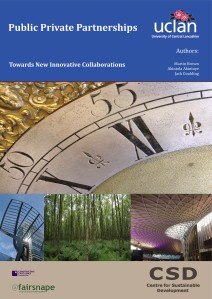
cover

Our recent publication

“Towards New Innovative Collaborations”

exploring PPP Public Partnerships and Collaborative Working within the changing built environment sector, is now available through Amazon

Extracts from the publication follow …

Introduction

This report presents an industry perspective and context of Public Private Partnerships (PPP), the discussion of which is supported by evidence from extant literature, current thinking, and through a recent Public Private Partnership Body of Knowledge International Conference in 2013, hosted by the University of Central Lancashire, Grenville-Baines School of Architecture, Construction and Environment, in conjunction with the research Centre for Sustainable Development (CSD).

This report highlights the key issues needed for industry stakeholders involved in Public-Private Partnership research. It also provides additional insight into CIB TG 72: Public-Private Partnerships for Research and Development. The report is structured around core priorities and emergent themes in PPP research, the main issues of which include the following areas:

  • The historical and current context of PPP and collaborative working from Building Down Barriers to 2013 Construction Strategy
  • Industry perspectives on PPP developments;
  • Key themes and outcomes arising out of the PPP Industry Day
  • The scope, reach and impact of international and industrial engagement through social media in relation to Public Private Partnerships.

Headlines

  • Public Private Partnerships need to emerge as collaborative, knowledge sharing, innovative and purpose-driven partnerships
  • Defining value, creating value and measuring value within and across Public Private Partnership projects is not fully understood by all…
  • There is a need for research and academic organisations to play a key role in Public Private Partnership projects to drive continuous improvement…
  • Building Information Modelling changes everything – from procurement, to collaborative working, to technology and innovation. This will undoubtedly change Public Private Partnerships…
  • Public Private Partnerships need to be seen as relevant to all sectors of the built environment …
  • Social Media and open sharing is an emerging and critical dimension for knowledge sharing, engagement and improvement…
  • Future Research and Development in the Public Private Partnerships arena should address issues outlined within this report…

INTRODUCTIONS

Martin Brown, Advocate and Consultant at Fairsnape Chair, Lancashire Construction Best Practice Club / CE Collaborative Working Champion “Our built environment collaborative working journey is now venturing into new territories. The future for a responsible built environment will increase both the pressure and opportunities beyond collaboration and partnerships to co-collaborate and co-create hybrid projects, moving to open innovations that in turn stimulate further opportunities. Such new and emerging agendas include social responsibility, managing increasingly scarce resources in purpose-driven circular economies, addressing restorative sustainability, adopting transparency and meeting the challenges of BIM and social media connectivity”…

“We believe that the innovations required to create the future won’t come from a single source. Not from science. Not from technology. Not from governments. Not from business. But from all of us. We must harness the collective power of unconventional partnerships to dramatically redefine the way we thrive in the future.” Hannah Jones, Nike’s Global Head of Sustainability and Innovation

John Lorimer, JLO Innovations, Local Authority BIM Liaison Officer, Construction Industry Council. “A successful Partnership is one that comes together and delivers more than the sum of its parts. Understanding how collaborative business relationships actually work, defining the benefits, articulating and sharing that with Industry and Clients are a significant challenge” …

“Changes are always coming and innovations such as BIM will act as a driver of effective integration of the supply chain. BIM is probably the biggest single change to hit the Industry in the past 50 years. Partnership working skills aren’t new, but they must be refocused to fit today’s delivery processes, including the use of BIM”  (John Lorimer keynote at #PPPConf2013).

Don Ward Chief Executive, Constructing Excellence. We believe a number of improvements can be made to the process to improve value-for-money through collaborative working,  ten years ago we identified that the process should consist of the following: identify and develop a business need; appoint the best team (not a worked-up solution) using award criteria focussed on evidence of predictability of outcome measures; agree a target cost (‘unitary payment’); value engineer with pain-gain share to arrive at an optimum solution; deliver and operate the solution with continuous improvement and equitable sharing of financial savings over the concession period” …

Professor Akintola Akintoye Dean, Grenfell-Baines School of Architecture, Construction and Environment, UCLan “The need for innovation through procurement strategies is now more important than ever before. The industry is faced with the need to deliver enhanced value for money, with increasingly complex projects, enhanced competition, and additional pressures to comply with legislative demands and requirements (e.g., sustainable development). Innovative construction procurement methods have developed out of these new demands, and have helped to improve risk management, value for money etc; and these new methods are now transforming the industry” …

Partnerships in Construction – A Reflection

Partnering and collaborative working relationships are considered the most important vehicle for successful project delivery, the rubrics of which have been embedded in many international construction strategies. This highlights the importance of working together to not only achieve successful project outcomes, but also the collaborative infrastructure required to fully leverage an integrated and resilient client/supply chain to deliver real ‘value’ to PPPs.


Understanding the Social Value Act for better bids …

The Social Value Act 2012 was established in part to help understand the difference between a contracts cost and a contracts value and to encourage greater collaboration between voluntary, community and private sectors.

Bid responses for public sector work can be greatly improved by a through understanding of and addressing the concepts of the act. Waste and recycling company Veolia Environment Services have recently released a new and useful youtube video explaining the Social Value Act from their perspective

Also, from – Towards New Innovative Collaborations

The Social Value Act 2012 introduces social benefits into public procurement of private services. It requires local authorities and other commissioners of public services to consider how their services can benefit people living in the local community. Under this legislation, local authority procurers must now consider how they can improve the social impact of their public service contracts before they start the procurement process.  More…

Not a good day for Green Building

Not a good day for Green Building in the USA.

Lloyd Alter on TreeHugger reports that the Green Building Initiative, which runs the Green Globes building certification system has been recognised as a LEED alternative by the federal General Services Administration

I feel sad for friends, colleagues, advocates in the US who are passionate in defending real green building and real building product transparency that will restore the damage done by the built environment.

Lloyd writes: The lobby organization formed last year to kill LEED and counting among its members just about every toxic chemical manufacturer in the USA, is ecstatic, but pushing for more …

The US Green Building Council that runs the LEED program put on a brave face in a press release, saying “At this point, it is unassailable, LEED works. It has played a significant role in GSA’s achievement of its energy and sustainability goals.”

Dream on. Green Globes is now recognized as legit and will eat your lunch; it’s cheaper, it lets builders use all that plastic, and doesn’t give points for FSC certified lumber. In state after state, the politicians paid for by the plastics industry will insist upon it.

Unfortunately I see this as a discussion, then argument and battle waiting to happen here in the UK and Europe. As we push for deeper green standards such as the Living Building Challenge, for deeper product transparency, as Google and other clients will undoubtedly push for non toxic red list materials in their buildings, we will see the push from the power of the petro-chemical, plastics  and big lumber organisations, resisting change for healthy products.

And unfortunately I see our UK Greenest Government Ever likely to side with these giants, removing as they already are in numerous areas, environmental protection so as not to damage industry and growth, headed by an Environmental Minister who is taking  green policy back to the 70s

The UK green build fraternity, advocates, green build councils and accreditation organisations needs to hold strong in the coming years.

cropped-pc210049flip.jpg

Towards a Responsible and Sustainability Construction Economy

Increasingly we hear more and more on emerging sustainable, responsible, collaborative economies. For example:

Patagonia, following on from Chouinard’s Responsible Business have launched their Responsible Economy initiative, and wisely, not having the answers shape the programme with the mission to start the debate – and ‘catch the wave‘.

Recently the TSSS and Earthshine launched an interesting and influential paper, BluePrints for a Sustainable Economy whose aim is to share a journey with people around the world, to help generate greater awareness of the issues and possibilities, to promote debate, to provide a sense of hope for what might be, and how we could all make the transition towards a more sustainable economy.

In the introduction to Towards New Innovative Collaborations  I wrote “Our built environment collaborative working journey is now venturing into new territories. The future for a responsible built environment will increase both  pressure and opportunities beyond collaboration and partnerships to co-collaborate and co-create hybrid projects, moving to open innovations that in turn stimulate further opportunities. 

So, what would a responsible, collaborative and sustainable economy for the construction sector look like?

Lets have the conversation.

How do we move from being the 40% negative sector to the 40% positive sector? How do we heal the future?

Untitled

“We can not call it a sustainable construction economy when we take more from nature than we give back”

We are seeing a number of excellent initiatives emerging, particularly in the area of restorative sustainability, converging on a sustainable construction economy – but what are the barriers, where are the leaders and drivers who will get us there?

This is just one of the topics planned in our Sustainability Leadership Conversations – join our Google+ community and participate in our twitter based conversations. The next conversation on Nov 5th with Eric Lowitt explores the Collaborative Economy.