Author Archives: martin brown

The Carbon Cycle: Transition Event

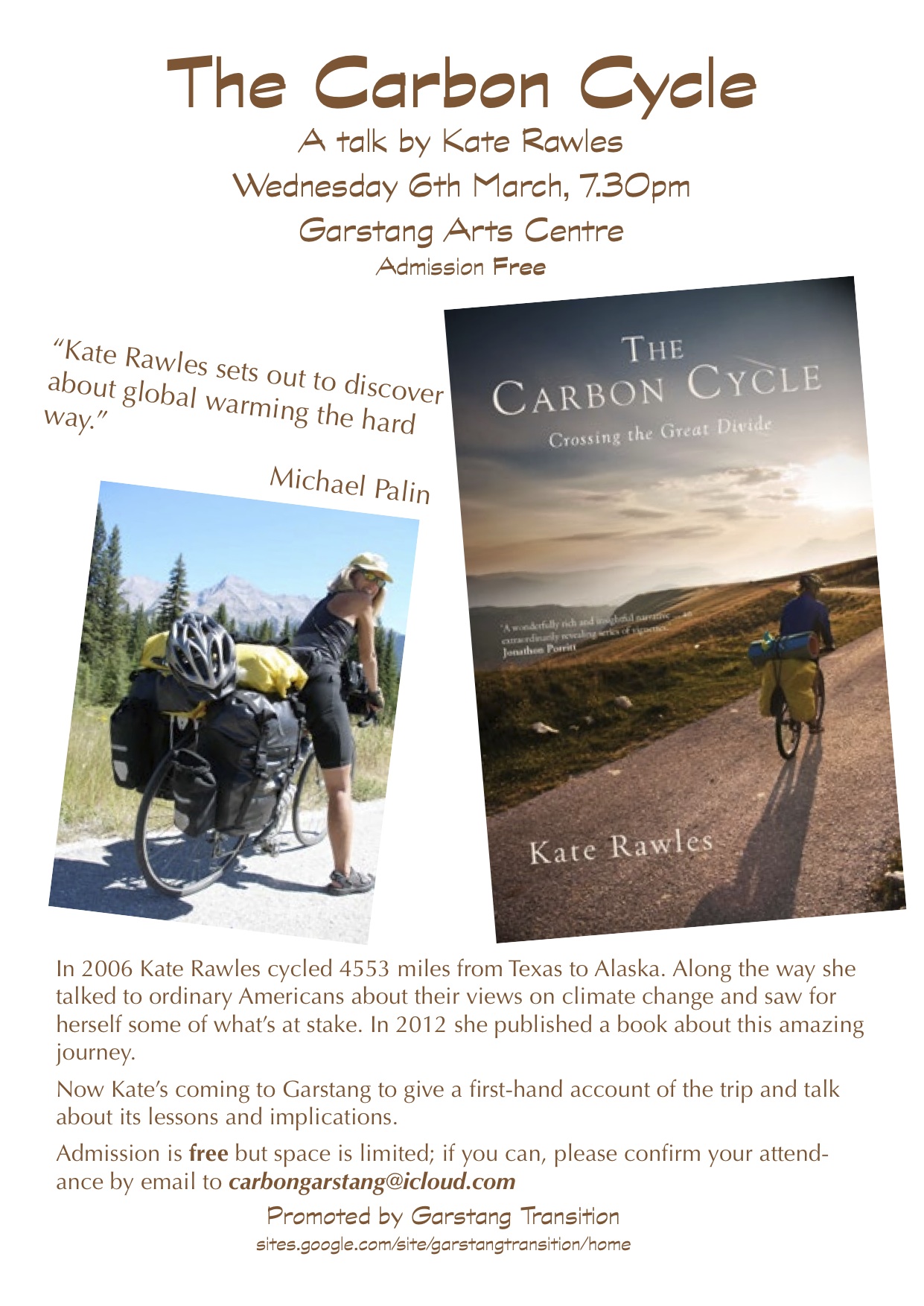
In 2006 Kate Rawles cycled 4553 miles from Texas to Alaska. Along the way she talked to ordinary Americans about their views on climate change and saw for herself some of what’s at stake.

In 2012 she published a book about her amazing journey. The Carbon Cycle

Now Kate’s coming to Garstang to give a first-hand account of the trip and talk about its lessons and implications. Admission is free but space is limited; if you can, please confirm your attendance by email to carbongarstang@icloud.com

Carbon Cycle Poster Web

Social media in construction – whats happening?

Towards the end of last year the Construction Marketing Association conducted a US national survey of construction professionals regarding their use of social media. Of note is that 90% of those surveyed used social media, and of those 91% managed social media internally. Also of interest is the % use of Social Media platforms used, along with the most effective (linkedin) and least effective (facebook) social media platforms.

Also take a look at my article feature in the Guardian last year Why the construction sector should engage with social media, our Be2Camp Social Media Framework for GreenDeal, and Pauley Creative’s 2011  How are the top 15 UK Construction Companies using Social Media

What do you think? What do you use in your business?

Social Media in Construction

Find Martin on Google+

#PPPConf2013 – Industry Day to Explore Public Private Partnerships

ppp

Cover it Live blog for Days 1 and 2 now live here

Are PPP’s the way forward for construction, energy, health, education, infrastructure and wellbeing projects?

UCLAN are hosting an industry day with industry and academic thought leaders on the 20th March to address this question. This will form the third day of the three day PPP International Conference in Preston

In addition to hearing from keynote speakers John Lorimer (ex MCC now JLO Innovations) and Dr. Sheila Farrell (Port Consultant and Visiting Professor,
Imperial College London) there will be the opportunity to explore and discuss local, national and international PPP topics on a series of round tables.

Industry Day Programme Join in live with the online PPP discussions using the #PPPConf2013 hashtag

The four discusion Round Table groups have been identified as:

Group 1: PPPs in general – Identifying projects suitable for structuring, financing and sustaining PPPs – to deliver superior value

Chair: Prof. Pekka Leviakangas, Finland; Note taking by: Martijn Van Den Hurk, University of Antwerp, Belgium; Live Blogging by: Renuka Takore, UCLAN, UK.

Group 2: Education, Health and other ‘Social Infrastructure’ PPP Projects

Chair: Mike Yarwood, Director, Navigant Consulting, Leeds, UK; Note taking by: Adrienne Yarwood, Lecturer, UCLAN, UK; Live Blogging by: Dr. Sachie Gunatilake, UCLAN, UK.

Group 3: Transport and other ‘Economic/ Physical Infrastructure’ PPP development

Chair: Prof. Rosario Macario, Lisbon Technical University, Portgal, Note taking by: Robert Argen, Lund University, Sweden; Live Blogging by: Jennifer Barrett, UCLAN, UK. @meme_cloud

Group 4: Nuclear and other specialised PPPs

Chair: David Atherton, Project Manager, WDA Project Limited, UK; Note taking by: Angela Vodden, Senior Solicitor at Barnsley MBC, UK; Live Blogging by: Ann Vanner, UCLAN, UK @annvanner

Virtual Roundtable Discussion: Current Position and Future of PPP

For those participating online – engage in an online discussion from 9.15. Comments will be feed back into the room along with the other round table group discussions. Use the #pppconf2013 hashtag. Facilitator: Dr, Jennifer Doyle, UCLAN, UK @JDoyleCSD

The PPP International Conference Website is here

Conference Programme Days 1 and 2

Ecologically Rethinking Construction

Jonathan Dawson, head of economics at Schumacher College, writing on Guardian Sustainable Business asked “How do we redesign a new economic theory framed by ecological systems?”

OLYMPUS DIGITAL CAMERAA question we need to ask and start addressing within the built environment.

We are seeing a new vocabulary emerging with concepts such as biomimicry, zero or net energy, water and environmental impact, Living Buildings, biophillia, circular economy … and more … As the interest and importance of these concepts influence in the way we design, build and use buildings, do we need a new paradigm?  Some 15 years after Egan, do we need to again rethink construction to address these emergent sustainability themes. approaches and skills that once again the sector is lacking, engaging the economists, surveyors and accountants? As Jonathan Dawson comments:

Ecology offers the insight that the economy is best understood as a complex adaptive system, more a garden to be lovingly observed and tended than a machine to be regulated by mathematically calculable formulae.

A comment that makes a nice resonance with the Living Building Challenge philosophy

And of course a key element in this new thinking is the internet, web 2.0 and the power of social media.

Enabled by the growing power of information technology, whole new ways of doing business and organising society are emerging, whose strength lies not in economies of scale but in economies of co-operation and symbiosis

Over the weekend , via twitter I caught a slide via Rachel Armstrong illustrating the difference and need to move from 20th century Cartesian or Newtonian thinking into 21st complexity, emergent thinking …

screenshot.32

Jonathan Dawson: “This moment of history calls on us to rewrite the dictionary and create new stories, much as the generations following on from Copernicus did to reflect the new world-view that emerged from his astronomical insights”

Construction Localism – how do you compare against benchmark?

Construction ‘localism’ is currently high on the agenda. And set to grow in importance.

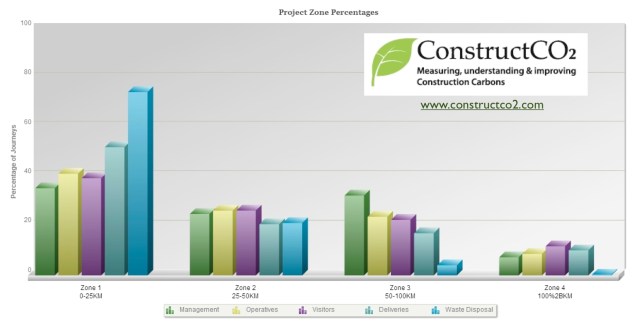
There is, rightly, much talk and focus on localism within construction projects and frameworks at the moment, based on the principle of keeping project spend local. And of course realising other benefits such as reduced travel and transport distances, reduced carbon emission, improved productivity and more.

But how do we compare and benchmark ‘localism’? How local is your project? As a client how can you know if your contractor is addressing your ‘localism’ requirements?

The benchmark being set through ConstructCO2 can provide a starting point. How do you compare? Do you know your project stats?

Construction Localism by Zone

Measuring and understanding your localism (and CO2) footprint must be a key measure, a KPI, as part of your sustainability and CSR programme. Going beyond the measuring it’s essential we monitor trends, make the comparisons, understand the causes and, take action.

bb7dff99a6e2e90c5e67b380cb0aac7b

It is one of the more important impact and influence areas your construction project has on sustainability and the environment.

For more on measuring your construction project carbons and project localism check out constructco2 or please do get in touch.

Sustainability beyond the low hanging fruit

My sustainability lecture to UCLAN SNBE and CSD 31/1/2013
Links referred to in presentation:
Please share your thoughts? Have we picked the low hanging options, what next for built environment sustainability?
For any clarifications or more information on the topics raised, or to keep in touch with UK developments on Living Building Challenge and HPD Standard, please get in touch (email or twitter) or subscribe to this blog

Managing sustainability knowledge across social media.

fs social media workflow

After last weeks UCLAN Centre for Sustainable Development,  Social Media launch session I was asked how to ‘manage’ and ‘filter’ what you can learn and share across the world of social media sustainability.  It was not too easy to summarise in a few minutes on notepaper, so here is my ‘work flow’ and the five key applications used:


Inwards …

Twitter

Most of my inflow arrives via twitter or twitter based apps, eg tweetdeck or hootsuite. I have a number of established feeds or filters established which enables me to keep a real time watch on activity relating to the topics I am concerned with, or related to my clients interests.

Google Reader

Blogs and websites I follow are RSS subscriptions into Google Reader

Flipboard

Described as a social magazine, Flipboard is a brilliant feed application that enables me have a one stop ‘viewing’ place. In addition to having twitter searches feeding into Flipboard, I also have Google Reader, linkedin groups I follow, hub feeds such as the Guardian Sustainable Business and 2degreesnetwork. (Feeds also include cycling, outdoor, walking and weather interests.)

Managing …

Instapaper

Instapaper works across many platforms and is my main ‘receptacle’. It is used to collect and tag articles for later reading. Train journeys and waiting times are great Instapaper reading catch up time. From here I retweet, and / or move to Evernote for keeping or further reference.

Evernote

Rapidly became my everywhere note book. I am drafting this in Evernote! Articles or extracts in Instapaper wanted for reference are exported to Evernote and filed away with tags. These can be for future reference, inspirations for blog posts or, importantly topics on which I can hone, improve or enhance the services I provide for my clients across the built environment.

Outwards …

Tweets can be made either direct from Instapaper or buffered through Buffer which enables some interesting time lapse tweets, or repeated tweets to catch differing time zones. (Care is needed with buffer however to be sure to react to responses!)

My Blog

From Evernote and within Evernote I can easily then compose and curate articles and  for this and other (eg Green Vision) blogs

So there you have it. This has been an established work flow a quite a while now and one that  works for me. It would be interesting to know your work flow and what works for you.

Having a strategy or plan to deal with social media is critical to making effective use of your time online. Building on the support provided to organisations  to date on similar social media strategies, we can help you hone your social media plans, with one to one face to face sessions, or on online via (eg) skype.

In addition coffee shop based, sustainability related, social media clinics will kick off  very soon. Watch his space, subscribed to this blog, follow on twitter or drop me an email

Have we picked the low hanging fruit of Sustainable Construction?

low hanging fruitThe mid 90’s saw my first involvement with sustainable construction, as Business Improvement Manager, setting up strategy and awareness programmes for Mowlem Construction, driven it should be noted to address client bid requirements in PFI and Prime Contracting.

At that time Brundtland’s definition from 1987 was fresh and it made good sense to include it in strategies and as a definition.

In hindsight, one of the problems of this approach is that it reinforced the thinking of that time, that environmental management, and by default sustainable construction belonged firmly and squarely within the Health and Safety departments.  A misconception that many organisations still subscribe to, or struggle to move away from.

But, since then, sustainability thinking has moved on from environmental management as H&S add on, to a wider view of sustainability that includes social and business responsibility, ethical procurement and localism and is now heading for a challenging future greener and deeper agenda

It is encouraging to note the move away from what I have referred to as ‘accommodationalist‘ thinking – ie doing only what we are required to do by law, no more no less. In fact this  thinking is now being challenged by the Governments red tape initiative, proposing to remove certain sustainability related legislation

Over the last 7 years I have been supporting organisations map out and chart progress on their ‘Route to Zero‘, identifying actions necessary today, tomorrow and most likely into the future. We may be in the position of being able to say we have picked off the low hanging fruit from the sustainability tree.

Most construction companies now have a sustainability policy and project approaches that are ISO 14001 accredited, to deal with better management of waste,  recording transport construction miles, employing locally and so on.

But now the real work begins, reaching higher into the greener, more dense canopies of the tree, with a new, emerging set of challenging actions that will take us closer to our zero impact ambitions.

Amongst these new challenges we can see:

  • Collaborative and circular economy thinking. For example what if every building improved with age, improved in its function, its resilience, its performance.  Became more ‘durable‘?  Contracts would not only need to cover the design and construction of buildings, but a new form of collaboration between provider and user that included continuous improvement criteria.  Such Circular Economy thinking would force new collaborations across the supply chain, across discipline and with clients.
  • Convergence of data, information rich ICT environments, an Internet of Things linked to metering sensors that will provide real time feedback on performance of the buildings and of the construction process, driving improved and sustainable resource utilisation. Getting us closer to zero waste and  zero carbon emissions.
  • Responsible specification and procurement, that is not only local but considers ethical and most importantly the health impact of building product ingredients. (see the Healthy Product Declaration Standard)
  • Challenging standards, that bring new deep green philosophies and certifications for buildings and facilities, as we see with the Living Building Challenge
  • The inclusion of costing nature within construction projects. ‘Cheap’ buildings may only be cheap because the real social, environmental costs have been externalised for someone else, often society and the public purse to deal with. Time to bring those externalised costs back into the project costs?
  • A mindful built environment sector, or one that has mindfulness, ie ‘in the moment’ awareness of the impact the design, the construction, the maintenance, use and deconstruction of the building will have upon the environment and nature. Mindfulness is a huge and complex topic but an important sustainability concept we will hear far much more of in 2013.

The first Green Vision tweetchat for 2013 will explore some of these issues on the 28th January at 8pm using the hashtag #GVisChat, asking the question are we getting closer to ‘Zero’?

If you would like to know more on how the Fairsnape Route to Zero mapping and charting programme can help your business, please do make contact

Update – Presentation on this theme 

Are we so oblivious to the ways of nature?

“After 10 generations of industrial society, and with most people in the west removed from a world of soil and sweat, we are so oblivious to the ways of nature that we cannot bring ourselves properly to absorb its vital importance”

Mark Cocker author of Crow Country reviewing the excellent What Has Nature Ever Done For Us? by Tony Juniper “How environmentalists now put money at the centre of their argument”  (For example, read the book/review to understand why the total bill for India’s programme of removing its flock of vulture scavengers has been calculated at $34 billion)

Mark Cocker, based in Norfolk and written extensively on modern responses to nature.  Crow Country is a fascinating look at the life of crows, on the state of country life in Britain, and on the relationship between ourselves and nature.

Related: Re-Connecting – the 3R’s for rethinking built environment sustainability

So, what have we done for nature?

Having listened to Tony Jupiter’s “What has nature done for us” podcast talk at the RSA over the weekend, my son Tom brought this simply brilliant animation to my attention – “what have we done to nature” …

MAN from Steve Cutts on Vimeo.

Related:

The world may not be ending today, but does the construction industry continue to waste as though there is no tomorrow?

3 R’s for rethinking built environment sustainability

Sustainability: Closing the Circle: Barry Commoner