Category Archives: built environment

2016 Built Environment Challenges

KONICA MINOLTA DIGITAL CAMERA

One: 2016 is the year Building Information Management in the UK becomes mandated for public sector projects. Our ongoing challenge is increasing the scope and application, across all the built environment sectors and organisations, moving us towards a digital and data driven industry.

Two: The 2015 Paris Agreement sets ambitious intent to cap global warming to 1.5deg C. Current built environment sustainability strategies and approaches are based around a 2deg cap, with targets too low or too slow. Our challenge is to enable the built environment to play it part, for which we will need all the restorative sustainability tools we have at our disposal. We need to flip our 40% negative impact, but can no longer seek to be near zero or net positive but need to push towards being demonstrably ‘very positive’.

ThreeHealth is the new GreenBuild. We have seen a big increase in health and wellbeing awareness with biophilia now firmly within the sector’s lexicon. Our challenge is to ensure health and wellbeing is a key driver in design, in materials, in the construction process and within building operations.

Four: our biggest opportunity is to now create the conditions that allow for leadership in integrated and collaborative thinking, combining the innovative approaches and development from the BIM, Restorative Sustainability and Healthy Buildings agendas.

FR_Visuals_FINAL


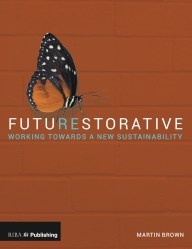
These challenges are explored in depth in forthcoming RIBA Book:
FutuREstorative

Architects and Green Deal: greater ability to improve public health than medical professionals

‘Architects have a greater ability to improve public health than medical professionals’

A provocative statement  made by physician Dr. Claudia Miller, assistant dean at the University of Texas School of Medicine, at a recent  healthy building materials panel moderated and blogged by Kirk Teske on his Point of View blog.

The panel* made a unanimous call for cooperation and transparency from building product manufacturers … the type of collaborative action our industry needs to shift the building materials paradigm from translucent to transparent, and from toxic to healthy

Here in the UK we are seeing the Green Deal  gearing up, which, putting aside the programmes finance and operational uncertainty, has a huge potential to improve public health and NHS health costs. A benefit not addressed or recognised to date. (Particularly given the UK’s lowest ranking across European Countries for health and housing related issues)

How would Green Deal look, and what additional health benefits would it provide, if the scheme embodied Living Building Challenge’s Red List Materials? Seems a no brainer to me.

Likewise the recently announced PF2 Education Funding Agency programme for schools in relation to educational building occupant health.

Slide1

Google may be the influential game changer, globally they are opening 40,000 square feet of office space a week (including a new UK HQ in London).  And none of those workplaces will use any of the materials on the red list developed by the Living Building Challenge. Google’s decision stems from two principles, a focus on health and vitality of its employees and cost of healthcare

The UK Collaborative for Living Building Challenge was launched in April and is currently developing an UK overlay for the standard. Get in touch for more information.


Panel:
Dr. Claudia Miller, an assistant dean at the University of Texas School of Medicine,
Jason McClennan, founder creator of the Living Building Challenge and CEO of International Living Future Institute; 
Bill Walsh, executive director of the Healthy Building Network ,
Howard Williams, vice president at Construction Specialties, a global building materials supplier.

Green Vision for Social Media at Green Build Expo

logoBe2Camp returns to Greenbuild Expo in May with Green Vision.

This year’s session, taking place on 8th May at Manchester Central from 1pm, will be the most exciting  yet, with an amazing line-up of speakers (see below for programme).

GreenBuild Expo itself attracts over 4,000 built environment professionals and takes place on 8th and 9th May. It features over 100 free seminars and workshops on all aspects on sustainable buildings, from integrating renewable energy and BIM for beginners to skills for Green Deal and strategies for climate change adaptation. Speakers include UK Green Building Council, Energy Saving Trust, Warm Up North, Manchester City Council and many more. For free registration visit www.greenbuildexpo.co.uk.

Be2Green

The speakers will include some of the top presentations from Green Visions last three years’ programme, along with BE2 friends old and new. Join us for the whole afternoon, or one of the three great sessions we have planned.

1.00 Welcome

1.15 – 2.00 Green Knowledge – how social media can help us learn, share and advance green sustainability knowledge, including essential tips on promoting your green credentials and featuring ‘Integration is the name of the game’ Paul Toyne , Global Head of Sustainability WSP

2.15 – 3.00 Green Materials – transparency in green and healthy materials, featuring presentation from Kelly Grainger, Interface and Janet Beckett,Carbon Saver UK

3.15 – 4.00 Green Futures – what’s emerging in the world of green building, featuring ‘Green Towns’ Prof Angus McIntosh , Oxford Brooks University and a keynote live presentation from Amanda Sturgeon, VP Living Building Challenge, from the recently completed Bullitt Centre in Portland, called by many the greenest commercial building in the world. (Not one to miss)

Do you have something to share, Pecha Kucha style (thats 20 slides, each 20 seconds) that will fit one of the above sessions? We will keep one slot free for ‘on the day’ contribution But if you are interested please let the Greenbuild Expo organisers know in advance. (1st come, 1st served ….)

As in previous years, our afternoon session will be live streamed and web enabled allowing real global sharing from and into the event.

BE2 (Be2Camp) are Greenbuild Expo’’s social media partners, and a social media advocacy for built environment sustainability and collaborative working

Green Vision, part of the Leeds Sustainability Institute and Centre for Knowledge Exchange and committed to driving sustainable change for construction professionals

Introducing the Living Building Challenge in the UK

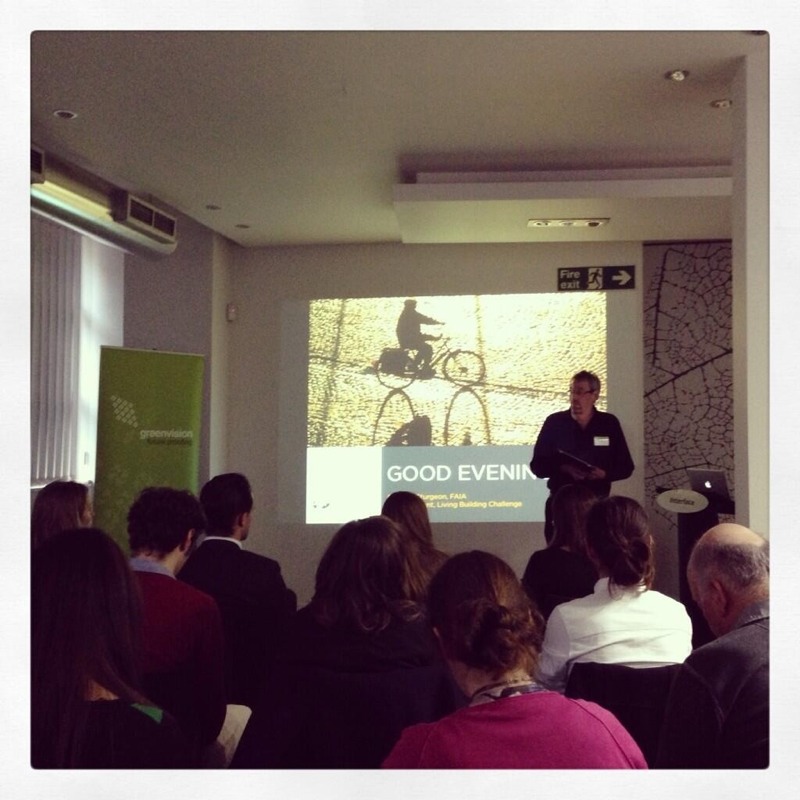
It was a real treat to introduce the public lecture from Amanda Sturgeon as part of the UK Living Building Collaborative launch at the Interface showroom in London last night.


Here are my introduction notes …

Good evening and a warm welcome to Living Building Challenge UK

Firstly a huge thank you to Interface, Kelly Grainger for hosting this evening and Claire Bowles at Green Vision for making it happen, and of  course Amanda Sturgeon from Living Building.

I and a few others have waited a long time for this …

As you may have read in Hattie Hartmans AJ article, our awareness with Living Building started via twitter and through twitter dialogues during the Living Futures conference in Portland in 2011

Later that same year I was privileged to have a guided tour of the CIRS building in Vancouver, during the week before completion (The CIRS building is one of the few buildings scheduled for LBC certification) Since then we have received Living Building related remote presentations live into Green Vision and Be2camp events.

Over the last few months we, that’s myself and Claire at Green Vision, have held regular Skype chats with Amanda and others at LBC, to set up this UK Collaborative and this event, so it’s a real pleasure to welcome Amanda along this evening

But before introducing Amanda a word about the Living Building UK Collaborative. We are part of the Green Vision / Leeds Sustainability Institute with two main aims:

One of advocacy to increase awareness and understanding of the Living Building Challenge

Secondly to provide support to clients for living building design, construction and certification in line with the challenging Living Building principles.

If you want to know more about the collaborative, would like to get involved or indeed would like support on possible future Living Building projects here in the UK please do get in touch.

We cannot let this evening pass without mentioning Mel Starrs, and her advocacy for deep green thinking. Mel, in her last blog piece (an article which you must read) welcomed the idea of LBC in the UK as a standard worthy of the green credentials of leading clients.

Mel’s blog was read by Su Butcher.

I am sure you will agree – launching the LBC here in the UK is in fitting honour for Mels passion for sustainability, green building and challenging standards.

Amanda – Vice President Living Building Challenge

Amanda is an award winning architect recognised as a pioneering leader in the green building movement in the US northwest, a founding member of the Cascadia Green Building Council and is a visiting professor at the University of Washington

Amanda was awarded with better bricks Architect Award in 2008 and recently gained Fellowship of the AIA, the American Insitute of Architects

Amanda, welcome to London and the UK Collaborative

The event was well tweeted, to catch up on comments and pictures view the #lbcuk and #uklbc hashtags (don’t ask) and follow @UK_LBC.

Record of the evening now on Storify

There will be a Slideshare record very soon

Image Building Pieces

#PPPConf2013 – Industry Day to Explore Public Private Partnerships

ppp

Cover it Live blog for Days 1 and 2 now live here

Are PPP’s the way forward for construction, energy, health, education, infrastructure and wellbeing projects?

UCLAN are hosting an industry day with industry and academic thought leaders on the 20th March to address this question. This will form the third day of the three day PPP International Conference in Preston

In addition to hearing from keynote speakers John Lorimer (ex MCC now JLO Innovations) and Dr. Sheila Farrell (Port Consultant and Visiting Professor,
Imperial College London) there will be the opportunity to explore and discuss local, national and international PPP topics on a series of round tables.

Industry Day Programme Join in live with the online PPP discussions using the #PPPConf2013 hashtag

The four discusion Round Table groups have been identified as:

Group 1: PPPs in general – Identifying projects suitable for structuring, financing and sustaining PPPs – to deliver superior value

Chair: Prof. Pekka Leviakangas, Finland; Note taking by: Martijn Van Den Hurk, University of Antwerp, Belgium; Live Blogging by: Renuka Takore, UCLAN, UK.

Group 2: Education, Health and other ‘Social Infrastructure’ PPP Projects

Chair: Mike Yarwood, Director, Navigant Consulting, Leeds, UK; Note taking by: Adrienne Yarwood, Lecturer, UCLAN, UK; Live Blogging by: Dr. Sachie Gunatilake, UCLAN, UK.

Group 3: Transport and other ‘Economic/ Physical Infrastructure’ PPP development

Chair: Prof. Rosario Macario, Lisbon Technical University, Portgal, Note taking by: Robert Argen, Lund University, Sweden; Live Blogging by: Jennifer Barrett, UCLAN, UK. @meme_cloud

Group 4: Nuclear and other specialised PPPs

Chair: David Atherton, Project Manager, WDA Project Limited, UK; Note taking by: Angela Vodden, Senior Solicitor at Barnsley MBC, UK; Live Blogging by: Ann Vanner, UCLAN, UK @annvanner

Virtual Roundtable Discussion: Current Position and Future of PPP

For those participating online – engage in an online discussion from 9.15. Comments will be feed back into the room along with the other round table group discussions. Use the #pppconf2013 hashtag. Facilitator: Dr, Jennifer Doyle, UCLAN, UK @JDoyleCSD

The PPP International Conference Website is here

Conference Programme Days 1 and 2

So, what have we done for nature?

Having listened to Tony Jupiter’s “What has nature done for us” podcast talk at the RSA over the weekend, my son Tom brought this simply brilliant animation to my attention – “what have we done to nature” …

MAN from Steve Cutts on Vimeo.

Related:

The world may not be ending today, but does the construction industry continue to waste as though there is no tomorrow?

3 R’s for rethinking built environment sustainability

Sustainability: Closing the Circle: Barry Commoner

BIM and FM who needs to educate whom?

Another resounding success for the CKE ThinkBIM series today that explored Building Information Management and Facilities Management and raised acutely pertinent issues and questions for future debate.


There certainly was much learning and sharing, from Deborah Rowland’s keynote, (Cabinet Office and Soft Landings) on the round table discussions, from Marty Chobot (FM Systems) on a live feed from North Carolina, proving FM can manage buildings from a BIM model, and of course from the numerous and entertaining pecha kucha style presentations.

Until today I saw a missing link in really moving BIM forward across the built environment being the lack of awareness / knowledge of BIM from the Facilities Management sector.

However I am once again reminded of the lack of understanding from design, construction and indeed the BIM fraternity of what exactly Facilities Management is really all about, and how they need, and indeed will benefit from access to BIM.

The conference discussions also pulled up memories from the late nineties and early noughties on Design and Construction Integration with FM, on the need for FM to be a process broker for new build, and the role of FM to both feedback lessons into construction whilst feedingforward improvements into the business – feedbackfeedforward

And perhaps, just perhaps, as suggested by a few attendees, BIM has started from the wrong end of the process, and should start from the business and FM side, feeding back into construction. And in the context of 1:5:200 thinking, you would start where most value is generated – the 200 business end, not the 0.5 design or 1 construction end of the process.

It’s probably too late to resurrect the FIM not BIM argument. But we need to be acutely aware that we do not just deliver buildings but collectively we provide facilities to clients, and that usability is far more important to FM than light bulb maintenance. Or should be.

The thinkBIM question take away must now be – who needs to educate whom

– Posted using BlogPress from my iPad

Heros and Texts for a future Built Environment based on #CSR

“suddenly the air smells much greener now”

Listening to ‘These Streets’, lyrics by Paolo Nutini summed up the brilliant, inspiring Green Vision conference in Leeds – exploring CSR within the built environment.

A mix of talks, presentations, round table discussions and pecha kuchas from Mel Starrs, Eden Brukman, Tamara Bergkamp, Eddie Murphy, Martin Brown, Faye Jenkins, Claire Walker, Rick Hamilton, Mark Warner, Pedro Pablo Cardoso-Castro, Andy Ainsworth, Paula Widdowson and many others showed that there is real emergence and a future for a Built Environment founded on social responsibility principles.

The air smells much greener …

We heard of excellent progress being made by individuals, projects and organisations on the CSR journey, and how behind these are great influential thinkers, often outside of the sector, many, unsurprisingly, related to the ‘outdoor’ sector.

Many of the speakers were enthusiastic in sharing CSR heros and recommended CSR reading. So here, as a summary, or reading list are those mentioned during the day. I wonder how many of these are on the reading list within design, construction and fm education? (Book titles link to Amazon)

Yvon Chouinard

Rock climber, environmentalist and outdoor industry businessman, noted for his contributions to climbing, climbing equipment and the outdoor gear business. His company @Patagonia is widely acclaimed for its environmental and social focus. According to Fortune magazine, Chouinard is arguably the most successful outdoor industry businessman alive today.

The Responsible Company What we have learnt in the first 40 years at Patagonia by Yvon Chouinard and Vincent Stanley (see my blog)

Let My People Go Surfing Yvon Chouinard – Probably the ‘must read book’ to understand CSR in Business

(On my blog: How can construction learn from Patagonia?)

Ray Anderson

Founder of Interface Inc., one of the world’s largest manufacturers of modular carpet for commercial and residential applications and a leading producer of commercial broadloom and commercial fabrics. He was known in environmental circles for his advanced and progressive stance on industrial ecology and sustainability.

Ray was was posthumously awarded an Outstanding Achievement award at this year’s Guardian Sustainable Business Awards in 2012. (There is a related, must watch, video here: John Elkington describing the work and legacy of Ray Anderson)

Confessions of a Radical Industrialist: Profits, People, Purpose: Doing Business by Respecting the Earth (2009) Later released in paperback as Business Lessons from a Radical Industrialist in 2011.

Paul Hawken

An environmentalist, entrepreneur, and author. Ray Anderson of Interface credited The Ecology of Commerce with his environmental awakening. He described reading it as a “spear in the chest experience”, after which Anderson started crisscrossing the country with a near-evangelical fervor, telling fellow executives about the need to reduce waste and carbon emissions.

Hawken’s book, Natural Capitalism: Creating the Next Industrial Revolution (1999) coauthored with Amory Lovins and Hunter Lovins, popularized the now-standard idea of natural capital and direct accounting for ecosystem services, a theme revisited by Rio +20 and likely to become more mainstream across the built environment.

Janine Benyus

Her 1997 book Biomimicry: Innovation Inspired by Nature defines Biomimry as a “new science that studies nature’s models and then imitates or takes inspiration from these designs and processes to solve human problems”. Benyus suggests looking to Nature as a “Model, Measure, and Mentor” and emphasizes sustainability as an objective of biomimicry. Key thinking in the Living Building Challenge principles, as is

E O Wilson

Edward Osborne Wilson an American biologist, researcher, theorist, naturalist and author. In the mid 80’s developed the concept of Biophilia, the connection between humans and nature, which translates into architecture and the built environment as comfort, well being and productivity through exposure to natural light and natural surrondings or imagry.

Anita Roddick

Dame Anita Roddick, human rights activist and environmental campaigner, best known as the founder of The Body Shop, a cosmetics company producing and retailing beauty products that shaped ethical consumerism The company was one of the first to prohibit the use of ingredients tested on animals and one of the first to promote fair trade with third world countries. Roddick was involved in activism and campaigning for environmental and social issues, including involvement with Greenpeace andThe Big Issue.

John Elkington

John Elkington @volansjohn is a world authority on corporate responsibility and sustainable development. He is currently the Founding Partner & Executive Chairman of Volans, a future-focused business working at the intersection of the sustainability, entrepreneurship and innovation movements

His latest book The Zeronauts, Breaking the Sustainability Barrier describes many of todays inspirational leaders : “Just as our species broke the Sound Barrier during the 1940s and 1950s, a new breed of innovator, entrepreneur, and investor is lining up to break the Sustainability Barrier”

Jorgen Randers

2052: What will the world look like in 2052

Jeff Hollender,

Jeffrey Hollender is an American businessperson, entrepreneur, author, and activist. He was well known for his roles as CEO, co-founder, and later Chief Inspired Protagonist and Executive Chairperson of Seventh Generation Inc., the country’s largest distributor of non-toxic, all-natural cleaning, paper and personal care products. www.jeffhollender.com/

Gary Hirshberg,

Gary Hirshberg is chairman and former president and CEO of Stonyfield Farm, an organic yogurt producer, based in Londonderry, New Hampshire. Now part of the Danone group.

Published in January 2008, Stirring It Up: How to Make Money and Save the World is a book about socially minded business that calls on individuals to realize their power to make a difference in the marketplace, while doing business in ways that adhere to a multiple bottom line – one that takes into consideration not only finance, but the environment and health as well.

Jeffrey Swartz,

Jeffrey Swartz is the former president and CEO of The Timberland Company an organization that believes that doing well and doing good are inextricably linked. Timberland’s commitment is to reducing global warming and preserving the outdoor environment.

David and Claire Hieatt,

Founders of Howies a clothing company based in Cardigan Bay, Wales produces eco-friendly T-shirts, jeans and sportswear, and aims to have ethically correct practices. Howies use natural fabrics as alternatives to petrochemical-derived modern fabrics. Examples include organic cotton, Merino wool and recycled cotton. Howies T-shirts often have images or slogans with political or environmental themes

Dee Hock

Dee Ward Hock is the founder and former CEO of VISA , described systems that are both chaotic and ordered, and used for the first time the term “chard” and chaordic,combining the words chaos and order.

More?

Over to you –

Follow the discussion on twitter with the #GVis2012 hashtag.

Who are your CSR Heros and CSR Texts to add to this Built Environment inspirers list?

What additions or comments would you make to the entries above?

A full record (video, blog, tweets, presentations, storify) of the Building CSR Event is being curated on the be2camp event page here.

We have no business applying the word sustainable to business activity until …

Much has been written and discussed around the use of the word ‘sustainability’ and indeed, within the built environment has become over an used term, we are seemingly littered with sustainable construction, design and fm, with sustainable products, techniques and technologies. It is as though the pre-fix ‘sustainable’ has become to mean little more than the way we now do things. Business as usual?

And yet in a world of transparency we increasingly run the risk of greenwash if we claim ‘sustainability status’ (or indeed ‘zero carbon’) for our activities and are really called to account.

I was reminded of this debate on reading the excellent The Responsible Business by Yvon Chouinard and Vincent Stanley

“A word about a word we have chosen to use as little as possible: Sustainability.  Its a legitimate term that calls us not to take more from nature than we can give back. But we do take more than we give, we do harm nature more than we help it.

We have no business applying the the word sustainable to business activity until we learn to house, feed, clothe and entertain ourselves – and fuel the effort – without interfering with natures capacity to regenerate itself and support a rich variety of life.

We are a long long way from doing business … and no human economic activity is yet sustainable”

What do you think? Let us know if you think the word sustainability has become over used and hence lost its meaning

Related Links:

Construction CSR Makeover: can construction learn from Patagonia?

Constructing CSR iTransparency

… on what makes a building green

Green Deal Opportunities for Industry

At last a good, readable and comprehensive guide to Green Deal from the Energy Efficiency Partnership for Buildings (EEPB) and the Construction Products Association

The Guide is aimed at manufacturers, distributors, main contractors and installers, from individuals to SMEs to large organisations, wanting to work within the Green Deal. It provides an introduction to the Green Deal and ECO programme, highlights opportunities arising from it, sets out the requirements, including a checklist, and gives examples of area-based approaches and combinations of measures. It includes 10 case studies, with many more available at eepb.org.uk/resources

Although not unsurprisingly the pdf guide does focus on the housing sector (because thats where the green deal debate is at the moment) there are also useful guidelines, references and case studies for commercial green deal applications and opportunities. 

I guess its in light of the forthcoming debate around green deal in the commercial section that the EEPB have renamed from the Energy Efficiency Partnership for Homes.

The guide should be available from the EEPB website or newsletter following simple subscription or membership process.