Tag Archives: biophilia

Healthy Buildings and Wellness: 12 Insights

Alison Nicholls, Associate Director, Constructing Excellence, put together the following, excellent summary of the recent Heathy Buildings and Wellness event held on the 31st January 2017.  The event was hosted Aecom at their Aldgate Tower offices, designed to meet the very latest standards in healthy buildings and wellness.

The business case behind healthy buildings and investing in standards such as WELL, BREEAM and the Living Building Challenge, as well as the demand for healthy buildings and the practicalities of delivery in both new and existing buildings and future implications for regulations and law were explored.

Here are the top things learnt during the workshop:

  1. Changing buildings is a great opportunity to instigate healthy changes
    Dave Cheshire from Aecom looked at how making making healthier choices easier for employees could help make them healthier, more productive and more resilient to stressful life and work events. Aecom are implementing solutions to encourage people to live well, both for their own staff and on client projects.
  2. Take the investment conversations up a level
    Dave’s top tip for making the business case was to take the conversation up a tier to those who have a more holistic view of the business investments. Engaging the Human Resources department at can help justify expenditure that might add cost to the capital budget but will save significant amounts over the long term occupation of the building.
  3. Circadian rhythms – mimicking nature
    As part of the British Antarctic Survey project Aecom looked at how intelligent lighting solutions could mimic natural daylight patterns in order to trigger the hormones that set our natural body clock. This is particularly important in a building where it’s pretty dark for six months of the year, however this learning can equally be applied to night workers or office buildings where natural light doesn’t penetrate deep into the building floor plates.
  4. People don’t always understand the risks
    Isabella Myers gave a public health perspective on the link between buildings and health and wellbeing. She flagged up the risks of delivering interventions when occupants were often resistant to changes and not necessarily convinced of the risks to their health from problems such as leaky boilers and fuel combustion. This can come in many forms including deaths from carbon monoxide and neuropsychiatric symptoms from long term exposure to toxins.
  5. Our strategies to save carbon may have made it worse
    Isabella reminded us that some of the strategies that have been employed to save energy and carbon dioxide have led to more airtight homes and buildings have caused the build-up of toxins that can impact people’s health.
  6. Healthy Buildings attract premium tenants
    Anita Mitchell Head of Sustainability for Lendlease Europe spoke about increasing market demand for healthy buildings. On a recent project in Sydney major clients in the financial services and blue-chip companies were demanding high levels of WELL Buildings Standard. Eventually this could lead to devaluing property that does not support health and wellbeing.
  7. Speculative developments can still be healthy
    The strategy to deliver WELL-Ready core and shell schemes enables tenants to implement their own health and wellbeing strategies in order to meet the WELL Building Standard.
  8. Health & Wellbeing cuts across the political divide
    Health and wellbeing impacts on social and economic sustainability, therefore both sides of the political divide can support the agenda, on the one hand it benefits society and on the other it delivers bottom-line economic benefits.
  9. Don’t forget the construction process
    Martin Brown from Fairsnape reminded us that whilst the end product needs to support wellbeing there is a requirement not to forget how the built environment is constructed, the toxicity of materials used and the people who build them. While we have made huge progress in terms of onsite health and safety, the industry has one of the highest mental health and suicide rates after agriculture.
  10. Biomimicry
    There is a lot we can learn from nature and how it functions in order to reproduce natural patterns and deliver healthier and better performing buildings. For example the Living Building Challenge certified Bullitt Centre in Seattle mimics the effect of a tree canopy to limit exposure to overheating and solar glare.
  11. Data can help
    By mapping physical data sets from BIM with biological datasets from the health sector and fitness trackers etc. a really rich picture of how buildings and the built environment are impacting on people’s health and wellbeing is emerging, and providing data for health improvement. There are lots of ways in which existing buildings can be improved to increase the health and wellbeing of the occupants. BRE is carrying out a research project on a real life Biophilic office refurbishment assessing the health and wellbeing of occupants before and after various interventions.
  12. WELL & BREEAM setting the standard
    BREEAM and WELL have been working together to establish common factors and areas of mutual recognition for elements of their respective standards. Chris Ward provided an overview of progress including an initial mapping exercise that has been published in a technical guidance document.This will lead to further collaborative work to ensure that health and wellbeing are an even more integral part of the BREEAM standard going forward.

The group will meet again in April to look at how innovative, healthy and sustainable materials are being specified and how that process can be improved to ensure that clients and specifiers increase their understanding and demand innovative products and materials.

The original constructing excellence post and presentations can be viewed here 

Related:

FutuREstorative – Working Towards a New Sustainability

WELL & BREEAM announce alignment for credits: more good or less bad?
Mindfulness, Biophilia and Salutogenesis: a powerful triptych for improving construction health and happiness


Mindfulness, Biophilia and Salutogenesis: a powerful triptych for improving construction health and happiness

pexels-photo-94616Increasingly health is becoming a key aspect and driver for building design and maintenance. (See Next Wave of Design: Wellness-minded Spaces)

OF note, are seeing a BREEAM alignment with WELL, but as pointed out in FutuREstorative, and by others, this approach needs to equally apply to the construction process, to project working environments, including project office accommodation.

Mindfulness, Biophilia and Salutogenesis can provide a powerful triptych of approaches for construction health and happiness. But what are they, and how can they improve construction?

Mindfulness

The state of being present in the moment. Mindfulness can help in reducing stress and mind-wandering in addition to enhancing the sense of wellbeing and fulfilment from life and work. Mindfulness is growing in use within other sectors to address amongst other things wellbeing, productivity and safety.

(In collaboration with Anne Parker, we can provide tailored Mindfulness for Construction awareness and training sessions)

Biophilia

Our innate relationship with nature. Research is proving that connection or exposure to nature or natural patterns has a huge influence on our state of mind, our wellbeing, cognitive skills and our recovery times from illness. We should for example, be applying the 14 Patterns of Biophilic Design to construction workplaces as part of a healthy construction agenda

Salutogenesis

FutuREstorative introduces the concept of salutogenesis to the built environment. A medical concept that encourages focus on factors that improve & support health and then keeping people healthy, rather than the focus of just reducing the impact on health. Translated to the built environment this can mean focusing on design issues in buildings and workplaces where people go home healthier, feeling better and happier than when they arrived. As an example, the growing recognition that light (daylight and circadian light) can be a medicine, having positive, even healing benefits. Adopting a salutogenetic mindset to the construction process can also encourage us to consider and focus on potential health benefits of working in construction.

salutogenesis-slide

22 Must Read Sustainability Books

FR_Visuals_FINALOne of my aims in writing FutuREstorative was to explore and encourage new thinking for sustainability in the built environment. In turn, inspiration for the book has, in part, come from a number of classic writers and books over the last half century or so, woven into FutuREstorative and into built environment sustainability potentials.

In addition to these books being powerful in shaping my thinking towards sustainability, they  often articulate alignment between nature, the outdoors, wildness and business sustainability.

The Bibliography in FutuREstorative gives a complete listing, but below are a sample 21 of the best, all worthy of making a great sustainable reading or gifts to inspire, as indeed would FutuREstorative!.  (Note the wonderful Icelandic tradition of giving books on Christmas Eve, simply as an additional gift to inspire)

Image 8.1a Book Shelf

Let my People go Surfing – Chouinard, Y.
Three books in one here, a biography, a mountain & surf adventure and a business sustainability philosophy. This is a must read for reluctant business CSR people.

Sand County Almanac – Leopold, A.
Recognised as the godfather of ecology, Sand County is the classic land ecology book. Classic quotes form Sand County include Thinking like a mountain and We reached the old wolf in time to watch a fierce green fire dying in her eyes. I realized then, and have known ever since, that there was something new to me in those eyes – something known only to her and to the mountain.

Silent Spring – Carson, R.
First published in three serializsed excerpts in the New Yorker in June of 1962,this is the book that in many ways triggered the 1960s environmental protest movement. Still as valid today as we deal with persistent chemicals within the built environment materials

Cradle to Cradle – Remaking the Way We Make Things – Braggart, M. and W. McDonough Groundbreaking for the circular economy thinking, challenging the way we make and dispose of things.

Ecology of Commerce – Hawken, P
An important text that aligned ecology and environmental concerns with mainstream business. “if you look at the science about what is happening on earth and aren’t pessimistic, you don’t understand data. But if you meet the people who are working to restore this earth and the lives of the poor and you aren’t optimistic, you haven’t got a pulse.”

Biophilia – Wilson, E.O
Part autobiographical and personal, Wilson’s introduction to the love and relationship with nature, that introduced us to the concept of biophilia. “Nature holds the key to our aesthetic, intellectual, cognitive and even wellbeing. …”

Transition Handbook – Hopkins, R.
The original handbook for the now-global Transition movement, addressing actions required in transitioning to a post peak-oil economy. “… by unleashing collective genius of those around us to creatively and proactively design our energy descent, we can build ways of living that are more connected, more enriching and that recognize the biological limits of our planet.”

Wildwood – A Journey through Trees – Deakin, R.
Living with trees, an autobiography from one of the UK’s foremost environmentalist writers. “To enter a wood is to pass into a different world in which we ourselves are transformed

Revolutionary Engineering – Miller, M.
How the international engineering firm Intergral approach restorative sustainability. Included are case studies from their Living Building Challenge projects. Intégral: Revolutionary Engineering is for trailblazers who care about advancing the building and construction industry toward greater occupant health and happiness, and stronger resilience and regenerative systems.

Design with Climate: BioClimatic Architecture 2015 update – Olgyay, V.
Reprint of a classic 1960s text that inspired and promoted architectural design based on biology and climate. I was not fully aware of this important work until researching for a commissioned review

Biomimicry in Architecture, 2nd Edition – Palwyn, M.,
Insights into the amazing world and future potentials of biomimicry within the built environment

Feral – Rewilding the Land, the Sea and Human Life. Monbiot, G.
Inspiration for restorative and regenerative environmentalism and conservatism through  Monbiot’s experience and passion on rewilding themes.

Tools for Grass Roots Activists. Gallagher, N. and L. Myers, P Brilliant collection of essays and tools from over two decades of the Patagonia invite-only Tools Conferences

Walden – Thoreau, H.D.
Recognised by many as being the classic work on environmental and conservation thinking. “We need the tonic of wildness…At the same time that we are earnest to explore and learn all things, we require that all things be mysterious and unexplorable, that land and sea be indefinitely wild, unsurveyed and unfathomed by us because unfathomable. We can never have enough of nature.”

Last Child in the Woods: Saving our Children from Nature-Deficit Disorder – Louv, R. 
Why we need biophilia in our and in our children’s everyday lives. “We have such a brief opportunity to pass on to our children our love for this Earth, and to tell our stories”

Confessions of a Radical Industrialist: How My Company and I Transformed Our Purpose, Sparked Innovation, and Grew Profits – By Respecting the Earth – Anderson, R.C. and R. White,
The guide that shaped and continues to inspire the values and ethos of Interface Inc. to take nothing from the earth that can’t be replaced by the earth

Landmarks – Macfarlane, R.
Why language and words are important to understanding our relationship with nature and landscapes. Certain books, like certain landscapes, stay with us even when we left them, changing not just our weathers but our climates.”

This Changes Everything: Capitalism vs. the Climate – Klein, N.
How capitalism and our economic structures are at the root cause of climate change.“So we are left with a stark choice: allow climate disruption to change everything about our world, or change pretty much everything about our economy to avoid that fate. But we need to be very clear: because of our decades of collective denial, no gradual, incremental options are now available to us.”

Responsible Business – Chouinard, Y. and V. Stanley
Background to the responsible business values and approaches at Patagonia. “At Patagonia, making a profit is not the goal because the Zen master would say profits happen ‘when you do everything else right.’”

Reinventing Fire – Lovins, A.
A route to a non fossil fuel future in four industries that includes the built environment. Reinventing Fire will require tapping, in particular, the two biggest motherlodes of energy, efficiency and the Sun.

Eden – Smit, T.
Background to the development and principles of the Eden Project in Cornwall, UK. “…. construction is a culture that depends on warfare and fault finding that is not compatible with collaborative partnerships …”

&

FutuREstorative: Working Towards a New Sustainability Brown, M.
Focuses on the emergence of a net positive and restorative sustainability, as a more rounded social, wellness, health and healthy buildings debate “We can and must reignite sustainability, set the sustainability soul on fire, make sustainability fun and exciting, and inspire a new generation – not only for a vision of sustainability that is regenerative but a vision that also acknowledges the damage of the past and makes amends, healing the future

 FutuREstorative : is available via RIBA Bookshops and other online book services!

WELL & BREEAM announce alignment for credits: more good or less bad?

UPDATE 01 Feb 2017

Credit Crosswalks: BRE and IWBI have released guidance to streamline joint certification of BREEAM and WELL

….

As mentioned and illustrated in FutuREstorative, we will see an alignment in building sustainability and performance standards over coming months and years. In the US we have seen an alignment between LEED and the Living Building Challenge on materials (Red List) and recently on energy and water.

On Monday 28th  Nov, we saw an announcement from The International WELL Building Institute and BRE for an agreement to pursue alignment between WELL and BREEAM will making it easier for projects pursuing both standards.

In practice this will mean documentation submitted for certain credits will be recognised by both WELL and BREEAM, saving project teams time and cost.

This will be a very interesting journey and further recognises the importance of health within building design, construction and use. WELL, like the Living Building Challenge is an excellent, robust but tough standard and one that cannot be attained without a different mind-set approach to buildings.

Key to that mindset is recognition of the impact of materials on health on construction workers and building users. An alignment or agreement between BREEAM and the LBC’s Red List would make great sense here.

It will be interesting to see how the differing philosophies between WELL (do more good) and BREEAM (do less bad) work together. Hopefully this further opens the door to a salutogenic approach to design – not just reducing ill-health but using buildings to improve health, for example, using light as medicine, as explored in FutuREstorative

salutogenesis-slide

Health – the next performance gap.

I will also be watching with interest if this agreement extends to the construction process, (ie. the BREEAM MAN credits) to improve the wellness and health of those involved in and affected by construction works. This is a health and wellness area that BREEAM, LEED, WELL and the Living Building Challenge do not readily address. Yet for those whose career is spent on construction sites, it is a key health and sustainability area, and one that benefits from biophilic design considerations, for example greenery in accommodation and living walls as project hoardings.

living-walls-construction-hoarding

Cities setting biophilic commitments.

Pittsburgh has become the latest city to be inducted into the Biophilic City network, setting ambitions and commitments to eliminate the use of all pesticides, fungicides and herbicides, to increase the city’s tree canopy from 42 percent to 60 percent by 2030, to pursue  the daylighting of streams in stormwater management efforts and to develop more greenways.

pexels-photo-94616-1

To qualify as a Biophilic City, cities work within a number of guidelines and monitoring indicators:

Guidelines:

  • Biophilic cities are cities of abundant nature in close proximity to large numbers of urbanites; biophilic cities are biodiverse cities, that value, protect and actively restore this biodiversity; biophilic cities are green and growing cities, organic and natureful;
  • In biophilic cities, residents feel a deep affinity with the unique flora, fauna and fungi found there, and with the climate, topography, and other special qualities of place and environment that serve to define the urban home; in biophilic cities citizens can easily recognise common species of trees, flowers, insects and birds (and in turn care deeply about them);
  • Biophilic cities are cities that provide abundant opportunities to be outside and to enjoy nature through strolling, hiking, bicycling, exploring; biophilic cities nudge us to spend more time amongst the trees, birds and sunlight.
  • Biophilic cities are rich multi-sensory environments, where the sounds of nature (and other sensory experiences) are appreciated as much as the visual or ocular experience; biophilic cities celebrate natural forms, shapes, and materials;
  • Biophilic cities place importance on education about nature and biodiversity, and on providing many and varied opportunities to learn about and directly experience nature; in biophilic cities there are many opportunities to join with others in learning about, enjoying, deeply connecting with, and helping to steward nature, whether though a nature club, organised hikes, camping in city parks, or volunteering for nature restoration projects;
  • Biophilic cities invest in the social and physical infrastructure that helps to bring urbanites to closer connection and understanding of nature, whether through natural history museums, wildlife centres, school-based nature initiatives, or parks and recreation programs and projects, among many others;
  • Biophilic cities are globally responsible cities that recognise the importance of actions to limit the impact of resource use on nature and biodiversity beyond their urban borders; biophilic cities take steps to actively support the conservation of global nature.

Indicators

  • Natural Conditions (eg % of forest or tree canopy cover, % working/living within 300m of green space, area of green roofs, living walls)
  • Biophilic Engagement ( eg daily visits to green spaces, flora and fauna eco-literacy, outdoor activity membership)
  • Biophilic Institutions, planning and governance, (eg city budget allocated to nature conservation, restoration education)
  • Human Health and Wellbeing (% spending 30 mins + in urban nature, in outdoor activities, equitable and just access to nature)

Other aspects of a biophilic city include bird friendly, water friendly (blue urbanism) and dark sky preservation.

Other Biophilic Cities include Wellington, NZ; Birmingham, UK; Victoria Gasteiz ; Spain; Portland, USA and Singapore.

The Biophilic City website has a wealth of information, stories and resources.

UK among the most nature-depleted countries in the world…

Agriculture, Urbanisation, Wetland and Forestry Management alongside Climate Change are the cause in a significant drop in the health and state of UK nature and wildlife. The State of Nature 2016 report published today describing the UK as “among the most nature-depleted countries in the world”

pexels-photo-93013

The 2016 Report led by the RSPB and the collaborative effort of over 50 conservation organisations details the dramatic decline in nature as a result of climate change “overwhelming negative” agriculture, industrialisation and urbanisation, pointing out that it is not just historical but continues today.

The report highlights the positive efforts with examples of natural habitat and wildlife recovery but sadly points out there are too few to prevent a tipping point, citing how public funding for biodiversity has decreased by a third over the last 7 years.

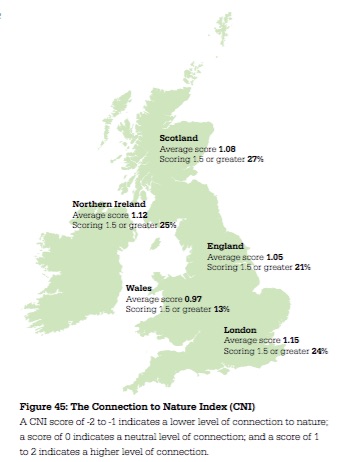
Of particular interest, relating to the current surge of interest of nature within the health, wellbeing and biophilic agendas, and recognition of biophilia and rewilding as the secret sauce for sustainability, is the report’s Connection to Nature Index.

connection-to-nature-index

  • Nature can have positive impacts on young people’s education, physical health, emotional well-being, and personal and social skills,
  • Only 21% of eight to 12-year-olds in the UK currently have a level of connection to nature that is considered to be a realistic and achievable target for all children.
  • Children who were more connected to nature had significantly higher English attainment” and that there are “strong correlations between [connection to nature] and pro-nature behaviours and pro-environmental behaviours.”


Sustainability, Sharing and Success

Below is my keynote presentation given to the UCLan Teaching and Learning conference recently, where the theme of the conference was Sustainability, Sharing and Success.

My keynote covered development of sustainability thinking, from the throwaway dreams and society  of the 1950’s to the circular economy, from the ubiquitous Brundtland definition to the UN Sustainable Development Goals, from sustainable buildings to healthy, biophilic and salutogenic buildings that heal. The keynote explored sharing through social media, and successful, ‘just’ sustainability leadership.

All themes covered  in detail within FutuREstorative published end of August 2016.

Going Wild for 30 Days

From 1st – 30th June 2016. The UK WildLife Trusts are running a month-long nature challenge.

Reconnecting with nature through campaigns such as #30DaysWild can be seen as part of the secret sauce for sustainability behaviour. We spend 90% of our time inside buildings, and as our relationship with nature disconnects, then our tolerance for respecting the environment and behaving sustainably will diminish.

Rewilding Nature, Rewilding Buildings and Rewilding People is a key aspect in addressing sustainability, health and building performance gaps.


Here, then are my #30DaysWild plans …

  1. Stop to appreciate nature, birds and wildlife when cycling
  2. Spread the word about biophilia and rewilding within construction circles
  3. Sleep out under stars
  4. Climb a tree
  5. Re Read Feral
  6. List all the trees in our garden
  7. Visit Brockholes Nature Reserve
  8. Garden with bare hands
  9. Plant trees
  10. Turn off technology for a day
  11. Identify 10 ‘weeds’
  12. Support Curedon Valley Park visitor centre project
  13. Present at least once on Living Building Challenge
  14. Walk in the rain
  15. Bivy or Bothy by Bike
  16. Create log pile
  17. Take time to identify dawn chorus birds by birdsong
  18. Capture nature, wildlife, birds,  with GoPro
  19. Catch a sunset from a Bowland Fell
  20. Add a twibbon to twitter account
  21. Brew coffee on a hill, mountain top
  22. Share extracts from FutuREstorative
  23. Capture nature in images for future presentations
  24. Reinvigorate our compost heap
  25. Take time to site and tune into nature
  26. Stargazing – become familiar with a new constellation or cluster
  27. Read Wild – An Elemental Journey’ has been on reading list too long!
  28. Shop by bike, not car
  29. Bring pond back to life
  30. Watch sunrise from Bleasdale Woodhenge

Join in & do something wild every day for a month and share with #30DaysWild


Biophilic Design & Rewilding- the secret sauce of sustainability?

Biophilia is emerging as the secret sauce of sustainability. It is not just about being able to see trees and fields from our windows, or having green plants within rooms, but something deeper and more profound.

The Cuerdon Valley Park Visitor Centre in Lancashire, the first UK project to be registered for and working towards Living Building Challenge certification, recently staged a project team biophilic design workshop (1), led by Joe Clancy using the Terrapin Bright Green guide ’14 Patterns of Biophilic Design’ (Joe, as an intern with Terrapin Bright Green was part of the guide team and co-author)

The workshop reviewed the design, construction and operation of the building from a new perspective, through each of the 14 patterns, covering aspects from light through to the layout of chairs and food to be served in the cafe.


Biophilia translates as love of nature and in design terms the consideration of how our innate relationship with nature can be addressed within buildings. We have evolved as part of nature, and as such the human mind and body function with greater efficiency and performance when natural elements are present. Biophilic design is ensuring that these elements and patterns are present.

Biophilic elements enhance wellbeing, foster the feel good factor, reduce building related illness and even improve health. For example light as in daylight, circadian lighting, differing light spectrums is being considered as a form of medicine, not only to reduce illness, but to improve and maintain health.

ReWilding
There is much talk of rewilding at present, and as rewilding nature and environments is not just about reintroducing wolf, lynx or other top of the chain predators but more about restoring or regenerating the natural environment ‘creating conditions that allow the emergence of natural responsiveness and development’(2)

We should learn from and apply rewilding thinking to our built environment,and in doing so rewild people, those who inhabit buildings, creating the conditions, through for eg biomimicry and biophilic applications, that allow (new and existing) buildings to breathe and to respond to natural and bioclimatic cycles. We are losing or removing our natural barometers from buildings, increasingly replacing them with SMART technologies, to satisfy a blinked focus on energy performance. In turn, this has weakened our intrinsic relationship with nature.(3)

It is recognised that a lack of connection with nature reduces our tolerance to respect the environment. However, enabling biophilic conditions that ‘rewild’ our built environment will improve user behaviour and increase respect for the sustainable function of buildings.

Biophilia could, therefore be a root cause solution to addressing our buildings sustainability performance, closing performance gaps, providing salutogenetic improvement on the health & well-being of those using the building, and providing business benefits relating to people costs and productivity

And, biophilic workshops are not just for green building design, but should be part of the start-up activities for any project, considering in addition to the building in use, the biophilic aspects of the construction process. Biophilic thinking applied to construction environment can address the stress, mental health and safety, productivity, enthusiasm and wellbeing of those working on our construction projects. Therefore, biophilic thinking could be a key to improving construction quality, environmental and safety compliance, productivity and hence costs.

On two, very recent, project sustainability review/audits, it has been encouraging to hear of construction organisations increasing awareness of biophilia through training related to health, sustainability and design.

(1) Report available soon.

(2) George Monbiot in Feral

(2) extract from FutuREstorative

Lynx Kitten Image:   www.conservationjobs.co.uk

Rewilding Building Image: Cuerdon Valley Park Visitor Centre

Rewilding People image – see – Last Child in the Woods Richard Louv

Images from Sense of Urgency presentation available on Slideshare.

Are we Building Schools for the Future???

Dangerous and dilapidated, poorly built and wasteful. Too many school buildings are failing our children + teachers wellbeing and educational attainment reports the RIBA in a comprehensive POE research based paper that calls for a Government review.

Since the early 2000’s Building Schools for the Future programme, through to the current EFA and Academy programmes it is concerning to read our schools still do not have civilised environments, foster health, wellbeing and happiness, delight and inspire children and teachers*

The RIBA report focuses on how design impacts on wellbeing but sadly omits the body of research and knowledge on biophilia and importance of connectivity with nature.

schoolsbanner-Cropped-660x424cropped

RIBA’s new report into the state of school buildings, Better Spaces for Learning reveals:

  • 1 in 5 teachers have considered quitting because of the wretched condition of the school buildings they have to teach in
  • The Government’s Education Funding Agency’s new school building programme is too rigid and is leading to waste and poor value for tax payers
  • Over 90% of teachers believe well-built and designed schools improve educational outcomes and pupil behaviour
  • Over-engineered schools, with Government-specified equipment that only costly consultants know how to operate, is costing £150 million per year which could have been avoided if schools were designed better

A new report on the state of school buildings in the UK has been published today (Wednesday 11 May) by the Royal Institute of British Architects (RIBA). Using the largest ever analysis of primary and secondary school buildings in the UK, a nation-wide poll of teachers, and extensive engagement with school buildings experts, RIBA’sBetter Spaces for Learning report makes the case for an urgent review of the Government’s Education Funding Agency’s current school building programme.

The report emphasises the importance of well-designed school buildings on young people’s wellbeing, behaviour engagement and crucially, attainment.

RIBA has identified that good school design can reduce running and maintenance costs, in some cases by more than several times a teacher’s average salary a year; it could have prevented the English school estate from spending upwards of £150m annually on unnecessary operation and maintenance costs.

The new report is further insight into the Government’s own assertion that just 5% of the nearly 60,000 school buildings across the UK are performing as intended and operating efficiently.* The prevalence of damp, leaky classrooms and asbestos-ridden buildings in British schools means too many pupils and teachers are struggling to learn and teach in conditions damaging to their health and education.

Better Spaces for Learning reveals that the Government’s current programme of building new schools is inefficient – with a lack of flexibility to make the best possible use of resources, and little opportunity for school staff to input into the design of their own new buildings. RIBA believes that the Government programme must be improved to guarantee better outcomes for our public money.

RIBA President Jane Duncan said:

“This country is in the grip of the worst shortage of school places in living memory. Our report highlights the vital importance of school design and how it affects the general health and wellbeing of their users, our children and their teachers. As limited funding is available to deal with the growing problem, every penny spent on schools must deliver maximum value for money. Award winning well-designed, successful schools with happy pupils and productive staff like Burntwood School in London shouldn’t be the exception, they should be the standard.

“How can we expect our children to compete with the world’s best when too many of our school buildings are substandard? Educational improvements resulting from the current programme of school building are not reaching the basic standards that British taxpayers and our economy expects. We need to do better for all of our children and their hardworking teachers. We urge the Government to review its programme of building new schools.”

(*to use Living Building Challenge parlance).