Tag Archives: construction

What is BIM

The following article was written to introduce PauleyCreative’s excellent BIM Infographic  illustrating the recent NBS BIM survey, providing an important snapshot of our collaborative working BIM journey and future directions.

It was also hosted on the 2degreesnetwork site as part of their BIM series.

It feels the article has been ‘on tour’ and received good responses and comments via twitter and elsewhere, so it seems only correct to ‘bring home’ and post here for readers of this blog. Enjoy, and please do add comments below.

What is BIM?

There are many definitions of BIM, but unfortunately many are wrapped in technical, project management or design terminology.

We can understand and describe BIM as “the total and virtual modelling of all aspects of a project prior to construction, during construction and in use.”

A BIM would typically model all data relating to, for eg, design scenarios, costings, build ability and clash detection, scheduling and procurement, sustainability impact, life cycle and facilities management factors as well as in use predictions. Championed by the Government, milestones are set for achieving increasingly mature levels of BIM. The first being level 2 by 2016.

We should view BIM, not just as new technology but as a continuation of the collaborative working journey within the built environment sector. A journey started, or first articulated, way back in 1934 by Alfred Bossom and core to most sector improvement programmes since, from Latham, Egan, Building Down Barriers, Constructing Excellence, to the recent Never Waste a Good Crisis report.

BIM will be challenging, demanding real collaborative working and sharing of data, knowledge and costings across project parties.

The key to collaborative working being effective and open communications, coupled with trust and importantly being comfortable with sharing within a digital environment. Indeed we need the debate on the potential role of communications, and in particular social media, within BIM environments.

Perhaps understandably, the current BIM agenda is driven by technology and design. But the debate will widen, out of necessity, to include other disciplines such as Facilities Management, Quantity Surveyors, SME contractors, product suppliers and manufacturers, Many of whom still remain unclear as to how work and management will be different when working within BIM projects or suppling equipment to a BIM project.

You may recall a recent Honda advert that played on the expression “everything we do goes into everything we do.”  That ad emphasised how the breadth of Honda’s experience is applied through lean manufacturing to all aspects of their products. This is a great expression we would be wise to adopt to explain how BIM will enable us to bring built environment collective experiences, knowledge, technologies and best practice to every building.

Imagine a built environment industry where the design office, the QS office, the project management team, subcontractors operatives, the manufacturers factory and so on is so lean that everything we do goes into everything we do.

We would be able to reclaim the rule of thumb 30% waste in our sector, improve on safety and sustainability and deliver better, lower cost, fit for use facilities whilst achieving healthy profit levels essential for a sustainable industry.

Increasingly I am helping the contractors that I support on their questions of “what is BIM” and “what do I need” to do through increasing awareness of collaborative working, BIM itself and becoming comfortable with web/social media/digital communication. If you would like to know more please do get in touch or follow the conversations on twitter @fairsnape


Five Emerging Themes in Construction CSR

A recent CSR in construction workshop ran some very interesting discussions on just what CSR in construction is, what it could be and what it should be.

There emerged a number of salient, central themes:

CSR is not a badge, a new lick of paint or indeed something to do to generate responses in bids and PQQ’s to win work, but is something that goes deep into the organisation. It is the brand, image and reputation of the business, in many ways CSR is part of the DNA upon which the business will grow and flourish. Words such as heart or soul of the business become relevant.

CSR thinking will challenge existing business models. We have moved from a era of CSR being bad news, not seen as a business issue, to one of commitment to being responsible and doing good whilst running a business. The challenge businesses may now face is moving forward, how to make a construction business of out doing good, where social responsibility is the vision and core of the organisation. Combining triple line thinking in an integrated strategy and integrated reporting approach will give new perspectives on construction businesses.

CSR approaches cannot be simply imposed top down. Whilst needing strong leadership vision, CSR requires real engagement of all staff and indeed all those who work for the business through the supply chains. Empowering managers to lead on CSR and engaging people in sharing CSR good news stories will become essential.

CSR transparency means all aspects of construction are increasingly on open public display. We cannot put one message to clients in bids, another to staff and still allow conflicting, or perhaps irresponsible practices to exist. The recent Goldman Sachs is a timely reminder that we are in the Age of Damage as described David Jones in Who Cares Wins

The power and potential of social media is yet to be realised. On one hand it presents a phenomenal tool for sharing news, keeping informed and engaging with clients and partners, on the other hand it can be the Achilles heel, rapidly broadcasting irresponsible practices or intentions. Having an appropriately positive approach to Social Media with guidelines or codes of practice for use by staff in the business and on projects will increasingly become high priority.

Supporting built environment organisations on developing CSR strategies it is encouraging to see a real desire for strategic CSR approaches that go beyond the volunteering and sponsorship models. If you wish to engage in conversations on CSR in construction follow and join me on twitter @fairsnape, subscribe to or share this blog post, or get in touch via fairsnape@gmail.com

Cost of Managing Project Photos


Seeing the wood from the trees. Are we taking too many site photos?

Seeing the wood from the trees. Are we taking too many site photos?

Last week I was discussing the issue of site photos with a contractor. The discussion included the cost (time) of taking so many photos which were probably never viewed, the increasing storage costs and the cost (time) in trying to find suitable photos for bids, publications or to verify events on site for many reasons.

A number of solutions were discussed including the mandatory tagging of photos before being uploaded or saved on to company sites, using open sites such a flickr, or  an emerging approach of embedding photo’s into the site online diary – or blog where they exist.

At the same time Paul Wilkinson @EEPaul was tweeting live from a COMIT event where the same problem was being discussed – the vast number of photos taken across the industry, made all so easy with smart phones, picture storage requirements increasing as the mega pixel cameras on site increase and so on.

Its not surprising then that we will see construction picture applications emerge, one of the first to come to my attention is Geedra (http://www.geedra.com/) which discusses the issues above in their blog – see Construction Photo Management Just Changed

I can foresee that construction companies will baulk at the cost (just under $2000 per annum, with a limited capacity free option).  But given the cost in time on taking unused pictures, server space for unnessary pictures and time in searching, this may actually be saving costs.

We should perhaps understand, like pictures taken and developed on film, there is a real cost of taking so many digital pictures.

PQQ Secrets: Listening to the voice of the customer

For PQQ responses to have chance of success they need to address the requirements and aspirations of the client and project.

They also need to differentiate from the competition. So when a client organisation presents on how to differentiate at bid stage, you should be on to a winner.

But of course it’s an ever iterative game, and you will need to be better than those who also hear the customers tips for bidding.

At last weeks CSkills Forum in Salford, Urban Vision Partnership presented what they look to as differentiators when marking and selecting PQQ’s, either as direct bids, as part of a consortia or within a supply chain. Urban Vision’s overall remit is to manage, protect, maintain and enhance development within the city.

Key Differentiating Factors:

– Creation of community benefit

– Workforce development

– Added value and innovation

– Environmental performance, eg 14001 and CO2 monitoring

– Health and Safety practices, eg 18001

– An IMS (Integrated Management System) approach to quality, sustainability and safety

How many of these can you honestly tick as being well established, or well in development, within your organisation, to articulate within bids?

Many of these have been part of the construction business improvement agenda for many years now, certainly since Egans Rethinking Construction back in 1998, whilst others are relatively new as Methods of Modern Construction Management.

Through fairsnape we can help with advice or support in these areas, in practice or in bid articulation. Why not have a conversation? You can follow and join me on twitter @fairsnape, subscribe to or share this blog post, or get in touch.

Construction #CSR Gen X + Y and a desire to ‘do good’

As part of background reading for construction CSR / Social Media project, focused on employers looking to attract young people into the industry, I came across a fascinating article in the Canadian Globe and Mail, GenY seeks responsible employer who listen.

It struck a real chord with an expression that had been forming over the last few weeks, that “if we dont get sustainability, social media and CSR right then young people will not want to work in construction. But they will want to work for other sectors” A compelling reasons why all this starts in the boardroom both as an organisaiton continuity or survival issue and forward thinking, growth and innovation matter.

And it is very much a social media matter, Gen X and Y will use social media to broadcast negative thoughts and obersvations, as well as positives. (The slide comes from a recent constructing social media presentation)

Corporate social responsibility ranks “quite highly” for Generation Y workers …

“The challenge is that Gen Ys hold organisations to their CSR policy. If they join and they feel that the organisation is not living up to the policy, they will become disengaged, leave the organisation and, even worse, will use social media to broadcast their negative thoughts.”

There are a number of other factors that make a company an employer of choice for Gen Y, such as: meaningful, engaging work and the opportunity to build skills; access to the latest technology; working with friends and co-workers in the same age group; a collaborative work environment and management style, and an organisational capacity for fun.

So what turns them off?

  • Stodgy, traditional companies – “they will join and stay for the money for a while, but then will leave looking for greener pastures.”
  • Managers who are not interested in them as people, or their career progression.
  • No clear line of sight between what they are doing and the big picture.
  • “When the cost of doing anything [long hours] outweighs the benefits [work-life balance].”

The Great Construction Green Reskilling

Last night I attended an interesting and informative “The future green skill needs of the construction industry” Round Table discussion, hosted by The Guardian.

The panelists Mark Farrar, CITB, Brian Berry, FMB, David Bownass, WSP and Gareth Jones Carbon Zero UK, were chaired by Jane Dudman from the Guardian.

A full report of the round table will appear in the Guardian on 16th Nov, but here are my thoughts on construction green skills future needs

Understandably the attention and focus was on trade green skills and the green deal which Mark Farrar from CITB referred to as a ‘targeted hot spot’ for the industry.

And yet the need for green skills in construction will permeate to all levels and roles and is far wider than the Green Deal although this may well be the catalyst, even a trojan horse.

Leaders and directors will need the skills to be able to act as role models, embedding green thinking across the organisational value chain,  to be able to look at all aspects of construction and  the organisation, including the organisations future direction through a sustainability lens.

Unless construction board rooms have a green agenda, commitment to addressing organisational skill needs could be transient. (See A Low Carbon Diet for Construction Boards)

Those involved with procurement, finance and quantity surveying will need skills to balance costs and value with sustainability, appropriate sourcing and social localism issues, and, be able to make informed decisions

Site managers, planners and supervisors require skills to balance sustainable construction, lean construction, reduced waste, reduced carbon, understand closed loop resources with the time old juggle of bringing the project in to quality cost and time. All this along side understanding increasingly complex constructions and green installations.

At trade green skills level the panelists agreed on the need for multi-skilled, multi competent persons and approaches, all needing a new approach to supervision and planning.

Getting it right first time, a systems thinking approach to quality along with closed loop resource concepts remain alien to the bulk of construction practice, training and education.

The re-skilling of the industry looks like a mammoth task when one considers the training implications, again not only of trades but of under graduates, management courses and CPD from the institutions

The environment skills map drawn up by IEMA represents a useful approach to environmental management skills that in the main can be read across to construction management.

But green skills are not the only future skills required, as we move to BIM, IPM, Collaborative and Lean construction … We need to ask why has our training investment, training organisations, education systems and institutes not delivered the needed skills on the correct scale.

Sustainability has been on the agenda for at least a generation since Brundtlands Sustainability Development definition in 1987.

Its nothing new.

Back in 2007  Rob Hopkins in the Transition Handbook forecast –

In 2011, the Government initiated the concept of the Great Reskilling in the training of construction industry workers.

Are we nearly there?

Construction in Crisis? BIM the solution?

Construction in crisis? buildings too complex? communication of knowledge rapidly changing? (Thoughts from the road)

Whilst I have long being a supporter of the need for the aims of BIM, it has been as seeing BIM as a technoloy to enable and enhance, better, improve collaborative working, not in a means to itself. In fact many agree collaboration in a digital age is or should be 80% people 20% technology.

In other blog posts here I have mentioned my thoughts on how BIM should in fact be FIM, Facilities Information Modelling, as the models set out or should set out the way the facilities will be used, managed, improved, adapted over time etc, not just the building. Ie the people aspects of building use. ( a recent example from a building designed on CAD, not quite BIM, being a student quiet zone for thinking and meditation littered with in the face fire exit signs and a large red fire panic button)

That BIM is being seen with both fear and salvation is interesting but not surprising, it will after all change the way the built environment sector works, and importantly works together and collaborates.

And yet BIM is perhaps just as the word processor is to creative writing, it may enable the articulation but not the creativity.

For BIM to be effective the people issues and desire for collaborative working need to be in place, to be well grounded and to be effective. To leap straight into BIM can be as ineffective as trying to write a creative masterpiece just because we have a new tool or piece of software available in the toolbox

Admist all the noise, news and promotion of BIM as a technology its therefore refreshing to read Randy Deutsch brilliant, BIM and Integrated Design, but perhaps his short but powerful summary that not only sums the book, but provides light on issues facing design, construction and fm. (extract below but view the article here: http://ow.ly/1vVNMJ)

(Update: Randy has reminded me You can read the first chapter here. Or buy a copy discounted online at Amazon, at your local bookstore or from the publisher.)


Q: How would you summarize your book in a single sentence?

A: The focus throughout this book is on people and the strategies they use to manage and cope with the transition to the new digital technology and the collaborative work process it enables as they initially adopt and then take the technology and process to a higher plane.

Q: Why do we need a book like this now?

A: There’s a crisis not only in the economy but in the profession. Buildings are becoming more and more complex and the way we communicate knowledge to one another is changing. At the same time the construction world is going through enormous changes, so is our environment.

We’ll only be able to tackle today’s complex problems through collaboration, and that takes work and a prepared mindset. You have to be disciplined, can’t just show up and wing it. Your teams’ efforts have to be coordinated and integrated. I noticed that there is a gap in learning along these lines in the profession and industry and this book seeks to fill it.

Q: There are a number of books that cover the subject of BIM. How is this one different?

A: Most books on BIM cover the technology or business case while this one focuses on the process that enables the highest and best use of the technology. BIM and Integrated Design focuses on the people side of the change equation, addressing BIM as a social and firm culture process and does so in four distinctive ways:

it addresses people problems, human issues, issues of communication and collaboration, firm-culture issues, issues of motivation and workflow related to working in BIM;

it explores the most commonly encountered obstacles to successful collaboration, as well as the challenges this technology and process create for individuals and organizations in their labor toward a comprehensive, successful BIM adoption and implementation;

it describes the social impacts and implications of working in BIM on individuals and firms, and how to overcome real and perceived barriers to its use; and

it discusses challenges to BIM collaboration including interoperability, workflow, firm culture, education, technological challenges, working in teams, communication, trust, BIM etiquette, one model versus multiple models, cost, and issues concerning responsibility, insurance, and liability.

Construction supply chain footprints

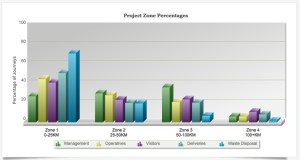
Our construction carbon tool, Constructco2, through its ability to monitor a projects supply footprint is throwing up some interesting issues:

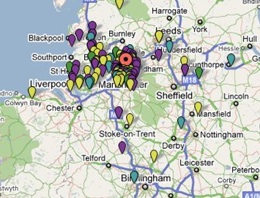
Take a look at a project footprint that has a focus on localism – ie in keeping material, supplier, management and even waste transportation as close as possible to the project:

And then one that doesn’t (which is actually less in construction value):

Across the 80 or so projects on the site we can start to see the travel pattern for materials, people and waste, and how close to the project …

All this starts to position Constructco2 as a possible valuable CSR tool and indicator, monitoring impact of projects on local communities, and starting to raise issues of procurement, appropriate sourcing / specification as well as good on site project management housekeeping

These notes are extracted from my recent ConstructCO2 presentation that is available to view on slideshare. 

For more on information please get in touch or visit Constructco2,and follow links.

Construction lacks green, key business and foresight skills

Construction lacks essential skills. A recent poll of 1,450 construction employers, conducted by Construction Industry Training Board and Sector Skills Council, CITB-ConstructionSkills, skills gaps such as understanding the implications of green issues (43%), identifying potential new business (39%) and not having sufficient IT skills (43%) were all areas picked out by industry managers and supervisors as lacking in their organisations.

In addition, a third (32%) of employers said that keeping up to date with the latest innovations, products and techniques was an important concern for their business. A further 32% also stated that their management team’s ability to identify the training needs of staff was an area that needed improvement.

Begs the question what have we been doing in the world of construction improvement over the last two decades since these skills were identified in seminal reports, eg Egan , Latham and others.

Importantly it also demonstrates a lack of awareness and vision at board, owner or senior management levels to identify, acknowledge and prepare for emerging trends, particularly in the sustainability, IT and social media arena.

Links:

A Low Carbon Diet For Construction Boards (CSRWire post by Martin Brown)

Future Proofing the Boardroom – Part One: Grounding and Stargazing (CSRWire post by Lucy Marcus)

Link to CITB 

Towards low carbon construction IGT Report: Government Response

Snippets from todays launch of the Governments Response to the  industry’s Innovation Growth Team Report:

Business Minister Mark Prisk said:

“An efficient, effective and profitable construction industry is at the heart of any growing economy.

“Meeting the UK’s commitment to reducing carbon will affect every aspect of the built environment and has the potential to provide the construction industry with a 40 year programme of work creating great opportunities for growth in the sector.

“Through this joint Government and industry action plan we are making a clear commitment to the low carbon transition which will create the certainty needed for construction companies to invest in essential new skills, processes and products.”

Climate Change and Energy Minister Greg Barker said:

“Improving the energy efficiency of the nation’s buildings is a win-win response to tackling emissions and spiralling fuel costs.

“The Government’s Green Deal will radically transform the energy efficiency of our homes and businesses, and presents a massive opportunity for Britain’s construction industry.

Government Chief Construction Advisor Paul Morrell said:

“I am delighted that the Government has taken on board so many of the recommendations from the IGT report which was developed with expertise from across industry.

“To ensure that construction rises to the low carbon challenge we need to continue this new level of cooperation so I am also pleased that a joint Government and industry board has been set up to ensure implementation of this plan.”

Influence of Construction 

A copy of the Government’s response to the Low Carbon Construction Innovation and Growth Team Report can be found at: http://www.bis.gov.uk/constructionigt


Info from the News Distribution Centre