Tag Archives: Green Vision

Green Vision for Social Media at Green Build Expo

logoBe2Camp returns to Greenbuild Expo in May with Green Vision.
This year’s session, taking place on 8th May at Manchester Central from 1pm, will be the most exciting  yet, with an amazing line-up of speakers (see below for programme).

GreenBuild Expo itself attracts over 4,000 built environment professionals and takes place on 8th and 9th May. It features over 100 free seminars and workshops on all aspects on sustainable buildings, from integrating renewable energy and BIM for beginners to skills for Green Deal and strategies for climate change adaptation. Speakers include UK Green Building Council, Energy Saving Trust, Warm Up North, Manchester City Council and many more. For free registration visit www.greenbuildexpo.co.uk.

Be2Green

The speakers will include some of the top presentations from Green Visions last three years’ programme, along with BE2 friends old and new. Join us for the whole afternoon, or one of the three great sessions we have planned.

1.00 Welcome

1.15 – 2.00 Green Knowledge – how social media can help us learn, share and advance green sustainability knowledge, including essential tips on promoting your green credentials and featuring ‘Integration is the name of the game’ Paul Toyne , Global Head of Sustainability WSP

2.15 – 3.00 Green Materials – transparency in green and healthy materials, featuring presentation from Kelly Grainger, Interface and Janet Beckett,Carbon Saver UK

3.15 – 4.00 Green Futures – what’s emerging in the world of green building, featuring ‘Green Towns’ Prof Angus McIntosh , Oxford Brooks University and a keynote live presentation from Amanda Sturgeon, VP Living Building Challenge, from the recently completed Bullitt Centre in Portland, called by many the greenest commercial building in the world. (Not one to miss)

Do you have something to share, Pecha Kucha style (thats 20 slides, each 20 seconds) that will fit one of the above sessions? We will keep one slot free for ‘on the day’ contribution But if you are interested please let the Greenbuild Expo organisers know in advance. (1st come, 1st served ….)

As in previous years, our afternoon session will be live streamed and web enabled allowing real global sharing from and into the event.

BE2 (Be2Camp) are Greenbuild Expo’’s social media partners, and a social media advocacy for built environment sustainability and collaborative working

Green Vision, part of the Leeds Sustainability Institute and Centre for Knowledge Exchange and committed to driving sustainable change for construction professionals

Introducing the Living Building Challenge in the UK

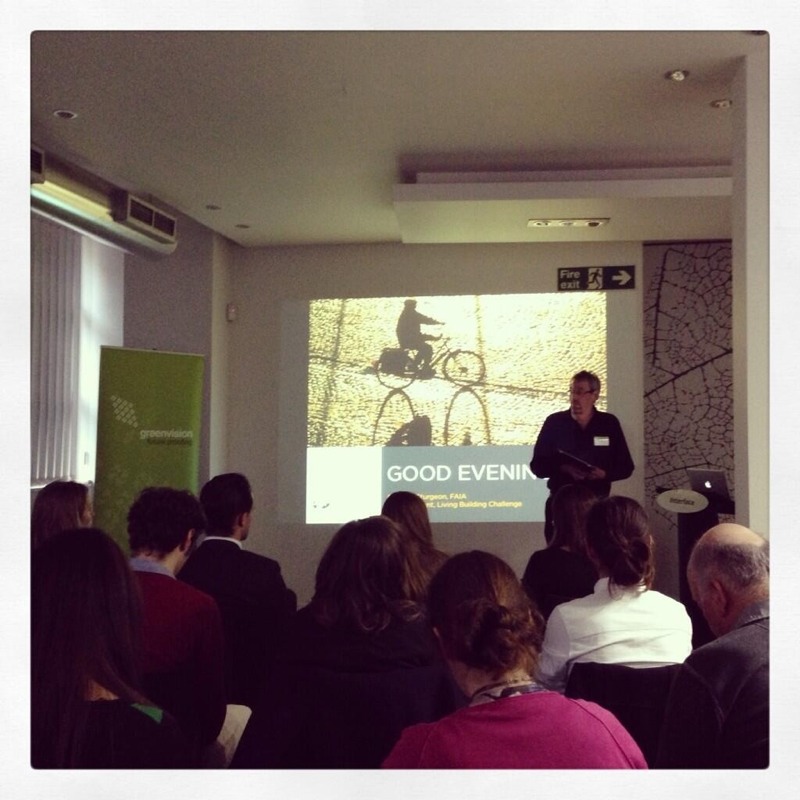
It was a real treat to introduce the public lecture from Amanda Sturgeon as part of the UK Living Building Collaborative launch at the Interface showroom in London last night.


Here are my introduction notes …

Good evening and a warm welcome to Living Building Challenge UK

Firstly a huge thank you to Interface, Kelly Grainger for hosting this evening and Claire Bowles at Green Vision for making it happen, and of  course Amanda Sturgeon from Living Building.

I and a few others have waited a long time for this …

As you may have read in Hattie Hartmans AJ article, our awareness with Living Building started via twitter and through twitter dialogues during the Living Futures conference in Portland in 2011

Later that same year I was privileged to have a guided tour of the CIRS building in Vancouver, during the week before completion (The CIRS building is one of the few buildings scheduled for LBC certification) Since then we have received Living Building related remote presentations live into Green Vision and Be2camp events.

Over the last few months we, that’s myself and Claire at Green Vision, have held regular Skype chats with Amanda and others at LBC, to set up this UK Collaborative and this event, so it’s a real pleasure to welcome Amanda along this evening

But before introducing Amanda a word about the Living Building UK Collaborative. We are part of the Green Vision / Leeds Sustainability Institute with two main aims:

One of advocacy to increase awareness and understanding of the Living Building Challenge

Secondly to provide support to clients for living building design, construction and certification in line with the challenging Living Building principles.

If you want to know more about the collaborative, would like to get involved or indeed would like support on possible future Living Building projects here in the UK please do get in touch.

We cannot let this evening pass without mentioning Mel Starrs, and her advocacy for deep green thinking. Mel, in her last blog piece (an article which you must read) welcomed the idea of LBC in the UK as a standard worthy of the green credentials of leading clients.

Mel’s blog was read by Su Butcher.

I am sure you will agree – launching the LBC here in the UK is in fitting honour for Mels passion for sustainability, green building and challenging standards.

Amanda – Vice President Living Building Challenge

Amanda is an award winning architect recognised as a pioneering leader in the green building movement in the US northwest, a founding member of the Cascadia Green Building Council and is a visiting professor at the University of Washington

Amanda was awarded with better bricks Architect Award in 2008 and recently gained Fellowship of the AIA, the American Insitute of Architects

Amanda, welcome to London and the UK Collaborative

The event was well tweeted, to catch up on comments and pictures view the #lbcuk and #uklbc hashtags (don’t ask) and follow @UK_LBC.

Record of the evening now on Storify

There will be a Slideshare record very soon

Image Building Pieces

Managing sustainability knowledge across social media.

fs social media workflow

After last weeks UCLAN Centre for Sustainable Development,  Social Media launch session I was asked how to ‘manage’ and ‘filter’ what you can learn and share across the world of social media sustainability.  It was not too easy to summarise in a few minutes on notepaper, so here is my ‘work flow’ and the five key applications used:


Inwards …

Twitter

Most of my inflow arrives via twitter or twitter based apps, eg tweetdeck or hootsuite. I have a number of established feeds or filters established which enables me to keep a real time watch on activity relating to the topics I am concerned with, or related to my clients interests.

Google Reader

Blogs and websites I follow are RSS subscriptions into Google Reader

Flipboard

Described as a social magazine, Flipboard is a brilliant feed application that enables me have a one stop ‘viewing’ place. In addition to having twitter searches feeding into Flipboard, I also have Google Reader, linkedin groups I follow, hub feeds such as the Guardian Sustainable Business and 2degreesnetwork. (Feeds also include cycling, outdoor, walking and weather interests.)

Managing …

Instapaper

Instapaper works across many platforms and is my main ‘receptacle’. It is used to collect and tag articles for later reading. Train journeys and waiting times are great Instapaper reading catch up time. From here I retweet, and / or move to Evernote for keeping or further reference.

Evernote

Rapidly became my everywhere note book. I am drafting this in Evernote! Articles or extracts in Instapaper wanted for reference are exported to Evernote and filed away with tags. These can be for future reference, inspirations for blog posts or, importantly topics on which I can hone, improve or enhance the services I provide for my clients across the built environment.

Outwards …

Tweets can be made either direct from Instapaper or buffered through Buffer which enables some interesting time lapse tweets, or repeated tweets to catch differing time zones. (Care is needed with buffer however to be sure to react to responses!)

My Blog

From Evernote and within Evernote I can easily then compose and curate articles and  for this and other (eg Green Vision) blogs

So there you have it. This has been an established work flow a quite a while now and one that  works for me. It would be interesting to know your work flow and what works for you.

Having a strategy or plan to deal with social media is critical to making effective use of your time online. Building on the support provided to organisations  to date on similar social media strategies, we can help you hone your social media plans, with one to one face to face sessions, or on online via (eg) skype.

In addition coffee shop based, sustainability related, social media clinics will kick off  very soon. Watch his space, subscribed to this blog, follow on twitter or drop me an email

Have we picked the low hanging fruit of Sustainable Construction?

low hanging fruitThe mid 90’s saw my first involvement with sustainable construction, as Business Improvement Manager, setting up strategy and awareness programmes for Mowlem Construction, driven it should be noted to address client bid requirements in PFI and Prime Contracting.

At that time Brundtland’s definition from 1987 was fresh and it made good sense to include it in strategies and as a definition.

In hindsight, one of the problems of this approach is that it reinforced the thinking of that time, that environmental management, and by default sustainable construction belonged firmly and squarely within the Health and Safety departments.  A misconception that many organisations still subscribe to, or struggle to move away from.

But, since then, sustainability thinking has moved on from environmental management as H&S add on, to a wider view of sustainability that includes social and business responsibility, ethical procurement and localism and is now heading for a challenging future greener and deeper agenda

It is encouraging to note the move away from what I have referred to as ‘accommodationalist‘ thinking – ie doing only what we are required to do by law, no more no less. In fact this  thinking is now being challenged by the Governments red tape initiative, proposing to remove certain sustainability related legislation

Over the last 7 years I have been supporting organisations map out and chart progress on their ‘Route to Zero‘, identifying actions necessary today, tomorrow and most likely into the future. We may be in the position of being able to say we have picked off the low hanging fruit from the sustainability tree.

Most construction companies now have a sustainability policy and project approaches that are ISO 14001 accredited, to deal with better management of waste,  recording transport construction miles, employing locally and so on.

But now the real work begins, reaching higher into the greener, more dense canopies of the tree, with a new, emerging set of challenging actions that will take us closer to our zero impact ambitions.

Amongst these new challenges we can see:

  • Collaborative and circular economy thinking. For example what if every building improved with age, improved in its function, its resilience, its performance.  Became more ‘durable‘?  Contracts would not only need to cover the design and construction of buildings, but a new form of collaboration between provider and user that included continuous improvement criteria.  Such Circular Economy thinking would force new collaborations across the supply chain, across discipline and with clients.
  • Convergence of data, information rich ICT environments, an Internet of Things linked to metering sensors that will provide real time feedback on performance of the buildings and of the construction process, driving improved and sustainable resource utilisation. Getting us closer to zero waste and  zero carbon emissions.
  • Responsible specification and procurement, that is not only local but considers ethical and most importantly the health impact of building product ingredients. (see the Healthy Product Declaration Standard)
  • Challenging standards, that bring new deep green philosophies and certifications for buildings and facilities, as we see with the Living Building Challenge
  • The inclusion of costing nature within construction projects. ‘Cheap’ buildings may only be cheap because the real social, environmental costs have been externalised for someone else, often society and the public purse to deal with. Time to bring those externalised costs back into the project costs?
  • A mindful built environment sector, or one that has mindfulness, ie ‘in the moment’ awareness of the impact the design, the construction, the maintenance, use and deconstruction of the building will have upon the environment and nature. Mindfulness is a huge and complex topic but an important sustainability concept we will hear far much more of in 2013.

The first Green Vision tweetchat for 2013 will explore some of these issues on the 28th January at 8pm using the hashtag #GVisChat, asking the question are we getting closer to ‘Zero’?

If you would like to know more on how the Fairsnape Route to Zero mapping and charting programme can help your business, please do make contact

Update – Presentation on this theme 

The world may not be ending today, but does the construction industry continue to waste as though there is no tomorrow?

OLYMPUS DIGITAL CAMERAOK, not all construction and indeed we have many exemplar, near-zero-waste construction projects , yet the industry continues to be wasteful, locked into a Take, Make, Waste attitude that contributes 40% of all waste.

The last few weeks of Green Vision activity have highlighted the emerging circular economy, cradle to cradle, living building, healthy product philosophies that will move us away from our cornucopian approach.

The push for 2013 must be to ‘rethink the way we make things’ and aim for more near-zero- waste projects. (near-zero-waste as meaning waste generated on a project, not the percentage of waste diverted from landfill)

Related posts:

Cradle to Cradle Tweetchat Storify

3 R’s for rethinking built environment sustainability

Is Our Green Build Compass Broken?

3 R’s for rethinking built environment sustainability

OLYMPUS DIGITAL CAMERA

Its over ten years since rethinking construction became the driving force for improving the construction industry. Back then, in 1998, sustainability wasn’t on the agenda for many construction organisations, and didnt feature in Egans influential report.

Now at the close of 2012, it is of course one of the key challenges for construction.

But is it now just a ‘must do, tick box’ matter, rather than a real agenda for improving, reducing costs and reducing our impact?

Earth2.0 Hub in an excellent blog post ( The Future of Business – inspired by and in harmony with nature.) provides a framework and the language of 3 R’s for future businesses working in harmony with the earth .  And its a framework we should learn from, borrow, adopt or adapt  at project and business level in rethinking built environment sustainability; Re-Design, Re-Connect and Re-Kindle.

Re-Design. Not only design of buildings, but to re-design the way we build. No longer are transactional efforts (reducing waste, conserving energy and recycling) enough.

How?: Take a look at Cradle to Cradle thinking, Circular Economy, Designing out toxic materialsDesigning out Landfill

Re-Connect. Time to rethink our relationship with nature. However just including nature as a natural capital to be costed is not meaningful approach. We need a relationship that is deeper, that is deep green thinking.

How?: take a look at Living Building Challenge – what if every building, like a flower, contributed to its environment. Or the One Planet Living ten principles

Re-Kindle. Time to rekindle the sustainability debate – moving away from the negative, harassment to doing less bad, to encouraging a move towards a positive new world of doing more good,  better. Resilience.

How?: Learning and benchmarking from other industries and sectors, for example Patagonia, or closer to the built environment, Interface Flooring

This blog, since 2005, has had as a tagline built environment improvement and its connectivity to the natural world . Since then, it has been a core philosophy within fairsnape.

cropped-pc210049flip.jpg

Since 2005 we have organised and facilitated benchmarkwalks, discussing sustainability issues , across and within sectors, whilst walking in the natural environment. Rather than in the conference of training room. You would be amazed how diffierent, how green, sustainability discussions when conducted in the great outdoors. Try it !

Cradle to Cradle, Circular Economy, Healthy Products Standard, Designing Out Landfill , Interface UK, and the UK Living Building Challenge all featured in our #GVis2012. Green Vision Conference in Leeds on the 12 Dec 2012.

>>> See Green Vision event material, links, blogs and more here  <<<<

<<< Read the Cradle to Cradle tweetchat transcript here <<<

The Living Building Challenge UK Collaborative will be ‘launched’ at this event on the 12th.

And, Cradle to Cradle is the book-topic for our Dec #GVisChat tweetchat on Dec 10th at 8pm.

Built to Last – Designing Out Landfill

There has been an increase in circular economy thinking and the built environment recently, and no doubt we will see much more in the coming weeks and months.  It forms a core element behind the Green Vision half day conference in Leeds on the 12th Dec.

Whilst researching back ground information on “Designing Out Landfill” for a client I was struck by these useful paragraphs from Sophie Thomas  co-director of design at the RSA and published in a Guardian Sustainable Business article in September 2012

Built to last

Design sits at the heart of the challenge to create a circular economy. Approximately 80% of a product’s environmental impact is “locked in” at the design stage, so understanding production cycles and reconfiguring them for maximum effectiveness is key. We cannot simply substitute one material for another without understanding the consequences.

Designing in this way is complex. Gone are the days of “sustainable” or “eco” design, when a simple change of material to a recycled alternative would give a project environmental credibility. This system calls for investigation into materials at a molecular scale. It demands true co-creation, with all stakeholders involved in the lifecycle of a particular product. Finally, it requires a new logistical approach to capturing and recirculating materials.

This effort needs to be led by businesses. At the moment, it is rare to see a company setting a design brief that includes requirements to recover material. Now, however, the business model is changing and the economic imperative for recovery is growing stronger.

So…

How well is design, construction and facilities management prepared for such ‘deep green’ thinking to waste elimination?

Ash disease and the built environment

There has been a huge amount of coverage in the media, and indeed across social media on Ash dieback disease, but little as yet related to the built environment, and the role we may have played in the spread of the disease or the potential impact it may, no will, have on the built environment.

Despite the UK Government (DEFRA) slow response, not to mention odd instructions to wash boots dogs and children after visits to the countryside, the causes of Ash Dieback seems to be emerging as:

  • Climate Change
  • Bio Security, or lack of
  • Demand for instant landscaping

The built environment is accountable for around 40% of climate change issues (waste, transport, carbon, energy etc) but its the increase in demand for instant green that may be our biggest contribution.  Odd isn’t it that efforts to plant trees and plants to provide green landscapes and green roofs in response to CO2 and biodiversity issues may have opened the door to yet bigger problems.

There is of course a great example of complexity theory at play here, we can no longer rely on cause effect thinking, but need to consider wider, biodiversity consequences. As Muir is quoted as saying ” when we tug at one part of nature we tug at the whole of nature”

  • We face a tidal wave of diseases with over 30 damaging pathogens identified poised, ready to threaten UK trees and plants. See Guardian article.
  • We face movement and transport restriction on timbers from Ash, Scots Pine and other plants, both in landscaping and use in construction, finishes and furniture.
  • We need to rethink, and fast

20121104-160816.jpg

I am reminded of my visit to UBC CIRS building in Vancouver last year and the gorgeous timbers in the atrium and main hall, timbers ‘salvaged’ from local forests affected by pine beetle disease and closely monitored by the Living Building Challenge.

As we launch Living Building in the UK with a UK collaborative, it may well be that the certification of future green buildings in the UK is through standards such as the Living Building Challenge, that give hard earned recognition to buildings and facilities that, like plants, contribute to making the world a better place.

The CIRS Building was recently profiled in our CKE Green Vision series with a presentation from Max Richter at Perkin+Will.

Green Vision is a key driver in launching Living Building thinking into the UK. Look out for more announcements at the next Green Vision conference event on the 12th Dec in Leeds and across the web. (Hashtag #GVis2012)

For more information on the Living Building collaborative in the UK, leave a comment, get in touch or pop over to our Living Building UK Collaborative page on Facebook and say hello.

On Patagonia

Since the early ’80’s Patagonia has featured in my life, initially in respect of climbing hardware and outdoor clothing and latterly as a real source of CSR, Corporate Social Responsible inspiration. I recall my first purchase, and a still a winter favourite, a Synchilla fleece jacket, produced from recyled plastic bottles, and this in the 80’s,

It is fantastic to see how the influence of Patagonia, Chouinard and contempories has now reached into built environment sustainability, as evidenced at the recent excellent Green Vision Building CSR event in Leeds.

Patagonia stores are still a magnet for me, in the UK, and from Chamonix to Banff. But it has been the Patagonia catalogue, published a few times each year with the seasons, that has in no small part shaped my sustainability thinking, through stunning photographs and excellent narratives from Yvon Chouinard, Rick Ridgway and Patagonia Ambassadors, It is from here I developed a passion for connecting sustainability thinking with nature, linking love of outdoor exploration with business excellence.


No better is this illustrated than in the Spring/Summer 2012 edition …

“we learned early the need for good quality … and environmental consciousness, because we’re part of the natural world from where we draw our strength”

If ever you see a Patagonia catalogue – pick it up and be inspired by the photographs and narratives.

( the Becoming Wild text in the image above can be found here )

The Responsible Company a great quote on Sustainability from Yvon Chouinard and Vincent Stanley:
“A word about a word we have chosen to use as little as possible: Sustainability.  Its a legitimate term that calls us not to take more from nature than we can give back. But we do take more than we give, we do harm nature more than we help it. We have no business applying the the word sustainable to business activity until we learn to house, feed, clothe and entertain ourselves – and fuel the effort – without interfering with natures capacity to regenerate itself and support a rich variety of life. We are a long long way from doing business … and no human economic activity is yet sustainable”

How is your corporate sustainability or CSR thinking aligned to nature?

Who inspires and influences your thinking?

Posted using BlogPress from my iPad

Heros and Texts for a future Built Environment based on #CSR

“suddenly the air smells much greener now”

Listening to ‘These Streets’, lyrics by Paolo Nutini summed up the brilliant, inspiring Green Vision conference in Leeds – exploring CSR within the built environment.

A mix of talks, presentations, round table discussions and pecha kuchas from Mel Starrs, Eden Brukman, Tamara Bergkamp, Eddie Murphy, Martin Brown, Faye Jenkins, Claire Walker, Rick Hamilton, Mark Warner, Pedro Pablo Cardoso-Castro, Andy Ainsworth, Paula Widdowson and many others showed that there is real emergence and a future for a Built Environment founded on social responsibility principles.

The air smells much greener …

We heard of excellent progress being made by individuals, projects and organisations on the CSR journey, and how behind these are great influential thinkers, often outside of the sector, many, unsurprisingly, related to the ‘outdoor’ sector.

Many of the speakers were enthusiastic in sharing CSR heros and recommended CSR reading. So here, as a summary, or reading list are those mentioned during the day. I wonder how many of these are on the reading list within design, construction and fm education? (Book titles link to Amazon)

Yvon Chouinard

Rock climber, environmentalist and outdoor industry businessman, noted for his contributions to climbing, climbing equipment and the outdoor gear business. His company @Patagonia is widely acclaimed for its environmental and social focus. According to Fortune magazine, Chouinard is arguably the most successful outdoor industry businessman alive today.

The Responsible Company What we have learnt in the first 40 years at Patagonia by Yvon Chouinard and Vincent Stanley (see my blog)

Let My People Go Surfing Yvon Chouinard – Probably the ‘must read book’ to understand CSR in Business

(On my blog: How can construction learn from Patagonia?)

Ray Anderson

Founder of Interface Inc., one of the world’s largest manufacturers of modular carpet for commercial and residential applications and a leading producer of commercial broadloom and commercial fabrics. He was known in environmental circles for his advanced and progressive stance on industrial ecology and sustainability.

Ray was was posthumously awarded an Outstanding Achievement award at this year’s Guardian Sustainable Business Awards in 2012. (There is a related, must watch, video here: John Elkington describing the work and legacy of Ray Anderson)

Confessions of a Radical Industrialist: Profits, People, Purpose: Doing Business by Respecting the Earth (2009) Later released in paperback as Business Lessons from a Radical Industrialist in 2011.

Paul Hawken

An environmentalist, entrepreneur, and author. Ray Anderson of Interface credited The Ecology of Commerce with his environmental awakening. He described reading it as a “spear in the chest experience”, after which Anderson started crisscrossing the country with a near-evangelical fervor, telling fellow executives about the need to reduce waste and carbon emissions.

Hawken’s book, Natural Capitalism: Creating the Next Industrial Revolution (1999) coauthored with Amory Lovins and Hunter Lovins, popularized the now-standard idea of natural capital and direct accounting for ecosystem services, a theme revisited by Rio +20 and likely to become more mainstream across the built environment.

Janine Benyus

Her 1997 book Biomimicry: Innovation Inspired by Nature defines Biomimry as a “new science that studies nature’s models and then imitates or takes inspiration from these designs and processes to solve human problems”. Benyus suggests looking to Nature as a “Model, Measure, and Mentor” and emphasizes sustainability as an objective of biomimicry. Key thinking in the Living Building Challenge principles, as is

E O Wilson

Edward Osborne Wilson an American biologist, researcher, theorist, naturalist and author. In the mid 80’s developed the concept of Biophilia, the connection between humans and nature, which translates into architecture and the built environment as comfort, well being and productivity through exposure to natural light and natural surrondings or imagry.

Anita Roddick

Dame Anita Roddick, human rights activist and environmental campaigner, best known as the founder of The Body Shop, a cosmetics company producing and retailing beauty products that shaped ethical consumerism The company was one of the first to prohibit the use of ingredients tested on animals and one of the first to promote fair trade with third world countries. Roddick was involved in activism and campaigning for environmental and social issues, including involvement with Greenpeace andThe Big Issue.

John Elkington

John Elkington @volansjohn is a world authority on corporate responsibility and sustainable development. He is currently the Founding Partner & Executive Chairman of Volans, a future-focused business working at the intersection of the sustainability, entrepreneurship and innovation movements

His latest book The Zeronauts, Breaking the Sustainability Barrier describes many of todays inspirational leaders : “Just as our species broke the Sound Barrier during the 1940s and 1950s, a new breed of innovator, entrepreneur, and investor is lining up to break the Sustainability Barrier”

Jorgen Randers

2052: What will the world look like in 2052

Jeff Hollender,

Jeffrey Hollender is an American businessperson, entrepreneur, author, and activist. He was well known for his roles as CEO, co-founder, and later Chief Inspired Protagonist and Executive Chairperson of Seventh Generation Inc., the country’s largest distributor of non-toxic, all-natural cleaning, paper and personal care products. www.jeffhollender.com/

Gary Hirshberg,

Gary Hirshberg is chairman and former president and CEO of Stonyfield Farm, an organic yogurt producer, based in Londonderry, New Hampshire. Now part of the Danone group.

Published in January 2008, Stirring It Up: How to Make Money and Save the World is a book about socially minded business that calls on individuals to realize their power to make a difference in the marketplace, while doing business in ways that adhere to a multiple bottom line – one that takes into consideration not only finance, but the environment and health as well.

Jeffrey Swartz,

Jeffrey Swartz is the former president and CEO of The Timberland Company an organization that believes that doing well and doing good are inextricably linked. Timberland’s commitment is to reducing global warming and preserving the outdoor environment.

David and Claire Hieatt,

Founders of Howies a clothing company based in Cardigan Bay, Wales produces eco-friendly T-shirts, jeans and sportswear, and aims to have ethically correct practices. Howies use natural fabrics as alternatives to petrochemical-derived modern fabrics. Examples include organic cotton, Merino wool and recycled cotton. Howies T-shirts often have images or slogans with political or environmental themes

Dee Hock

Dee Ward Hock is the founder and former CEO of VISA , described systems that are both chaotic and ordered, and used for the first time the term “chard” and chaordic,combining the words chaos and order.

More?

Over to you –

Follow the discussion on twitter with the #GVis2012 hashtag.

Who are your CSR Heros and CSR Texts to add to this Built Environment inspirers list?

What additions or comments would you make to the entries above?

A full record (video, blog, tweets, presentations, storify) of the Building CSR Event is being curated on the be2camp event page here.