Author Archives: martin brown

A TQM for the social media, digital age?

I see Harvard University are initiating a Digital Problem Solving programme for the digital age.

The Digital Problem-Solving Initiative (DPSI) at Harvard University is an innovative and collaborative project piloted in Fall 2013 that brings together interested students, faculty, fellows, and staff and enables participants to work in teams on practicable and concrete digital use cases – problems and opportunities – across the university.

The pilot offers students and other participants a novel opportunity to enhance and cultivate competency with digital tools and online activity as teams engage with research, creative production, and policies governing the digital world.”

This looks an interesting project, dusting down the 80’s and 90’s Total Quality Management, (problem solving, team work, quality circles and more) and re-inventing for a digital age. Anyone remember great work done through National Society for Team Work (NSQT)?

Wondering if any UK University would be interested in or is running a similar pilot?

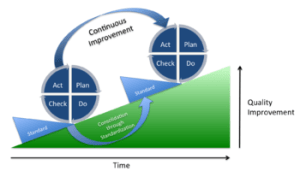
Before all those programmes and initiatives, and indeed the foundation for them all was the Deming improvment PDCA cycle ( Plan Do Check Act) which still holds great significance in a social media, digital enabled world.

PDCA_Process

For all projects, we need to consider the planning, the execution, the checking and importantly how we will act and improve for next time around.  (Which makes the Deming cycle an ever improving spiral) And of course requires continual effort to maintain equilibrium as my last blog post explored

The Checking is not just numbers and inspections, but critically the stories from those involved – as evaluation. Today, social media  can really enable the collation, sharing and analysis of stories, and hence has a huge part to play in future KPI’s (key performance indicators) as we move forward to ever more social businesses and organisations.  (Subscribe to this blog for future updates and support on this topic)

Helping your planning, doing, checking and improving efforts keep in equilibrium 

Sustainability: in equilibrium … or pedalling squares?

cover

For me one of the best cycling reads of the year so far is Velo by Paul Fournel (review here) a collection of zen like thoughts on, well, all things cycling. And one I really do recommend for your summer readings.

From one of the brilliant posts, Circles:

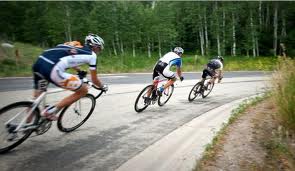
To ride a bike is to make circles. You have to think about that when you pedal, as a little reminder the movement of the legs is circular,  you have to grant it this and turn the cranks roundly.

Cyclists have a sense of this.  As soon as the cadence falls and fatigue mounts they say they are peddling squares.

Cyclists have their own gyroscope, producing not only movement but equilibrium, the faster you turn your legs. the more harmonious this equilibrium becomes.

A cyclists equilibrium is a circular equilibrium

And so it is with sustainability, to keep moving forward, we need to keep circling think Edwards Deming Plan Do Check Act circle,

We need to keep pedalling, we need equilibrium,

The faster your progress, the greater your sustainability equilibrium, where all ‘competing influences are balanced’

Snapseed (1)

If you slow, become distracted or fatigue, sustainability efforts are no longer circular and become square, and if you stop you fall off …

Helping your sustainability stay circular

Amory Lovins, Restorative Sustainability, System Thinking … and BIM

I recently came across this great quote from Amory Lovins at the Rocky Mountain Institute (and used in a recent BIM Beyond Barriers report)

“As we shape our buildings and then our buildings shape our lives, we can choose to create abundance by design, not scarcity through inattention.

We can design radically efficient buildings that take nothing, waste nothing, do no harm, and create delight when entered, tranquility when occupied, and regret when departed—yet cost the same or less to build, cost almost nothing to run, and make people happier, healthier, and more productive.

 The key is integrative design that optimizes the building as a whole system, for multiple benefits, rather than its disjoint components for single benefits. Many similar benefits are available in existing buildings, as RMI’s RetroFit initiative aims to spread.

 And Building Information Modelling (BIM) is a powerful tool for spreading these results worldwide

Amory B. Lovins
Chairman and Chief Scientist
Rocky Mountain Institute

RetroFit-Challenge_logoRGB

EMPOWERING THE LARGER COMMERCIAL BUILDING INDUSTRY

Seventy-five percent of global electricity goes to buildings, and at least half of that is wasted. We want to reduce building energy use by 50 percent by 2050. We believe that building owners can lead the way to meeting this goal and significantly reducing global carbon emissions while improving their bottom line. During the Challenge, RMI is testing a number of approaches for accelerating building energy efficiency to result in more effective, and more implementable, portfolio energy strategies. Our portfolio partners will help lead other building owners in changing the way we all use energy. Lessons gleaned from the Challenge will inform RMI’s own publications and educational outreach, providing a foundation for larger scale implementation projects that demonstrate the vision of Reinventing Fire.

JUST: a social justice label for construction …

Taking built environment sustainability deeper into the responsibility agenda, the International Living Future Institute are launching (Oct 2013) a new and important transparency initiative for the built environment to sit along side the Living Building Challenge and Declare. Just will provide clients, specifiers and procurers with ‘a view of how participating organisations treat their employees and where they invest their profits’

Just will cover the important areas of gender and ethnic diversity, salary equity, gender pay equity, community involvement, responsible investing and more, taking it beyond other programmes in the built environment sector. (And arguably areas that the UK Considerate Constructors Scheme should be addressing?)

The Press Release from ILFI reads:

In today’s global economy, it’s difficult to know what your consumer dollars are really supporting. JUST gives you an insider’s view of how participating organisations treat their employees and where they invest their profits. JUST works seamlessly with the International Living Future Institute’s Declare™ materials label and the next iteration of the Living Building Challenge™ (Version 3.0 — coming spring 2014).

By providing participating companies with a clear, elegant and informative equity ‘nutrition-label’, JUST aims to transform the marketplace through transparency and open communication. It aligns with the Institute’s Declare™ materials label to provide a holistic picture of both the products a company produces and the human story behind those products.
To participate in this voluntary disclosure program, an organization must submit documentation that asks for in-depth information about twenty distinct aspects of workplace equity and justice.
We’ll be launching the JUST label and searchable database FALL 2013. Join us in this critical initiative!
.

Excellence in Sustainability Leadership

low hanging fruitSince TQM days, the EFQM has remained my go-to framework for understanding organisational approaches, practices and performance. Of the nine criteria,  Leadership has always presented a challenge to those leaders not directly engaged and driving the organisations policies and strategies:

How Leaders develop and facilitate the achievement of the vision and mission, develop values required for long term success and implement these via appropriate actions and behaviours, and are personally involved in ensuring that the organisation’s management systems are developed

In 2004, the EFQM Corporate Social Responsibility Framework  was developed, giving more definition to sustainability and social responsibility leadership.

Excellent leaders ensure the mission, vision, values and ethics of the organisation reflect a socially responsible culture which they role model and reinforce with the organisations people and relevant stakeholders

They are personally involved in ensuring the management system addresses current and future social, environmental and economic issues

Leaders ensure that any organisational change takes into account CSR and Sustainability commitments.

What do you think? Does this criteria still hold good 10 years on ?

In preparing this post, as part of our Sustainable Leadership Conversation initiative, Andrea Learned challenged me to mention a  leaders I see as demonstrating these excellence traits. A tough call, but outside of the built environment I would include Yvon Chouinard at Patagonia (See Responsible Business),  within the built environment I would include Ray Anderson at Interface. Yet in everyday construction we can see signs of such leadership, for example with those at Marks and Spencers (PlanA), Adrian Penfold at British Land (open sharing CSR ) and leaders in SME organisations, making change through real engagement, (such as Malcolm Clarke at Baxall Construction in Kent)

Who would you nominate as a sustainability leader?

Join us and discuss on the 30th July for the first sustainability leadership conversation by using and following the #SustLdrConv hashtag.

Towards New Innovative Collaborations

cover

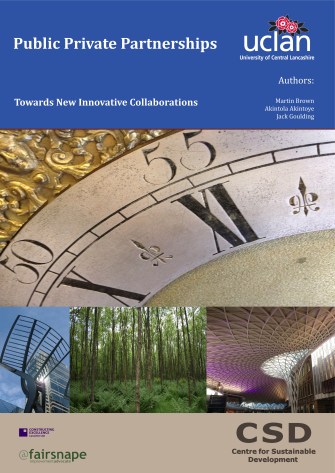
Our PPP Publication, “Towards New Innovative Collaborations” was recently released  and available via Amazon.

Starting with a fabulous quote from Hannah Jones at Nike:

” innovations required to create the future won’t come from a single source. Not from science. Not from technology.Not from governments. Not from business. But from all of us. We must harness the collective power of unconventional partnerships to dramatically redefine the way we thrive in the future

this publication covers a number of insightful perspectives on Collaborative Working, PPP and other Partnerships, an overview of key strategies and approaches, a record of the PPP Body of Knowledge conference held at UCLan earlier this year and a set of challenging recommendations to move Towards New Innovative Collaborations

From the introduction by Martin Brown:

Our built environment collaborative working journey is now venturing into new territories. The future for a responsible built environment will increase both the pressure and opportunities beyond collaboration and partnerships to co-collaborate and co-create hybrid projects, moving to open innovations that in turn stimulate further opportunities. 

#P3Report13

*Copies of the publication can be ordered via email 

Launching the Sustainable Leadership Conversation

imagesSustainability is moving into new territories, with new leaders and leadership styles emerging.

Across all industries, we now see many leading organisations stepping forward and placing sustainability truly at the core of their leadership.  At the same time, the use of social media is increasingly being used as a powerful tool for engaging, learning and sharing for collective sustainability leadership and organisational development.

Whether through corporate accounts or personal accounts tied to corporations, social media has the power to provide role models who are willing to share their experience and wisdom with others – through content creation (articles, blog posts) and content curation (sharing of key research or important discussions happening in a variety of places online).

The development of this sustainability leadership, amplified through social media is to be celebrated and shared broadly to impact the biggest picture we are all so passionate about – a sustainable future.

That’s why we, Andrea Learned and Martin Brown, have decided to come together, collaborate, and to co-host something we’ll call #sustldrconv (Sustainability Leadership Conversation). Our intention is to develop a sustained (pun could not be avoided!) and fluid conversation on just this topic.

Ideally, this will develop into a programme of Twitter conversations (and move into other networks) all toward understanding the issues facing sustainability leadership and how to use social media to learn and grow as quickly and solidly as possible.

We hope that our independent backgrounds and solid sustainability social networks will ensure a thoughtful and fun transfer of sustainability learning across sectors – and indeed transatlantic collaboration across ‘the pond’ and beyond.

The built environment, perhaps more than any other field/industry/category has huge influence on sustainability, and cannot be considered in isolation.  Every corporation, NGO, private and public sector organization operates within it.  What happens in the built environment has huge implications for all.

#SustLdrConv will kick off (July 30 at 12 noon PT, 3 pm ET, 8 pm BST) with a tweetchat, with examples of such partnerships, ideas or powerful new ones  and exploring the questions: So just what is sustainable leadership? Are we ready to partner with built environment organisations to co-create a sustainable future?

#SustLdrConv will, in the future develop beyond tweetchats, and include interviews, case studies, learning material and coaching.  The intention will be to continue these conversations across and outside social media boundaries.

#SustLdrConv is about how companies and people, those already on the journey and those still under the radar, are gathering experience and wisdom that we can all learn from.

#SustLdrConv will enable the transfer of innovative leadership

#SustLdrConv will support leaders in using social media for effective business engagement and future co-creation.

Background Reading:

A Low Carbon Diet For Construction Boards

Why the Sustainability Leadership Pipeline Begins with Women 

Are tweetchats the new digital benchmarking

Andrea, (@AndreaLearned) based in Seattle USA, is an author and communications strategist with a deep background in marketing to women (her book: Don’t Think Pink), but an even deeper passion for forwarding sustainability thought leadership.

She leverages social media to build “face to face” relationships between and among the field’s big thinkers – nurturing partnerships, developing content and spreading sustainability wisdom through every channel. Andrea’s personal interest in the built environment arises from her belief that it is the one unifying topic from which almost any business can see the case for sustainability.

Martin, (@fairsnape) based In Lancashire UK, is a business improvement advocate and consultant, founder of Fairsnape. As a built environment strategist he is committed to enabling success within and across organisations with a focus on sustainability, collaboration and social media. He is a Living Building Challenge Ambassador and partner with Green Vision, facilitating web-enabled events and #GVisChat tweet-chats for a green built environment.

(This blogpost  also appears on Andrea’s blog and elsewhere)

Construction 2025 Industrial Strategy

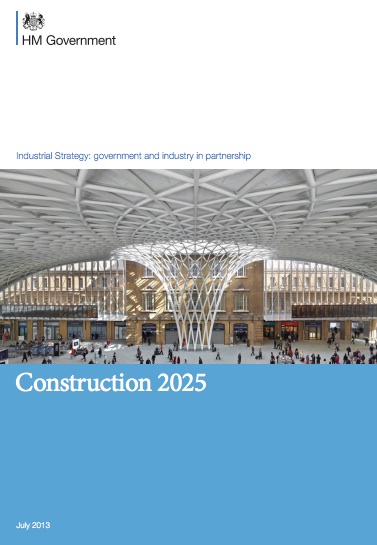
Reading the published edition of the Government Industry Strategy, Construction 2025, released yesterday I had two metaphors in mind, Snakes & Ladders and Babies in the River. Metaphors at first annoyingly contradictory, but on reflection pleasingly complementary.

UntitledThe Construction 2025 Industrial Strategy vision contains ambitions to cut costs, deliver projects faster, reduce carbon emissions, improve image and exports, through working digitally,  sustainably, and yes more efficiently.

Snakes and Ladders: illustrates the myriad strands and issues we are trying to deal with in the industry. Indeed the strategy includes a number of ladders with the excellent intention to move the industry forward, but also a number of slippery snakes to prevent meaningful progress for industry players and the industry as a whole. And, no doubt there will be plenty of commentaries on what issues are ladders (BIM and Carbon perhaps?) and which are snakes (image, diversity, SME relevance perhaps?)

However,

Babies in the River:  illustrates why only dealing with these strands and issues will not move us forward, and we will continue with energy sapping improvements, incremental changes and pockets of best practice. (You need to read  Annie Leonard, Story of Stuff excellent article)

Continue reading

Innovation and inspiration in sustainability

This free ebook from Guardian Sustainability Business contains excellent, innovative and inspiring case studies that should be read by directors, senior and Untitledsustainability managers across construction.

“At a time when multiple social, environmental and economic challenges face the world, instances of true leadership and innovation can be game changing and offer a much-needed light in the dark.

However, ensuring these examples of excellence are shared, embraced and learnt from can often be a tricky feat when the business landscape is so innately complex”

Built Environment related case studies include:

  • BAM Nuttall: peer-led training unlock wealth of hidden talents
  • British Land: chain reaction in building design
  • Skanska: working with rivals for the greater good
  • Interface: net gains for poor coastal communities
  • M&S: proud to be the biggest – and the greenest
  • URS: how to build a big building with a small footprint
  • The Co-operative: landmark HQ designed with environment in mind
  • Kebony: hardwood alternative that’s soft on the environment
  • Royal Mail: LED lights the way to energy savings
  • Hastoe Group: lays the blueprint for sustainable communities

However …

“If a company wants to see a future then 80% of what it will have to learn will be from outside its own industry.” (Gary Hamel)

… real inspiration and innovation for those of us in construction and the built environment will come from learning from those outside of the sector, on themes of communications, carbon, employee engagement, biodiversity and more.

fairsnape: innovating and improving

Construction CSR – A Clients View

At the launch of the British Land Corporate Responsibility Report 2013,  Head of Planning and Corporate Responsibility, Adrian Penfold, gave people the chance to quiz him on our approach to corporate responsibility and on our plans for the future.

Here are Adrian’s responses to the questions we received via Twitter@BritishLandCR (original wording kept for all questions, including abbreviations).

Of course, I was particularly interested in my question:

Adrian, What do you see as key drivers for Corp Responsibility in built environ. over next 5 yrs? By Martin Brown @fairsnape

At a corporate level, we have identified three key drivers for corporate responsibility in general over the next five years:

  • Resource shortages and unpredictable climate patterns posing ever-greater risks to wellbeing and economic stability in developed and developing nations.
  • Public concern about how businesses operate leading people to ask questions about the role of business in shifting to more sustainable models of consumption and supporting wider societal needs.
  • Local, national and global issues stemming from low economic growth, challenges in accessing employment and skills shortages.

For the built environment, I think regulation will play an important part, particularly Minimum Energy Performance Standards and Building Regulations. But I believe the real changes are coming through in the attitudes of our customers. In our recent experience, Marks & Spencer and UBS are for example both very challenging in the environmental criteria that they require, particularly on new buildings. We welcome this, as we are well positioned to work with them in this area, and we expect to see more of this kind of requirement from other businesses.

Do read the whole article for similar comments on the built environment current challenges of wellbeing, energy, co2, green leases and green deal.

In addition to the comments this is another brilliant example illustrating the maturity of twitter in the built environment / corporate social responsibility sector, and why it should be a key tool for construction boards strategy planning.