Tag Archives: CSR

Construction Localism – how do you compare against benchmark?

Construction ‘localism’ is currently high on the agenda. And set to grow in importance.

There is, rightly, much talk and focus on localism within construction projects and frameworks at the moment, based on the principle of keeping project spend local. And of course realising other benefits such as reduced travel and transport distances, reduced carbon emission, improved productivity and more.

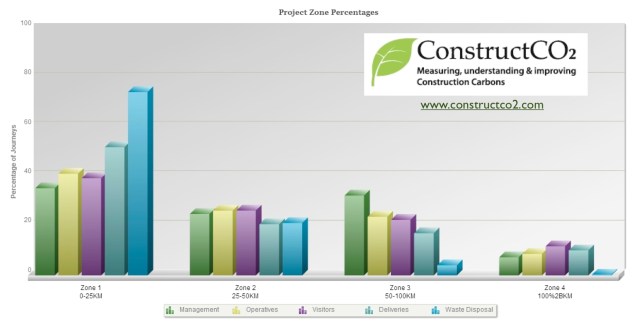
But how do we compare and benchmark ‘localism’? How local is your project? As a client how can you know if your contractor is addressing your ‘localism’ requirements?

The benchmark being set through ConstructCO2 can provide a starting point. How do you compare? Do you know your project stats?

Construction Localism by Zone

Measuring and understanding your localism (and CO2) footprint must be a key measure, a KPI, as part of your sustainability and CSR programme. Going beyond the measuring it’s essential we monitor trends, make the comparisons, understand the causes and, take action.

bb7dff99a6e2e90c5e67b380cb0aac7b

It is one of the more important impact and influence areas your construction project has on sustainability and the environment.

For more on measuring your construction project carbons and project localism check out constructco2 or please do get in touch.

Have we picked the low hanging fruit of Sustainable Construction?

low hanging fruitThe mid 90’s saw my first involvement with sustainable construction, as Business Improvement Manager, setting up strategy and awareness programmes for Mowlem Construction, driven it should be noted to address client bid requirements in PFI and Prime Contracting.

At that time Brundtland’s definition from 1987 was fresh and it made good sense to include it in strategies and as a definition.

In hindsight, one of the problems of this approach is that it reinforced the thinking of that time, that environmental management, and by default sustainable construction belonged firmly and squarely within the Health and Safety departments.  A misconception that many organisations still subscribe to, or struggle to move away from.

But, since then, sustainability thinking has moved on from environmental management as H&S add on, to a wider view of sustainability that includes social and business responsibility, ethical procurement and localism and is now heading for a challenging future greener and deeper agenda

It is encouraging to note the move away from what I have referred to as ‘accommodationalist‘ thinking – ie doing only what we are required to do by law, no more no less. In fact this  thinking is now being challenged by the Governments red tape initiative, proposing to remove certain sustainability related legislation

Over the last 7 years I have been supporting organisations map out and chart progress on their ‘Route to Zero‘, identifying actions necessary today, tomorrow and most likely into the future. We may be in the position of being able to say we have picked off the low hanging fruit from the sustainability tree.

Most construction companies now have a sustainability policy and project approaches that are ISO 14001 accredited, to deal with better management of waste,  recording transport construction miles, employing locally and so on.

But now the real work begins, reaching higher into the greener, more dense canopies of the tree, with a new, emerging set of challenging actions that will take us closer to our zero impact ambitions.

Amongst these new challenges we can see:

  • Collaborative and circular economy thinking. For example what if every building improved with age, improved in its function, its resilience, its performance.  Became more ‘durable‘?  Contracts would not only need to cover the design and construction of buildings, but a new form of collaboration between provider and user that included continuous improvement criteria.  Such Circular Economy thinking would force new collaborations across the supply chain, across discipline and with clients.
  • Convergence of data, information rich ICT environments, an Internet of Things linked to metering sensors that will provide real time feedback on performance of the buildings and of the construction process, driving improved and sustainable resource utilisation. Getting us closer to zero waste and  zero carbon emissions.
  • Responsible specification and procurement, that is not only local but considers ethical and most importantly the health impact of building product ingredients. (see the Healthy Product Declaration Standard)
  • Challenging standards, that bring new deep green philosophies and certifications for buildings and facilities, as we see with the Living Building Challenge
  • The inclusion of costing nature within construction projects. ‘Cheap’ buildings may only be cheap because the real social, environmental costs have been externalised for someone else, often society and the public purse to deal with. Time to bring those externalised costs back into the project costs?
  • A mindful built environment sector, or one that has mindfulness, ie ‘in the moment’ awareness of the impact the design, the construction, the maintenance, use and deconstruction of the building will have upon the environment and nature. Mindfulness is a huge and complex topic but an important sustainability concept we will hear far much more of in 2013.

The first Green Vision tweetchat for 2013 will explore some of these issues on the 28th January at 8pm using the hashtag #GVisChat, asking the question are we getting closer to ‘Zero’?

If you would like to know more on how the Fairsnape Route to Zero mapping and charting programme can help your business, please do make contact

Update – Presentation on this theme 

Innovation Voucher Provision

mb-m-and-c-1-blueThe Technology Strategy Board (TSB) is making Innovation Vouchers available worth up to £5000 for construction and built environment companies. Applications are due to open on the 10th of December and close on the 23rd of January 2013.

Fairsnape in association with IBE-Partnership is delighted to assist you  in preparing and submitting your application for Innovation Vouchers in the following topics that we offer as your innovation provider to improve your construction performance.

  1. Social Media – Awareness, Getting Started, Developing, Strategy and Policies, Measuring,
  2. CSR – Awareness, Developing Strategies, Integrating and aligning systems, Measuring.
  3. Sustainability (1) – Awareness, Strategy, Policies, Aligning / writing systems, Measuring
  4. Sustainability(2) – (Beyond Waste) – Awareness, circular economy, cradle to cradle thinking, healthy products innovation, measurement,
  5. Construction Carbon – Awareness, Strategies, Measuring and Improving, Application of wold class tools
  6. Benchmarking – (Beyond KPI’s) – Awareness, Strategy, Benchmarking Project, Measuring, Application of world class tools
  7. Business Strategy – (EFQM) Awareness, Improving overall and holistic strategy, facilitation, measurement
  8. Collaborative Planning / Last Planner – Awareness, Strategies, Training, Guidance, Facilitation, Application of world class tools
  9. Lean Construction Techniques – Awareness, Strategies, Training, Guidance, Facilitation, Application of world class tools
  10. Collaborative Working – Awareness, Strategy, Principles, Training, Facilitation, Preparation for BIM
  11. BIM – Awareness, Strategy, Policies, Preparation Plan, Facilitation,
  12. Customer Management– Awareness, Strategies, Training, Guidance, Facilitation, Application of world class tools
  13.  ISO14001 – Awareness, Strategy + Policies, Improving/Writing EM system + process, training, readiness for assessment
  14. ISO90001 – Awareness, Strategy + Policies, Improving/Writing QM, training, readiness for assessment system + process
  15. PAS 2030 – Awareness, Strategy + Policies, Improving/Writing Green Deal system + process, training, readiness for assessment
  16. Bidding – Awareness, Strategy, Process/Approach, Support,

mb-m-and-c-1-blueThis is a great opportunity for you to innovate and improve your effectiveness and efficiency, improve attractiveness to clients  and of course improve the bottom line at no cost to you. If you are interested in progressing further please call or get in touch to discuss.

00 44 7776 234702

Email | Twitter | Blog Linkedin | G+

Future ISO14001 revisions to include supply chain and CSR?

ISO 14001, the international environmental management system standard, is shortly to undergo its second revision. The revised standard, which is expected to be published in 2015, will operate into the mid-2020s

The EMAS Helpdesk on behalf the European Commission’s Sustainable Production and Consumption Unit has launched a  survey, requesting input on relationship of EMAS to 14001, the results of which will be fed into the official ISO 14001 revision process. 

Of particular interest, hinting at 14001 changes are

Should  ISO 14001 …

2.1.7. …place greater emphasis on the management of environmental impacts across the entire life cycle / supply chain of products / services provided and used?

2.18 …seek to position environmental management in the context of sustainable development (e.g. ISO 26000, sustainability reporting)?

The online survey can be found here 

Integrating Management Systems under Construction Social Responsibility umbrella

Interesting discussion yesterday with forward thinking construction professionals at Stobbarts (on the British Energy Coast in Cumbria) who really understood the importance of wrapping management systems, procedures and processes under a Corporate Social Responsibility umbrella.

The exercise in question was part of the PAS 2030 preparation, bringing together existing standards that meet an impressive range of standards (9001, 14001, 18001, 50001, 27001, Carbon Action Standard and more)

Construction organisations do not operate in a vacuum. Our relationships to society and environment in which we operate is increasingly an important element of construction activities. It is also increasingly being used as a measure of overall construction performance.

Clients and customers of the construction industry not only want a good product and good service in delivering that product, but a good social product as well.  Increasingly a key PQQ issue from clients, but, CSR cannot remain in the marketing or bidding departments but has to be reflected through the organisation.

No surprise then as more and more organisations are looking to integrate their systems which have grown independent to meet the requirements of ISO 9001, 14001 and 18001 standards, it makes sense to consider the social aspect of each, and frame within an organisations CSR statement.

(And to keep within the ISO thinking ISO 26000 provides good guidance to Social Responsibility)

On Patagonia

Since the early ’80’s Patagonia has featured in my life, initially in respect of climbing hardware and outdoor clothing and latterly as a real source of CSR, Corporate Social Responsible inspiration. I recall my first purchase, and a still a winter favourite, a Synchilla fleece jacket, produced from recyled plastic bottles, and this in the 80’s,

It is fantastic to see how the influence of Patagonia, Chouinard and contempories has now reached into built environment sustainability, as evidenced at the recent excellent Green Vision Building CSR event in Leeds.

Patagonia stores are still a magnet for me, in the UK, and from Chamonix to Banff. But it has been the Patagonia catalogue, published a few times each year with the seasons, that has in no small part shaped my sustainability thinking, through stunning photographs and excellent narratives from Yvon Chouinard, Rick Ridgway and Patagonia Ambassadors, It is from here I developed a passion for connecting sustainability thinking with nature, linking love of outdoor exploration with business excellence.


No better is this illustrated than in the Spring/Summer 2012 edition …

“we learned early the need for good quality … and environmental consciousness, because we’re part of the natural world from where we draw our strength”

If ever you see a Patagonia catalogue – pick it up and be inspired by the photographs and narratives.

( the Becoming Wild text in the image above can be found here )

The Responsible Company a great quote on Sustainability from Yvon Chouinard and Vincent Stanley:


“A word about a word we have chosen to use as little as possible: Sustainability.  Its a legitimate term that calls us not to take more from nature than we can give back. But we do take more than we give, we do harm nature more than we help it. We have no business applying the the word sustainable to business activity until we learn to house, feed, clothe and entertain ourselves – and fuel the effort – without interfering with natures capacity to regenerate itself and support a rich variety of life. We are a long long way from doing business … and no human economic activity is yet sustainable”

How is your corporate sustainability or CSR thinking aligned to nature?

Who inspires and influences your thinking?

Posted using BlogPress from my iPad

Heros and Texts for a future Built Environment based on #CSR

“suddenly the air smells much greener now”

Listening to ‘These Streets’, lyrics by Paolo Nutini summed up the brilliant, inspiring Green Vision conference in Leeds – exploring CSR within the built environment.

A mix of talks, presentations, round table discussions and pecha kuchas from Mel Starrs, Eden Brukman, Tamara Bergkamp, Eddie Murphy, Martin Brown, Faye Jenkins, Claire Walker, Rick Hamilton, Mark Warner, Pedro Pablo Cardoso-Castro, Andy Ainsworth, Paula Widdowson and many others showed that there is real emergence and a future for a Built Environment founded on social responsibility principles.

The air smells much greener …

We heard of excellent progress being made by individuals, projects and organisations on the CSR journey, and how behind these are great influential thinkers, often outside of the sector, many, unsurprisingly, related to the ‘outdoor’ sector.

Many of the speakers were enthusiastic in sharing CSR heros and recommended CSR reading. So here, as a summary, or reading list are those mentioned during the day. I wonder how many of these are on the reading list within design, construction and fm education? (Book titles link to Amazon)

Yvon Chouinard

Rock climber, environmentalist and outdoor industry businessman, noted for his contributions to climbing, climbing equipment and the outdoor gear business. His company @Patagonia is widely acclaimed for its environmental and social focus. According to Fortune magazine, Chouinard is arguably the most successful outdoor industry businessman alive today.

The Responsible Company What we have learnt in the first 40 years at Patagonia by Yvon Chouinard and Vincent Stanley (see my blog)

Let My People Go Surfing Yvon Chouinard – Probably the ‘must read book’ to understand CSR in Business

(On my blog: How can construction learn from Patagonia?)

Ray Anderson

Founder of Interface Inc., one of the world’s largest manufacturers of modular carpet for commercial and residential applications and a leading producer of commercial broadloom and commercial fabrics. He was known in environmental circles for his advanced and progressive stance on industrial ecology and sustainability.

Ray was was posthumously awarded an Outstanding Achievement award at this year’s Guardian Sustainable Business Awards in 2012. (There is a related, must watch, video here: John Elkington describing the work and legacy of Ray Anderson)

Confessions of a Radical Industrialist: Profits, People, Purpose: Doing Business by Respecting the Earth (2009) Later released in paperback as Business Lessons from a Radical Industrialist in 2011.

Paul Hawken

An environmentalist, entrepreneur, and author. Ray Anderson of Interface credited The Ecology of Commerce with his environmental awakening. He described reading it as a “spear in the chest experience”, after which Anderson started crisscrossing the country with a near-evangelical fervor, telling fellow executives about the need to reduce waste and carbon emissions.

Hawken’s book, Natural Capitalism: Creating the Next Industrial Revolution (1999) coauthored with Amory Lovins and Hunter Lovins, popularized the now-standard idea of natural capital and direct accounting for ecosystem services, a theme revisited by Rio +20 and likely to become more mainstream across the built environment.

Janine Benyus

Her 1997 book Biomimicry: Innovation Inspired by Nature defines Biomimry as a “new science that studies nature’s models and then imitates or takes inspiration from these designs and processes to solve human problems”. Benyus suggests looking to Nature as a “Model, Measure, and Mentor” and emphasizes sustainability as an objective of biomimicry. Key thinking in the Living Building Challenge principles, as is

E O Wilson

Edward Osborne Wilson an American biologist, researcher, theorist, naturalist and author. In the mid 80’s developed the concept of Biophilia, the connection between humans and nature, which translates into architecture and the built environment as comfort, well being and productivity through exposure to natural light and natural surrondings or imagry.

Anita Roddick

Dame Anita Roddick, human rights activist and environmental campaigner, best known as the founder of The Body Shop, a cosmetics company producing and retailing beauty products that shaped ethical consumerism The company was one of the first to prohibit the use of ingredients tested on animals and one of the first to promote fair trade with third world countries. Roddick was involved in activism and campaigning for environmental and social issues, including involvement with Greenpeace andThe Big Issue.

John Elkington

John Elkington @volansjohn is a world authority on corporate responsibility and sustainable development. He is currently the Founding Partner & Executive Chairman of Volans, a future-focused business working at the intersection of the sustainability, entrepreneurship and innovation movements

His latest book The Zeronauts, Breaking the Sustainability Barrier describes many of todays inspirational leaders : “Just as our species broke the Sound Barrier during the 1940s and 1950s, a new breed of innovator, entrepreneur, and investor is lining up to break the Sustainability Barrier”

Jorgen Randers

2052: What will the world look like in 2052

Jeff Hollender,

Jeffrey Hollender is an American businessperson, entrepreneur, author, and activist. He was well known for his roles as CEO, co-founder, and later Chief Inspired Protagonist and Executive Chairperson of Seventh Generation Inc., the country’s largest distributor of non-toxic, all-natural cleaning, paper and personal care products. www.jeffhollender.com/

Gary Hirshberg,

Gary Hirshberg is chairman and former president and CEO of Stonyfield Farm, an organic yogurt producer, based in Londonderry, New Hampshire. Now part of the Danone group.

Published in January 2008, Stirring It Up: How to Make Money and Save the World is a book about socially minded business that calls on individuals to realize their power to make a difference in the marketplace, while doing business in ways that adhere to a multiple bottom line – one that takes into consideration not only finance, but the environment and health as well.

Jeffrey Swartz,

Jeffrey Swartz is the former president and CEO of The Timberland Company an organization that believes that doing well and doing good are inextricably linked. Timberland’s commitment is to reducing global warming and preserving the outdoor environment.

David and Claire Hieatt,

Founders of Howies a clothing company based in Cardigan Bay, Wales produces eco-friendly T-shirts, jeans and sportswear, and aims to have ethically correct practices. Howies use natural fabrics as alternatives to petrochemical-derived modern fabrics. Examples include organic cotton, Merino wool and recycled cotton. Howies T-shirts often have images or slogans with political or environmental themes

Dee Hock

Dee Ward Hock is the founder and former CEO of VISA , described systems that are both chaotic and ordered, and used for the first time the term “chard” and chaordic,combining the words chaos and order.

More?

Over to you –

Follow the discussion on twitter with the #GVis2012 hashtag.

Who are your CSR Heros and CSR Texts to add to this Built Environment inspirers list?

What additions or comments would you make to the entries above?

A full record (video, blog, tweets, presentations, storify) of the Building CSR Event is being curated on the be2camp event page here.

Construction CSR Makeover: can construction learn from Patagonia?


CSR and Transparency seem to be linked buzz words in the world of sustainability at the moment.

Fuelled perhaps by an increase in CSR generally, a growing awareness of social media ‘whistleblowing’, the potential of the Social Value Act and a desire to improve or differentiate sustainability offering in bids and delivery on contracts.

Our Green Vison tweetchat last night concluded construction is ready for and in need of a CSR make over. But where to start? One of the suggestions was to listen to and learn from other sectors.

As if on cue, this  morning I was aleretd to Patagonia’s Footprint Chronicles update.  A grand example of merging CSR, Supply Chain Management, Transparency, Storytelling and using social media to stitch it all together

For our tenth season we have completly revamped the Footprint Chronicles to show a world map of every factory that makes Patagonia clothing and gear, profiles of the social and environmental of key suppliers and fabric mills and profiles of key  independent partners who vet  social and environmental practices throughout our supply chain

The Footprint Chronicles® examines Patagonia’s life and habits as a company. The goal is to use transparency about our supply chain to help us reduce our adverse social and environmental impacts – and on an industrial scale. We’ve been in business long enough to know that when we can reduce or eliminate a harm, other businesses will be eager to follow suit.

View the map 

A great place to start learning where CSR in Construction can go …

Indications that this is possible are emerging. With similar end game intentions, our own constructco2 which maps construction phase carbon emissions, transport and the project supply chain foorprint and Sourcemap a crowdsourced directory of product supply chains and carbon footprints – see for example CITRIS Builing

Your comments are most welcome, engage in the CSR debates on twitter @fairsnape or get in touch to discuss further.  We are helping many construction organisations measure their carbons and re-evaluate their approach to CSR.

Improving Bid success through construction #CSR

Is your PQQ or Bid success rate dopping? Are you loosing out to competitors and not sure why? You could do no better than to get along to one of the numerous best practice or knowledge exchange events such as the excellent Green Vision programme from CKE in Leeds.

Last night the focus was on CSR, Corporate Social Responsibility, which has moved a million miles away from just doing good, volunteering and charity donation, important though as these are. No, supply chain CSR approaches in the words of Bob Simpson (Walmart/ex ASDA) have to be ‘contemporary’ and demonstrate value to clients.

Bob went on to emphasis how the supply chain has to demonstrate “a point of difference” through CSR, when bidding for work, that includes:

  • Design Problems out (through BIM for example)
  • Improving site efficiency (maximising considerate constructor scores?)
  • Embracing localism
  • Hating waste in all its forms including energy, carbon, transport
  • Exceeding safety standards
  • Taking the initiative. The supply chains are the experts in construction.

Paul Connell E.on consultant reinforced the same message describing how supply chains adding value to E.on to help them deliver their ambitious Cities Programme of collective intelligence, enabling large organisations to engage with individuals on a meaningful level.

Setting the scene, my CSR presentation focused on the changing world of communications and transparency, and the need for construction not only to be solid and reliable but also innovative in CSR. Particularly in the public sector, where the newly minted Social Value Act will require construction to start to really understand and demonstrate the value of CSR approaches.

There is a storify record of the event here.

How contemporay is your CSR approach? Is it helping you demonstrate value to your clients and winning you work? Maybe now is the time to re-evaluate. We are helping many organisations review their CSR, PQQ and Bid approaches.  Do get in touch to discuss.

Social Value Act, CSR and Construction

Could the Social Value Act 2012 which came into being earlier this year have profound implications on construction procurement and on construction’s approach to Corporate Social Responsibility?

Indications are that it will.

The Social Value Act requires local authorities, when entering into public procurement contracts, to give greater consideration to economic, social or environmental wellbeing during the procurement stage.

(3) The authority must consider—

(a) how what is proposed to be procured might improve the economic, social and environmental well-being of the relevant area, and

(b) how, in conducting the process of procurement, it might act with a view to securing that improvement.

This will require the authority to pre-determine social value expected, along with measures and targets for both the project procurement and delivery. Raising the game on construction understanding of Social Value and CSR.

In response, bids will clearly demonstrate how social value will be created and delivered (as a result of selection to the project). We could (will?) see more weighting and scores afforded to social value issues making ‘soft’ issues ever more competitive.

What are currently seen as innovative differentiators could well become the norm and common place (such as free fruit in site canteens, free whole person health checks for operatives, demonstrating localism through mapping carbons of site travel etc)

Construction can have a huge influence and impact on social value and social wealth, through employment, transport, material purchase, SME procurement, environmental and social impacts … and more. With a little rethinking those impacts, often seen as negative, can deliver real positive value.

Construction, and built environment CSR strategies and performance will need to become ever more important, more strategic and more informed. At one level demonstrating a coherent approach to social value and at another as a competitive differentiator.

Hence now, as ever, is the best time to ensure that CSR approaches are robust, realistic and aligned with staff client and society expectations.

If you are interested in the growing debate on the impact of the Social Value Act and CSR in construction, please join me on twitter @fairsnape, using the #socialvalueact hashtag. You can also comment below and or subscribe to this blog or get in touch to discuss wider CSR and Bidding support.

We have a planned CSR in Construction Tweetchat scheduled for the 18th June where we will be debating, over twitter, the impact of the Social Value Act. (Using hashtag #GVischat)