Tag Archives: sustainability

Construction Localism – how do you compare against benchmark?

Construction ‘localism’ is currently high on the agenda. And set to grow in importance.

There is, rightly, much talk and focus on localism within construction projects and frameworks at the moment, based on the principle of keeping project spend local. And of course realising other benefits such as reduced travel and transport distances, reduced carbon emission, improved productivity and more.

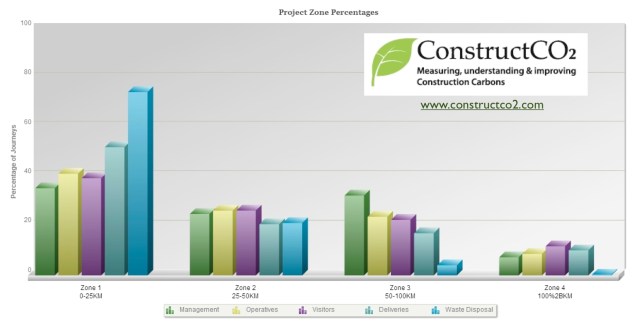
But how do we compare and benchmark ‘localism’? How local is your project? As a client how can you know if your contractor is addressing your ‘localism’ requirements?

The benchmark being set through ConstructCO2 can provide a starting point. How do you compare? Do you know your project stats?

Construction Localism by Zone

Measuring and understanding your localism (and CO2) footprint must be a key measure, a KPI, as part of your sustainability and CSR programme. Going beyond the measuring it’s essential we monitor trends, make the comparisons, understand the causes and, take action.

bb7dff99a6e2e90c5e67b380cb0aac7b

It is one of the more important impact and influence areas your construction project has on sustainability and the environment.

For more on measuring your construction project carbons and project localism check out constructco2 or please do get in touch.

Managing sustainability knowledge across social media.

fs social media workflow

After last weeks UCLAN Centre for Sustainable Development,  Social Media launch session I was asked how to ‘manage’ and ‘filter’ what you can learn and share across the world of social media sustainability.  It was not too easy to summarise in a few minutes on notepaper, so here is my ‘work flow’ and the five key applications used:


Inwards …

Twitter

Most of my inflow arrives via twitter or twitter based apps, eg tweetdeck or hootsuite. I have a number of established feeds or filters established which enables me to keep a real time watch on activity relating to the topics I am concerned with, or related to my clients interests.

Google Reader

Blogs and websites I follow are RSS subscriptions into Google Reader

Flipboard

Described as a social magazine, Flipboard is a brilliant feed application that enables me have a one stop ‘viewing’ place. In addition to having twitter searches feeding into Flipboard, I also have Google Reader, linkedin groups I follow, hub feeds such as the Guardian Sustainable Business and 2degreesnetwork. (Feeds also include cycling, outdoor, walking and weather interests.)

Managing …

Instapaper

Instapaper works across many platforms and is my main ‘receptacle’. It is used to collect and tag articles for later reading. Train journeys and waiting times are great Instapaper reading catch up time. From here I retweet, and / or move to Evernote for keeping or further reference.

Evernote

Rapidly became my everywhere note book. I am drafting this in Evernote! Articles or extracts in Instapaper wanted for reference are exported to Evernote and filed away with tags. These can be for future reference, inspirations for blog posts or, importantly topics on which I can hone, improve or enhance the services I provide for my clients across the built environment.

Outwards …

Tweets can be made either direct from Instapaper or buffered through Buffer which enables some interesting time lapse tweets, or repeated tweets to catch differing time zones. (Care is needed with buffer however to be sure to react to responses!)

My Blog

From Evernote and within Evernote I can easily then compose and curate articles and  for this and other (eg Green Vision) blogs

So there you have it. This has been an established work flow a quite a while now and one that  works for me. It would be interesting to know your work flow and what works for you.

Having a strategy or plan to deal with social media is critical to making effective use of your time online. Building on the support provided to organisations  to date on similar social media strategies, we can help you hone your social media plans, with one to one face to face sessions, or on online via (eg) skype.

In addition coffee shop based, sustainability related, social media clinics will kick off  very soon. Watch his space, subscribed to this blog, follow on twitter or drop me an email

Have we picked the low hanging fruit of Sustainable Construction?

low hanging fruitThe mid 90’s saw my first involvement with sustainable construction, as Business Improvement Manager, setting up strategy and awareness programmes for Mowlem Construction, driven it should be noted to address client bid requirements in PFI and Prime Contracting.

At that time Brundtland’s definition from 1987 was fresh and it made good sense to include it in strategies and as a definition.

In hindsight, one of the problems of this approach is that it reinforced the thinking of that time, that environmental management, and by default sustainable construction belonged firmly and squarely within the Health and Safety departments.  A misconception that many organisations still subscribe to, or struggle to move away from.

But, since then, sustainability thinking has moved on from environmental management as H&S add on, to a wider view of sustainability that includes social and business responsibility, ethical procurement and localism and is now heading for a challenging future greener and deeper agenda

It is encouraging to note the move away from what I have referred to as ‘accommodationalist‘ thinking – ie doing only what we are required to do by law, no more no less. In fact this  thinking is now being challenged by the Governments red tape initiative, proposing to remove certain sustainability related legislation

Over the last 7 years I have been supporting organisations map out and chart progress on their ‘Route to Zero‘, identifying actions necessary today, tomorrow and most likely into the future. We may be in the position of being able to say we have picked off the low hanging fruit from the sustainability tree.

Most construction companies now have a sustainability policy and project approaches that are ISO 14001 accredited, to deal with better management of waste,  recording transport construction miles, employing locally and so on.

But now the real work begins, reaching higher into the greener, more dense canopies of the tree, with a new, emerging set of challenging actions that will take us closer to our zero impact ambitions.

Amongst these new challenges we can see:

  • Collaborative and circular economy thinking. For example what if every building improved with age, improved in its function, its resilience, its performance.  Became more ‘durable‘?  Contracts would not only need to cover the design and construction of buildings, but a new form of collaboration between provider and user that included continuous improvement criteria.  Such Circular Economy thinking would force new collaborations across the supply chain, across discipline and with clients.
  • Convergence of data, information rich ICT environments, an Internet of Things linked to metering sensors that will provide real time feedback on performance of the buildings and of the construction process, driving improved and sustainable resource utilisation. Getting us closer to zero waste and  zero carbon emissions.
  • Responsible specification and procurement, that is not only local but considers ethical and most importantly the health impact of building product ingredients. (see the Healthy Product Declaration Standard)
  • Challenging standards, that bring new deep green philosophies and certifications for buildings and facilities, as we see with the Living Building Challenge
  • The inclusion of costing nature within construction projects. ‘Cheap’ buildings may only be cheap because the real social, environmental costs have been externalised for someone else, often society and the public purse to deal with. Time to bring those externalised costs back into the project costs?
  • A mindful built environment sector, or one that has mindfulness, ie ‘in the moment’ awareness of the impact the design, the construction, the maintenance, use and deconstruction of the building will have upon the environment and nature. Mindfulness is a huge and complex topic but an important sustainability concept we will hear far much more of in 2013.

The first Green Vision tweetchat for 2013 will explore some of these issues on the 28th January at 8pm using the hashtag #GVisChat, asking the question are we getting closer to ‘Zero’?

If you would like to know more on how the Fairsnape Route to Zero mapping and charting programme can help your business, please do make contact

Update – Presentation on this theme 

Are we so oblivious to the ways of nature?

“After 10 generations of industrial society, and with most people in the west removed from a world of soil and sweat, we are so oblivious to the ways of nature that we cannot bring ourselves properly to absorb its vital importance”

Mark Cocker author of Crow Country reviewing the excellent What Has Nature Ever Done For Us? by Tony Juniper “How environmentalists now put money at the centre of their argument”  (For example, read the book/review to understand why the total bill for India’s programme of removing its flock of vulture scavengers has been calculated at $34 billion)

Mark Cocker, based in Norfolk and written extensively on modern responses to nature.  Crow Country is a fascinating look at the life of crows, on the state of country life in Britain, and on the relationship between ourselves and nature.

Related: Re-Connecting – the 3R’s for rethinking built environment sustainability

Innovation Voucher Provision

mb-m-and-c-1-blueThe Technology Strategy Board (TSB) is making Innovation Vouchers available worth up to £5000 for construction and built environment companies. Applications are due to open on the 10th of December and close on the 23rd of January 2013.

Fairsnape in association with IBE-Partnership is delighted to assist you  in preparing and submitting your application for Innovation Vouchers in the following topics that we offer as your innovation provider to improve your construction performance.

  1. Social Media – Awareness, Getting Started, Developing, Strategy and Policies, Measuring,
  2. CSR – Awareness, Developing Strategies, Integrating and aligning systems, Measuring.
  3. Sustainability (1) – Awareness, Strategy, Policies, Aligning / writing systems, Measuring
  4. Sustainability(2) – (Beyond Waste) – Awareness, circular economy, cradle to cradle thinking, healthy products innovation, measurement,
  5. Construction Carbon – Awareness, Strategies, Measuring and Improving, Application of wold class tools
  6. Benchmarking – (Beyond KPI’s) – Awareness, Strategy, Benchmarking Project, Measuring, Application of world class tools
  7. Business Strategy – (EFQM) Awareness, Improving overall and holistic strategy, facilitation, measurement
  8. Collaborative Planning / Last Planner – Awareness, Strategies, Training, Guidance, Facilitation, Application of world class tools
  9. Lean Construction Techniques – Awareness, Strategies, Training, Guidance, Facilitation, Application of world class tools
  10. Collaborative Working – Awareness, Strategy, Principles, Training, Facilitation, Preparation for BIM
  11. BIM – Awareness, Strategy, Policies, Preparation Plan, Facilitation,
  12. Customer Management– Awareness, Strategies, Training, Guidance, Facilitation, Application of world class tools
  13.  ISO14001 – Awareness, Strategy + Policies, Improving/Writing EM system + process, training, readiness for assessment
  14. ISO90001 – Awareness, Strategy + Policies, Improving/Writing QM, training, readiness for assessment system + process
  15. PAS 2030 – Awareness, Strategy + Policies, Improving/Writing Green Deal system + process, training, readiness for assessment
  16. Bidding – Awareness, Strategy, Process/Approach, Support,

mb-m-and-c-1-blueThis is a great opportunity for you to innovate and improve your effectiveness and efficiency, improve attractiveness to clients  and of course improve the bottom line at no cost to you. If you are interested in progressing further please call or get in touch to discuss.

00 44 7776 234702

Email | Twitter | Blog Linkedin | G+

3 R’s for rethinking built environment sustainability

OLYMPUS DIGITAL CAMERA

Its over ten years since rethinking construction became the driving force for improving the construction industry. Back then, in 1998, sustainability wasn’t on the agenda for many construction organisations, and didnt feature in Egans influential report.

Now at the close of 2012, it is of course one of the key challenges for construction.

But is it now just a ‘must do, tick box’ matter, rather than a real agenda for improving, reducing costs and reducing our impact?

Earth2.0 Hub in an excellent blog post ( The Future of Business – inspired by and in harmony with nature.) provides a framework and the language of 3 R’s for future businesses working in harmony with the earth .  And its a framework we should learn from, borrow, adopt or adapt  at project and business level in rethinking built environment sustainability; Re-Design, Re-Connect and Re-Kindle.

Re-Design. Not only design of buildings, but to re-design the way we build. No longer are transactional efforts (reducing waste, conserving energy and recycling) enough.

How?: Take a look at Cradle to Cradle thinking, Circular Economy, Designing out toxic materialsDesigning out Landfill

Re-Connect. Time to rethink our relationship with nature. However just including nature as a natural capital to be costed is not meaningful approach. We need a relationship that is deeper, that is deep green thinking.

How?: take a look at Living Building Challenge – what if every building, like a flower, contributed to its environment. Or the One Planet Living ten principles

Re-Kindle. Time to rekindle the sustainability debate – moving away from the negative, harassment to doing less bad, to encouraging a move towards a positive new world of doing more good,  better. Resilience.

How?: Learning and benchmarking from other industries and sectors, for example Patagonia, or closer to the built environment, Interface Flooring

This blog, since 2005, has had as a tagline built environment improvement and its connectivity to the natural world . Since then, it has been a core philosophy within fairsnape.

cropped-pc210049flip.jpg

Since 2005 we have organised and facilitated benchmarkwalks, discussing sustainability issues , across and within sectors, whilst walking in the natural environment. Rather than in the conference of training room. You would be amazed how diffierent, how green, sustainability discussions when conducted in the great outdoors. Try it !

Cradle to Cradle, Circular Economy, Healthy Products Standard, Designing Out Landfill , Interface UK, and the UK Living Building Challenge all featured in our #GVis2012. Green Vision Conference in Leeds on the 12 Dec 2012.

>>> See Green Vision event material, links, blogs and more here  <<<<

<<< Read the Cradle to Cradle tweetchat transcript here <<<

The Living Building Challenge UK Collaborative will be ‘launched’ at this event on the 12th.

And, Cradle to Cradle is the book-topic for our Dec #GVisChat tweetchat on Dec 10th at 8pm.

Built to Last – Designing Out Landfill

There has been an increase in circular economy thinking and the built environment recently, and no doubt we will see much more in the coming weeks and months.  It forms a core element behind the Green Vision half day conference in Leeds on the 12th Dec.

Whilst researching back ground information on “Designing Out Landfill” for a client I was struck by these useful paragraphs from Sophie Thomas  co-director of design at the RSA and published in a Guardian Sustainable Business article in September 2012

Built to last

Design sits at the heart of the challenge to create a circular economy. Approximately 80% of a product’s environmental impact is “locked in” at the design stage, so understanding production cycles and reconfiguring them for maximum effectiveness is key. We cannot simply substitute one material for another without understanding the consequences.

Designing in this way is complex. Gone are the days of “sustainable” or “eco” design, when a simple change of material to a recycled alternative would give a project environmental credibility. This system calls for investigation into materials at a molecular scale. It demands true co-creation, with all stakeholders involved in the lifecycle of a particular product. Finally, it requires a new logistical approach to capturing and recirculating materials.

This effort needs to be led by businesses. At the moment, it is rare to see a company setting a design brief that includes requirements to recover material. Now, however, the business model is changing and the economic imperative for recovery is growing stronger.

So…

How well is design, construction and facilities management prepared for such ‘deep green’ thinking to waste elimination?

Can social media power the Green Deal (and Sustainability)?

Earlier this year, through Be2camp, the built environment social media advocacy, we published a guide on using social media to improve understanding and application of Green Deal issues.  

This was discussed in a 2degreenework interview with myself and Stephen Kennett 

Stephen Kennett : You’ve launched the ‘Social media framework for the Green Deal’, can you explain what it’s about?

Martin Brown: Of course – It’s a wiki guide to using social media to improve understanding and application of Green Deal issues. It was initially compiled by a group of social media and sustainability advocates all working in the Green Deal space, and brought together through the Be2camp movement.

The purpose of the guide is to explain how social media can be used to understand, learn, and share Green Deal learning. The aim is to look at four key themes: Green Deal workflow – in other words, how the Green Deal will work in practice; Green Deal delivery – installation and the skills issues; Green Deal business issues; and visibility – promoting best practice and good news.

SK: Why use social media in the world of Green Deal? …. Read the rest of the interview here 

…. Access the guide to social media for green deal here  and please do add to the guide …

Or for more information just get in touch or drop us a tweet

Construction Carbon Cost and Risk Management

Having effective scenario planning in place within a construction business is essential to developing effective forward looking strategies that protect the business into the future and provide resilience against change.

One of our current uncertainties is related to the price of carbon, and how once the price of carbon has been fixed, how that will impact your business and project costs. It is now only a matter of time before carbon costing becomes established as an indicator and ‘repayment’ cost for your environmental impact

As with the increase cost of waste management over the last decade or so, cost of carbon will, most likely be a supply risk and cost.

The concept of shadow pricing is not new, (based on the lifetime damage costs associated with greenhouse gas emissions)  Applying a shadow cost to your carbon emissions now will enable you to action plan and reduce carbons, reducing exposure to future costs  hitting your business.

A good place to start is through measuring and understanding your project construction carbons with Constructco2 and then applying a carbon cost of £10 per tonne.  If you haven’t measured your construction carbons as yet (why not?) then use the ConstructCO2 benchmark of 96.7 Kg/£K project spend.

How would that cost affect your business? How would you manage projects with this additional cost, and importantly what actions would you take to reduce your project emissions?

Perhaps we should be asking the question will you start?

Many of the contractors, clients and subcontractors we support through constructco2 are seeing cost and bidding benefits. (More)

Useful Background Reading:

Based on recent Huffington Post article  The Benefits of Carbon Shadow Pricing Tyler Elm and Jim Harris

DECC: Carbon Valuation

Simple Rules: Addressing Sustainability

Addressing climate change, environmental harm and sustainability can seem far to difficult and complex to tackle, so often we dont, or we do so with approaches that are masked by process and checklist.

Daniel Goleman, in Ecological Intelligence gives us three simple, yet remarkably comprehensive rules for reducing impact:

1. Know your impacts

2. Favour improvement

3. Share what you learn

Imagine the power of everyone in your organisation fully understanding the environmental impact of what they do, favouring improvement to address (over doing nothing) and continually sharing with colleagues, supply chain, clients and the wider industry.

In respect for sharing, social media has enabled unparalleled learning and sharing for sustainable improvement, something the built environment is just awakening to.

Does your organisation have Ecological Intelligence and a set of simple rules for reducing environmental impact?

Simple Rules:
Through facilitated workshops, we can help you explore a ‘simple rules’ approach to dramatically improving effectiveness of your processes and procedures, increase buy in whilst reducing red tape bureaucracy.
Behind seemingly complex issues there are simple rules. The concept of Simple Rules is a key principle within complexity and emergence thinking. The oft cited simple rules being those for flocking birds. 
 This blog series will explore application of simple rules to sustainability and the built environment. Based on the premise: if we were to discard all strategies , policies, processes, procedures, work instructions and checklists, what simple rules would emerge or would we need.
Next: Simple Rules for Business Improvement