Tag Archives: carbon

Mobilising the Construction Sector for Climate Action

We now know that buildings and the built environment are a key factor to our climate change problem, whilst at the same time, a vital part of climate change solutions.

2015 is seen by many as the turning point in the fight against climate change. In December, France hosts the 21st “Conference of the Parties”, or COP21, with a goal of reaching a binding agreement to limit global warning to between 1.5degC to 2degC.

Without significant action by the built environment sector, this target can not be met

December 2015 


The built environment sector’s crucial role in mitigating climate change is finally being recognised. For the first time in the history of climate negotiations, A ‘Buildings Day’ will be held December 3 at the COP21 UN conference on climate change in Paris.

  • Helping to put the buildings and construction sector on the below 2 °C path
  • Aligning existing initiatives, commitments and programmes to achieve greater scale and increase the pace of efficiency actions
  • Catalysing stronger collaboration and targeting sectoral and cross sectoral climate action and solutions for all

17062008118

Now then, is the time for every built environment organisation; funder; client; designer; constructor; and maintainer, to revisit and to recommit to sustainability goals that will not only seek to limit global warming through reducing carbon and other greenhouse gas emissions, but also seek to be net positive.

More than 30 per cent of global greenhouse gas emissions are buildings related, with emissions from buildings set to double by 2050 if we continue business as usual. Not addressing climate change will increase the risks and vulnerability of countries, regions and local communities. The forecast rapid urbanisation, without action will accelerate impacts.

Yet:

  • The built environment sector offers one of the most cost-effective and economically beneficial paths for reducing energy demand and associated emissions while at the same time supporting adaptation and resilience to climate change.
  • Many low-energy, renewable and deep renovation solutions are available. Proven policy, finance and technology actions exist.
  • The economic, health, and social benefits of sustainable buildings are significant. Buildings provide shelter, places to live, work, learn and socialise, directly affecting our daily lives. Providing more than 50 per cent of global wealth, and one of the largest employers at local level, the sector also offers a path to poverty alleviation.
  • Buildings are long-term ventures. Today’s new buildings are tomorrow’s existing stock. Failure to act now would lock in growth in GHG emissions for decades.

Better Build Green is the World Green Building Council’s new campaign which focuses on the UN climate change negotiations – COP21 in Paris. The campaign aims to show the world that green buildings offer one of the best and most cost-effective ways to tackle climate change and help keep global temperature rises within the two degrees limit. The message is simple: not only had we better build green if we are to reach a two-degree world tomorrow, but we are better off today if we do.

Sources:

UN Environment Programme Buildings Day 

Friends of Europe

Better Build Green

The New Economy – Why Buildings Matter in Fights Against Climate Change

Fairsnape iSite: Beyond Sustainability

Beyond sustainability: Buildings are a climate change problem … and also part of the solution.

Buildings are a climate change problem … and also part of the solution. With buildings responsible for an estimated 40% of all carbon emissions and having a huge influence of lifestyle, commerce and industry carbon reduction efforts, we can now longer afford to incrementally be less bad. And this year, 2015, being a significant year for climate change action, with the COP21 in Paris in December and the imminent release of the UN Sustainable Development Goals, it is time to recognise the role of buildings as a climate change solution.

https---img.evbuc.com-https%3A%2F%2Fcdn.evbuc.com%2Fimages%2F15507896%2F145406037897%2F1%2Foriginal

Beyond Sustainability, as you may have seen in the media, via social media or by invite, is our significant event in London on the 5th Oct. The event highlight will be Jason McLennan’s (CEO International Living Futures Institute) first UK keynote, which promises to be an inspiring call to do more good, as being less bad is not just enough anymore

The event will also include an overview of Living Building Challenge and Well Building Standard activity in the UK from Martin Brown, Fairsnape, and Ann Marie Aguilar, Arup Associates.  Hattie Hartman (Sustainability Editor at AJ) will chair a panel debate, featuring regenerative and well being sustainability activity in the UK from a range of presenters.  In addition John Alker UKGBC will introduce the UKGBC’s new campaign ‘Better Places for People‘ 

There will, of course, be opportunity for Q and A panel debates with speakers.

Please take this as your invite to attend. The event will held appropriately, in the wonderful Royal College of Physicians building on Regents Park. More details and how you can you can still register here.

Jason F. McLennan Keynote speaker:

Considered one of the most influential individuals in the green building movement today and the recipient of prestigious Buckminster Fuller Prize (the planet’s top prize for socially responsible design), Jason F. McLennan’s work has made a pivotal impact on the shape and direction of green building in the United States and Canada and he is a much sought after designer, presenter and consultant on a wide variety of green building and sustainability topics around the world.

So what was / is Climate Week Paris and how relevant to the built environment?

You couldn’t have missed the #CWParis hashtag and tweets from the Business Climate Summit in twitter streams over the past few days. The Climate Week Paris business meeting hosted by The Climate Group was scheduled six months before Paris hosts the UN conference where almost 200 countries are set to seal a (yet another) global climate change pact.

Key events included a Business & Climate Summit and Climate Finance Day, with world’s leading companies and policymakers brought together to demonstrate that low carbon makes good business, and good environmental sense

There were calls from many company executives at Paris urging governments to introduce more carbon pricing systems, such as a carbon tax or emissions trading schemes.

Relevance to built environment

With the Built Environment contributing the (rule of thumb) 40% of Carbon emissions, and a huge influence on business operation the sector had a presence through advocacy organisations and businesses with large built environment assets, but from reports seen and feeds followed, there was a very low presence from built environment providers – if any!

A high level session on transition to a ‘Low Carbon Built Environment’ (with a panel led by Christiana Figueres @CFigueres, Executive Secretary of the UN Framework Convention on Climate Change (UNFCCC) and chaired by Sandrine Dixson-Declève, Director of Cambridge Institute for Sustainability Leadership) discussed how “architect, town planners and engineers, collaborating with the construction, real-estate, materials & technology and financial communities, could showcase solutions for the built environment that can be deployed in Europe and inspire worldwide action”

One of the main points addressed was the lack of visibility suffered by the construction sector, as topics like energy efficiency and net positive standards are often seen as highly-technical and not understood by the general public.

Key to meeting the global goal of decarbonisation by 2050 is seen as the transition of new and existing buildings to EU Net Energy Standards . The EU Standard Requires “Member States shall ensure that by 31 December 2020 all new buildings are nearly zero-energy buildings; and after 31 December 2018, new buildings occupied and owned by public authorities are nearly zero-energy buildings”

Marks and Spencer (M&S) announced that they joined RE100, a global initiative for major companies committing to 100% renewable power, through their Plan A programme to lower carbon emissions from their activities and building operations.

The World Green Build Council promoted and launched its BuildUpon report during Climate Week Paris, aiming to create a building renovation revolution in Europe. See the Imagine a Built Environment that Enables a High Quality of Life for All  report

The BuildUpon report includes two notable actions,

  • identifying and engaging with ‘Unusual Suspects’, those not as yet engaged in the low carbon built environment dialogue.
  • A proposed open source wiki for information, the RenoWiki, a comprehensive summary of renovation initiatives across the 13 project EU countries, “to bring clarity on how national renovation strategies can strategically build upon the current landscape and how identified solutions might be scaled-up across other countries”

And, as reported in the Guardian Article “in an unprecedented alliance, 25 global news publishers have agreed to share climate change content to raise awareness in the runup to the next UN summit and agreed to scrap licensing fees for climate change content so that members of the alliance can freely republish articles.”

A call then to the Built Environment news publishers to do similar, to share climate change content and bring that content out from behind paywalls?

(I am grateful for informative tweets, sharing news and links from Climate Week Paris from friend , @WeMeanBusiness, @GuardianSustBiz, @SDDecleve @ClimateGroup and others in Paris)

Ahead of Paris #COP21: Construction Carbon targets wake up call?

Most if not all of our construction sustainability / carbon strategies,standards and targets are based on preventing an increase in global warming temperatures beyond 2 deg C.  That may well have to change, with harsher, tougher targets becoming essential.

As reported in Science Daily, the 2 deg target is increasingly under pressure as being ‘utterly inadequate’ for protecting those at most risk from climate change, with targets of 1.5 or even 0.8 being proposed.  The long-term goal to stay below 2°C warming is currently undergoing a 2013-15 Review, the results of which are expected this June and could be adopted in Paris at COP21 in December 2015.

mb-m-and-c-4-green

A slow, pale green approach? Do we need to reset our sustainable construction map and compass?

It may well be that our slowness in moving forward with carbon reductions over the last decade or so is now catching up and that the effort to cap carbon and or temperature rises will become more and more difficult.

In construction we have seen site based carbons increase, and whilst there maybe a decrease in construction transport emissions, that can be attributed to efficiencies in vehicle efficiency. Globally we are increasingly procuring materials and services farther and farther away from contracts.

Cowed: A Book Review

imagesCowed:  The Hidden Impact of 93 million Cows on America’s Health, Economy, Politics, Culture and Environment, 

Denis Hayes and Gail Boyer Hayes

Do Cows hibernate Dad? asked one of my sons a decade or so ago when we moved into rural Lancashire, noticing that cows were absent in the fields during winter months and as then not aware of the noisy, steamy and rather smelly over wintering cow sheds. One of the rural spring treats which we will witness soon, is when the cows are let out into the spring green fields, where they literally can jump for joy like spring lambs. the word cavorting* would seem invited for just this occasion.

Cowed is an entertaining and educating insight into the American relationship with its cattle, triggered by the authors visit in the UK and noticing how very different cattle in UK fields appeared to that seen or indeed out of sight in the US.

From Cowboys through to intelligent, mechanised milking, Denis and Gail provide real insights from their environmentalism knowledge, (Denis was cofounder of Earthday in the 70’s, now founder /CEO of the Bullitt Foundation in Seattle and a recent guest on our #sustldrconv series,  Gail is an Environmental lawyer, health writer and editor)

Throughout, I was reminded of John Muir’s comment that ‘when we tug on one part of nature we find it joined to everything else”, This may be as on the day I started reading Cowed, I visited a botanical garden in Vancouver where this quote was engraved into the floor and entrance screens.

Nevertheless, for me it summed up one of Cowed’s core themes. That the Cow, which we have removed from natural habituation and domesticated or rather industricated, is now so intrinsically linked to so many aspects of our lives from food to furniture and in doing so, uncoupled from its natural connections and bio-relationship with soil, air and water.

Cowed provided, for me a straightforward  explanation of the recent research, debate and controversy on natural cattle grazing patterns and impact for soil carbon sequestration based around the work of Allan Savory. This is something I had come across before on a TED talk but poorly understood.

Living in rural Lancashire I easily recognised the description of dairy farming within the first few pages, but I struggled to recognise the US description of cattle management in the remainder of the book, perhaps with the exception of the cattle ranching images from old Westerns!. Yet Cowed does highlight issues we here in the UK need to be aware of and guard against as concepts of mega farms are proposed and debated here.

*to jump or move around in a playful way, sometimes noisily, and often in a sexual way

Not knowing the construction industry carbon footprint is not acceptable.

Minimising and reducing carbon in construction has been a central plank of industry sustainability strategies for a good many years. It is therefore embarrassing for the industry, as Construction Manager reports, that we don’t still don’t have an industry handle on or indeed understand construction carbon figures.

An earlier Sustainability Strategy for Construction set a 2012 target of 15% reduction from the 2008 figure of 48T of CO2 / £million spend which should give us about 42 T / £m at 2012 with targets for further reductions by 2020 and 2050 in line with UK reduction targets.

Although … Peter Hansford “The strategy is to achieve a 50% cut in construction sector emissions from 1990 levels by 2025, and the GCB (Green Construction Board) is tasked with making it happen”

Indications are that, dispute a focus on sustainability, with just about every organisation in construction self-claiming to be sustainable,  construction emissions actually rose by 13% over the period 2008 – 2012.

As a major emitter of CO2, (when adding in transport and travel) the construction has a socially responsibility to address and reduce.

The fact that as an industry we don’t really know is down right unacceptable.

Our ConstructCO2 tool shows an average of 97.5kg / £k based on all construction types. As we gain more data (currently 300 projects) we can break this down into more meaningful targets, but since the first project on ConstructCO2 our benchmark has not fallen below 90kg/£K. (As an industry we should be below 40kg/£K)

When we founded ConstructCO2, we set out to keep it simple to record and used the strap line of Monitor, Understand and then Reduce.  Having monitored for a number of years we now understand the causes of construction carbon

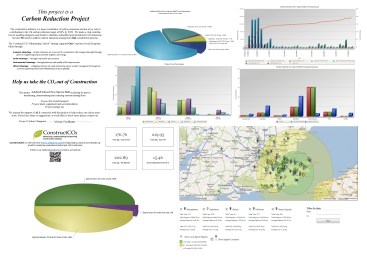
Ashford School CCO2 A2 Poster

and can take steps to reduce through proactive planning.

Reducing Construction Carbon - Infographic


Why then, as industry we do not understand or monitor Construction CO2?

  • Cash in King, Carbon is Queen was a rallying call from Construction Advisor Paul Morrell – but very few rallied.
  • BREEAM hasn’t followed through – with just the requirement to record travel, transport and energy use, but not to reduce, monitor over time or collate. As an industry we have a mass of disparate spreadsheets across the country containing probably all the data we need.
  • Recording data at site level is deemed too time consuming, put into the too busy to do box by contractors, excepting of course the enlighten contractors using ConstructCO2 who see the benefits of doing so – or their clients are telling them to do so.
  • In the main, clients are not requiring projects to record and act on carbon emissions as a project key performance indicators.
  • Reducing carbon at site entails a collaborative approach from all on construction method, specification, procurement, planning, sub contractor management and so on. We simply don’t collaborate on reducing CO2.

Benefits of Monitoring CO2 (as reported by ConstructCO2 users)

  • Every kg of CO2 reduced equates to x£ not spent
  • Reducing CO2 from material and waste transport improves the local spend
  • Reducing mileage CO2 from personnel travel reduces driving time stress on operative & managers, improves productivity and time on site. Car sharing also reduces the fuel cost of operatives and managers.
  • Understanding the carbon issues enables more informed procurement, selection and logistics management

As Shaun McCarthy, Director of the Sustainability Supply Chain School said on twitter, its not Rocket Science,

Indications are that the GCB and WRAP UK will take up the mantle of managing data on construction carbons. Lets hope they talk to ConstructCO2, understand our lessons learnt and keep it simple but effective.

A Green Deal that could have done so much. RIP

It could have been such a good deal, but it now seems the Green Deal, the green flagship of our current government is dead.

Going back to 2011/12 – the concept of a scheme that promised to reduce fuel poverty, reduce carbon,  improve our housing stock, and create a vibrant, certified (PAS2030) market sector – Green Deal looked brilliant. It certainly put sustainability thinking on the agenda of many organisations in the construction, maintenance, services and built environment sectors.

My workshops and presentations at that time, More Than Just a Green Deal tried to widen the debate – embedding more resilient and sustainability thinking into green deal. (see related Green Deal blog posts here)

But somehow along the way Green Deal got lost, became mired in politics, in energy company greed and bureaucratic red tape. The company set up by the Government to aggregate loans for the Green Deal was bailed out recently with a multi-million-pound loan of public money.

‘In a parliamentary inquiry held in September, MPs called the Green Deal a “disappointing failure”, with flawed planning that has left consumers without promised cashback and improvement works’

And plans for non domestic Green Deals seems to have quietly fizzled away in the corner …

A recent article in the Telegraph Your Money section Householders See Red Over Green Deal catalogued problems of the scheme

The Government’s flagship energy efficiency policy has become a headache for thousands of householders left with bungled installations or waiting for promised cash back payments that fail to materialise. In some cases, the energy companies responsible for carrying out the works have left householders with botched improvement works in the rush to meet energy efficiency targets’

One of the organisations supported to attain PA2030 under the MCS scheme has had certification for the last few years, yet has never had the opportunity for any installation under the scheme, yet must undergo re-accreditation on an annual basis. In light of the effort, system development and training the organisation went through, this is now a big frustration and laughing matter, making them very suspicious of further government backed green schemes.

Consequently Green Deal is unlikely to appear on any of the main political party manifesto for the coming election – and therefore most likely to be dismantled.  But of course it should be there, we need to be addressing one of the big sustainability issues in domestic building stock.

Back in 2012 I posed the question “how did we get to 2012 and still not have a viable solution to housing building performance”? We now need to ask the question – “how did we get to 2015 and still not have a viable solution DESPITE 2 years of promises, effort and funded approaches”?

A pity, a real pity and wasted opportunity.

Reducing Construction Carbon – Project Planner / Infographic

The planning chart / infographic below was produced as part of the ConstructCO2 support tools to enable projects to reduce construction phase carbon emissions. It provides a visual check box for use at project planning stage as to what actions, initiatives and approaches will be taken to reduce carbon, and to achieve the project carbon target.

Further information on the ConstructCO2 site
Reducing Construction Carbon - Infographic

Managing Construction Carbons

Managing construction carbon is an essential part of successful project management.

If you are not already using constructco2, here is our latest update release for the ConstructCO2 carbon monitoring toolkit…

As part of the annual review of the ConstructCO2 toolkit’s conversion factors we have updated the Modes of Transport to match those published this year by DEFRA and the Carbon Trust. These updates ensure that we are in line with industry standards and reflect the emission improvements declared by DEFRA every year.

We are aware that many users are now using ConstructCO2 carbon footprint in connection with ISO 14001, Carbon Trust  Standard, ISO 9001 and other standards. You may be interested to know that we offer an independent audit and verification service to verify the accuracy of your data within ConstructCO2. Please do get in touch to discuss

We are also aware that some early adopters may not be fully using some of the more recent additions and improvements to the toolkit, therefore we will be running webinar refresher sessions in the autumn. More news and dates soon.

To assist in publicly demonstrating your commitment in measuring and reducing your projects carbon footprint we have developed:

Reducing Construction Carbon - InfographicA Reducing Carbon Action Planning Infographic to assist strategic and operational carbon reduction:


Project Carbon Performance Posters to communicate carbon progress and engagement with those on site:Ashford School CCO2 A2 Poster


and ConstructCO2 Banners, with QR codes allowing progress checks on performance:cco2 banner

We are very keen to hear your improvement suggestions to incorporate, or you have any queries please don’t hesitate to contact us.  Also if you are not currently using ConstructCO2 but would like a free trial just ask!

Go back

Your message has been sent

Warning
Warning
Warning

Warning.

Responsible BIM

We are hearing more and more of ‘Responsible Business‘ approaches, generally taken to mean a combination of sustainability and CSR. But what happens when this emergent thinking in Construction meets BIM? Responsible BIM?

Below is the transcript or notes behind my pecha kucha presentation, exploring Responsible BIM, made to the excellent ThinkBIM event on 2 April in Leeds, .

I wanted to inject a balance of current ‘soft issues’ thinking against a prevalent hard technology thinking. I have no  issues with the passion behind the BIM approaches, I am constantly impressed and think it amazing, but sometimes feel BIM technology and language is a runaway train. Unfortunately just about every BIM event I attend I hear at the outset, BIM is about the people not the technology, with the rest of the event focuses on the application of the technology, with very little soft skill content. When was the last time we saw a BIM event focus solely on collaboration without mentioning software? Having said that, its is the balance of views at ThinkBIM events is what sets it apart from other BIM events.

The title ‘Flatland to Wonderland’ comes from a brilliant article and the work of Petra Kuenkel, who we interviewed as part of our Sustainability Leadership Conversation (#sustldrconv) twitter series recently. In short, we need both the flatlands of reality along with the possibilities of the wonderland for a sustainable future

Flatland

3D modelling, and offsite component manufacture with simple on site assembly isn’t new, as illustrated in the Building article that covered the BAA Project Genesis project in 1997. Pre Egan and pre Building Down Barriers we were doing BIM, so why didn’t it take off as the Egan Report did?  (Egan was at BAA and also involved in Project Genesis).  Somehow we lost the 3D collaborative conversation, maybe the Egan agenda itself ,with a focus on KPI’s and customer satisfaction masked some of the brilliant emerging work of that time?

One of the BIM wake up calls for contractors I work with recently has been the inclusion of BIM questions within PQQ’s in particular the PAS 91 BIM options – and the need for bidding contractors to have a BIM Strategy, signed as commitment from the CEO, detailing milestones, training and development, information management and more. “Lets write one quick”

And on the issue of information management – lets start to align to ISO 9000  documentation control requirements. How many BIM users (real and say-they-do’s) have embedded their BIM information and data communication processes into their Quality Systems. I am currently helping a good number of organisations revisit their management systems and inject current information management thinking. Particular so on how and what information is shared with supply chain members. Doing so enables us to audit, and improve information management using the Plan Do Check Act approach

But, yes, we have BIMwash. BIM language is not that difficult to learn, the technology is not that difficult to purchase, and hey presto we are BIM compliant. Not surprising then that contractors sit and wait for a client to insist or require BIM on a project before applying BIM thinking. As a BIM community we need to change the conversation away from BIM being just a design tool or client requirement to a continuous improvement tool with many many benefits.

And on to the wonderland …

If we really want to co-create a sustainable built environment, and isn’t that what BIM is all about?, then we need to have both the harsh reality of the flatlands with the spirituality of the wonderland. This resonates with Lucy Marcus Be2Camp BE2Talks back in 2011 where she described the need for leaders to be both Grounded and Stargazers.

I am impressed with the Collective Leadership approach and model (developed by the Collective Leadership Institute), and the necessity to move beyond collaboration. (How many times have I heard or read a contractor claiming to be collaborative simply because they have a supplier progress meeting once a week)  The Collective Leadership Model provides the scope of elements leadership and collaboration could, should, look like in a modern construction environment. Covering both technicality and people issues of diversity, and mindfulness

Ah mindfulness …

Currently we seem to be struggling with two drivers, on one hand the sustainability agenda of being simple, of realigning with nature. biophilic approaches and natural renewable solutions and on the other the ever increasing complexity of data, be it BIM data or big data and technology.

It is not surprising that one of the most sought after advisors to silicon valley is a Vietnamese Buddhist monk, Thich Nhat Hanh, (Thay), seen by many as the the modern guru for mindfulness.  Such practices are seen to be key for business, enabling focus on real innovation, free from clutter of distractions. We will see much more of this in the construction sector I am sure, as we learn to balance people with technology, simplicity with data, well being with efficiency.

US BIM write Randy Deutsch approaches this thinking in a recent blog article for Design Intelligence Beyond BIM Boundaries – “in order to master BIM, we have to do less BIM, we have to do other things” And if we focus on better communications, people skills, listening, empathy and understanding, then BIM will flourish without effort.

Perhaps BIM is now is seen by many as a big hammer, an approach that if not adopted then we are not doing construction correctly, “if the only tool we have is a hammer then every problem is a nail”  BIM practitioners and advocates need more tools in their conversation and offerings covering both technology and soft skills. As Randy commented ‘ go against common wisdom and fortify your soft skills”

We had a brilliant twitter based conversation with Casey Rutland as part of the #EXPOC21 series this week where the conversation led to whether BIM will simplify or complicate sustainability. Many people re-tweeted the question, but with few answers offered, other than when done correctly, BIM will enhance sustainability, done incorrectly it will harm sustainability. Incorrectly here can mean overloading buildings with technology solutions when natural solutions would work (but harder to model perhaps) or by not taken cognisance of where materials are coming from or their health impacts. Casey introduced the concept of SustainaBIMity – the mash up of sustainability thinking with building information management. A far better description than Green BIM

Aligning BIM thinking to progressive sustainability thinking such as the Living Building Challenge is exciting and has huge potential. In the near future we will see BIM objects cover the attributes of health data, justice in production data, carbon and travel data. (Note the dialogue in the US between Autodesk and the Healthy Products Declaration database for example)

And we know that carbon, embodied and transportation will become a key BIM data element, procuring kitchen pods from China for modular construction on the other side of the globe may be a data and cost solution but it is not a restorative sustainability solution. (cf Modular Construction on Souremap)

In our pursuit of designing and creating buildings that work for people, planet and purpose, we perhaps need to address both the higher Maslow needs as well as focusing on basic shelter needs, and in some way build them into data and modelling,  Biophilia at last is opening up a whole new chapter for design, and BIM, and well for the built environment as a whole. In the UK the term Sick Building Syndrome has dropped out of use, but we need to be aware of the dangers of creating buildings through BIM that don’t model or promote health and well being.

There are examples of this, for example by early involvement mind and health charity experts to view and comment on proposed buildings in a 3D environment, advising on the potential enhancement or damage to end user well being. And only yesterday,(01/04/14)  Rick Fedrizzi, President of USGBC writing in EDC called Health the next frontier of green build performance, and more recently calling on the built environment to use medical data for improved building solutions.

My final slide proposed that every BIM project should have an educational element, to inform and motivate the industry and that this should be embedded into PAS1192 or equivalent documentation. No project or organisation should be allowed to claim BIM compliance unless they openly share their approaches and lessons learnt, covering both the flatland BIM and the wonderful healthy buildings that enable people and organisations to flourish.